Aircraft category
Ultra Long Range Jets for private charter
Intercontinental range, multi-zone cabins and sleeping space. Typically 12–17 passengers.
- Passengers
- 12–17
- Longest range
- 8,000 nm
- best model in dataset
- Typical cruise
- 485 kt
- Per hour
- US$12,500+
- Estimate
Ultra Long Range Jets compared
| Aircraft | Range | Cruise | Passengers | Baggage |
|---|---|---|---|---|
| Bombardier Global 5500 | 5,900 nm | — | 13–15 | — |
| Dassault Falcon 7X | 5,950 nm | — | 12–14 | — |
| Dassault Falcon 8X | 6,450 nm | — | 12–14 | 140 cu ft |
| Bombardier Global 6500 | 6,600 nm | — | 13–15 | — |
| Gulfstream G600 | 6,600 nm | — | 14–16 | 175 cu ft |
| Gulfstream G550 | 6,750 nm | 488 kt | 14–16 | 170 cu ft |
| Gulfstream G650 | 7,000 nm | 488 kt | 14–16 | 195 cu ft |
| Bombardier Global 7500 | 7,700 nm | — | 14–17 | — |
| Gulfstream G700 | 7,750 nm | — | 14–17 | 195 cu ft |
| Bombardier Global 8000 | 8,000 nm | — | 12–14 | — |
Trips ultra long range jets can fly nonstop
With the longest-range model in our dataset, 104 of 104 covered city pairs are typically nonstop.
Ultra Long Range Jets charter cost
In our pricing model, ultra long range jets charter for US$12,500–US$17,500 per flight hour Estimate. A one-way trip usually also pays for some positioning; see any route page for trip estimates.
Ultra long range jet charter: when only nonstop will do
Ultra long range jet charter is for the trips where the distance is the problem: London to Los Angeles, New York to Dubai, Europe to the far side of Asia. These are the largest and longest-legged business jets in regular charter service, built to fly twelve hours or more without stopping, with cabins divided into zones and space for several people to sleep flat. They are also the most expensive aircraft most travellers will ever charter, which makes it worth being clear about when you actually need one.
The panels above show the class as it sits in our dataset: typical passengers, typical cruise, the longest-range model we list, an indicative hourly band and ten models compared. This guide explains how to read those figures, which trips genuinely need this class, and how to judge an ultra long range quote against the alternatives.
We are a charter broker. We do not own or operate aircraft. We ask licensed operators for availability, compare the options and show you the operator's name on every quote.
What sets the class apart
"Ultra long range" is a market label, like every business jet size class. Broad definitions of the classes are gathered in Wikipedia's business jet article, and different sources draw the lines in different places. For charter purposes, the aircraft in this class share four traits:
- Range for intercontinental nonstops. The models in our dataset range from roughly 5,900 to 8,000 nautical miles in published figures. That is enough, on the longest-range types, for many city pairs on opposite sides of the world.
- The largest business jet cabins. Typically three or four zones, including a private stateroom on some aircraft.
- Sleeping space. Several seats and divans make up as flat beds, and some aircraft have a dedicated bed.
- Crew rest. Many aircraft have a separate crew rest area, which matters on flights long enough to need an extra pilot.
Speed is part of it too. The class cruises in the high 400-knot range where our data has a published figure, and on long trips a few extra knots add up to meaningful time.
The aircraft on ultra long range quotes
Our dataset lists ten types. The table above shows their indicative range, passengers and, where we have it, cruise and baggage. Those are published manufacturer or public figures, not independently verified. In character, from the longest range down:
Bombardier Global 8000. The longest published range in our data, with the Global 7500's cabin. It is new to service, so charter examples are scarce.
Gulfstream G700 and Bombardier Global 7500. Next in range in our data, with the largest cabins in the class. The Global 7500 was designed around a four-zone cabin; its background is in Wikipedia's Global 7500 article. Both are relatively new, so charter availability is limited and prices are at the top of the band.
Gulfstream G650. Long the benchmark for the class, with a large charter fleet worldwide. Its history, including the extended-range G650ER, is covered in Wikipedia's G650 article.
Bombardier Global 6500 and the Global 5500. Modern Global family aircraft with excellent range. They are often more available than the flagships.
Dassault Falcon 8X and the Falcon 7X. Three-engine Falcons, known for flexible airport access for their size.
Gulfstream G550 and the Gulfstream G600. The G550 is an older, widely flown type with strong range; the G600 is a newer design.
In practice, the aircraft you are offered depend heavily on where the trip starts. The fleet is much smaller than for light or super midsize jets, so the nearest suitable aircraft may be a long way away.
Choosing between two ultra long range quotes
When a request comes back with more than one aircraft in this class, the headline type matters less than a few practical questions:
- Range headroom on your route. An aircraft with plenty of range margin is less likely to need a stop on a windy day or with a full load. On the longest trips, the flagships can be worth the premium for that reason alone.
- Year and refurbishment. An older aircraft with a recently refurbished cabin can be as comfortable as a new one, and often costs less. We show the year on every quote and can ask for recent photographs.
- Layout. Two aircraft of the same type can have very different cabins. If you need a stateroom, a certain number of beds or a table for eight, check the layout, not just the model name.
- Where the aircraft is based. An aircraft already near your departure airport means less positioning, which can make a larger type cheaper overall than a smaller one further away.
- Connectivity. Coverage on ocean and polar routes varies by system. If you must stay online, we confirm what is fitted.
We lay these points out on each quote, so you are comparing like with like rather than brand names.
Which trips genuinely need an ultra long range jet?
For this page, the fact pack lists three of our curated city pairs where an ultra long range jet is the smallest category we expect to fly nonstop after a practical-range margin. These are screening estimates, not operator commitments:
| Corridor | What makes it an ultra long range trip |
|---|---|
| London – Los Angeles | A long polar-route sector, especially westbound into headwinds |
| New York – Dubai | A long flight between North America and the Gulf |
| Geneva – Aspen | Transatlantic distance plus a high-altitude arrival |
That list is short, and that is the point. Our curated corridors are the routes people actually fly most, and for almost all of them a smaller class can do the job nonstop. An ultra long range jet is needed only when the great-circle distance plus winds and reserves exceed what a heavy jet can carry.
Mountain arrivals such as Aspen deserve a separate word. High-altitude airports limit which aircraft can use them and how heavy they can be, and hot or snowy conditions tighten that further. The largest jets are not always accepted, or not at full weight. A Geneva to Aspen trip may, in practice, need a different arrival airport and a short onward flight or drive. We ask the operator to confirm the plan before you commit.
You can see every corridor, with flight time by class, in our private jet routes directory.
When the class is used on shorter trips
Many ultra long range charters are for trips a smaller aircraft could fly. Travellers choose the class for its cabin: a family with young children on an eight-hour flight, a delegation that needs a meeting area and a rest area, or a group that simply wants the space. That is a legitimate choice, and we quote it without fuss. We will also tell you when a heavy jet or super midsize jet would cover the same trip for much less.
Crew and planning on very long flights
Very long flights bring requirements you do not meet on shorter trips:
- Augmented crews. Flight time and duty limits set by regulators mean that on the longest flights the operator often carries an extra pilot, and sometimes a second flight attendant, so crew members can take rest in flight. That adds to the cost and needs a suitable crew rest area on board.
- Rest before the return. After a long flight, the crew needs a minimum rest period before flying again. If you want a quick turnaround, the operator may need to send a second crew in advance.
- International paperwork. Overflight and landing permits, customs and immigration slots and passenger information all need to be in place, and some countries require permits several days in advance.
- Catering for twelve or more hours. Meals are ordered in advance and reheated on board. Tell us about dietary needs and preferred times early.
We raise these points with operators when we request your quote, so the options you see are workable on your dates.
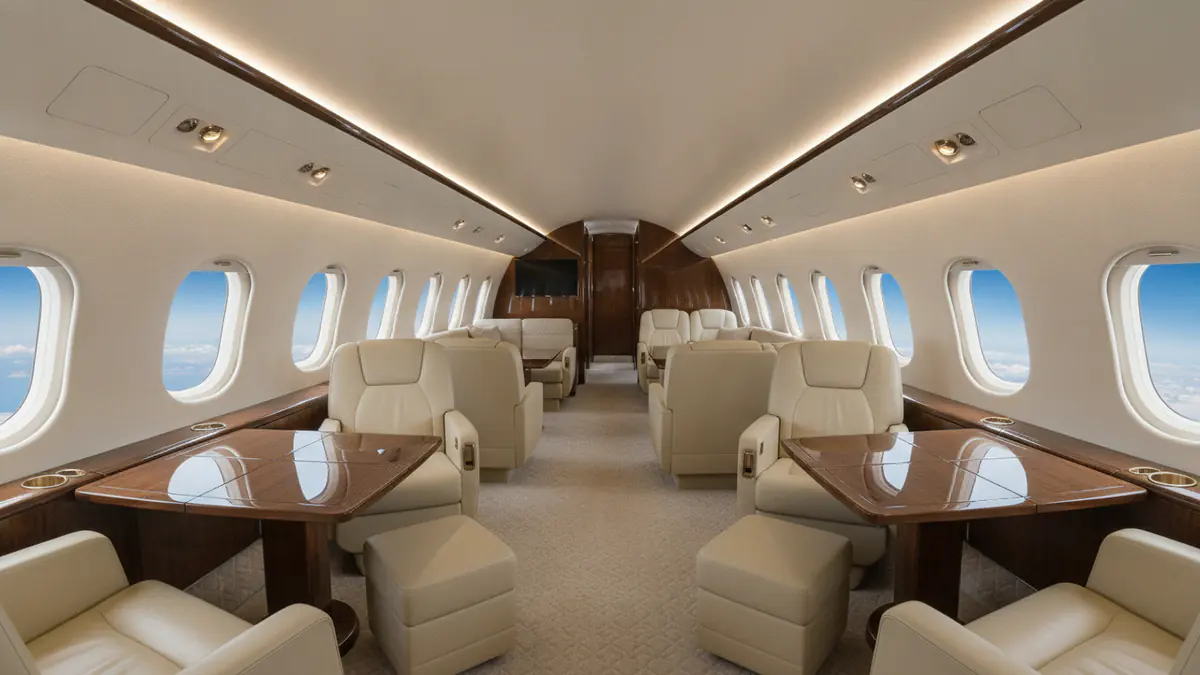
Inside an ultra long range cabin
Layouts vary widely, but on a typical ultra long range aircraft you can expect:
- Three or four cabin zones, such as a forward club area, a dining or conference area, a lounge and an aft stateroom.
- Beds for several passengers, with seats and divans converting for sleep. The number of flat beds is always lower than the number of seats, so tell us how many people need to sleep.
- A full galley and at least one flight attendant.
- Two lavatories, often including one with a shower on the largest aircraft.
- High-speed connectivity on most aircraft, though coverage varies over oceans and polar routes.
Manufacturers also market lower cabin altitudes and quieter cabins on newer models, which many passengers find reduce fatigue on long flights. Those benefits vary by aircraft, and we do not quote figures for them.
Ultra long range jet charter cost
In our pricing model, which uses published market rates, ultra long range jets fall in a USD 12,500–17,500 per flight hour band, shown above as an estimate, not a quote. Real quotes depend heavily on the specific aircraft, its base, the date and the repositioning needed.
The biggest factor is often positioning. The fleet is small and concentrated in a few hubs. If the nearest suitable aircraft is on another continent, a one-way booking may include a long empty leg to reach you and another to go home. That is why:
- Round trips often work out better per flight hour than one-ways, particularly with a short stay.
- Flexibility on dates helps, because an aircraft already heading your way can cut positioning.
- Crew costs are higher, with augmented crews and longer stays abroad.
It is also worth pricing a nonstop against a heavy jet with a fuel stop. A 45-minute stop can save a significant sum, and on some routes it is the only way to use a heavier fleet. Others prefer to pay for the nonstop and arrive sooner and more rested. The private jet cost guide explains every item on a quote, including taxes and fees that apply whatever you fly.
Empty legs on ultra long range jets
Because these aircraft reposition across oceans, their empty legs can be the most valuable of all, and among the rarest. If your dates are flexible, it is worth asking us to watch for one. As always, empty-leg dates and times are fixed by the original booking and can change. Our empty-leg flights page shows current listings.
How to request an ultra long range jet
For an accurate quote, tell us:
- The full itinerary, with dates, and whether the aircraft should stay with you.
- Passengers and baggage, and how many people need to sleep.
- Must-haves, such as a stateroom, shower, specific connectivity or a minimum year of build.
- Flexibility, because a day either way can change which aircraft are available.
We ask licensed operators for availability and send you options with operator, type, year and total price shown. You can start a request on the JetPriceCheck home page, or use the quote form here, which is already set to this class. For a comparison of every class, see our aircraft categories guide, and for short trips a light jet is usually far better value.
Ultra long range jet charter FAQ
How far can an ultra long range jet fly?
The models in our dataset show published ranges from about 5,900 to 8,000 nautical miles. Practical range with passengers, bags, reserves and real winds is lower, and the operator confirms the nonstop plan for each trip.
How many passengers does an ultra long range jet carry?
Typically twelve to seventeen in charter configuration, which is our category default. Fewer can sleep flat, so tell us how many beds you need.
Do I need an ultra long range jet to cross the Atlantic?
Usually not. Most transatlantic corridors we cover can be flown nonstop by super midsize or heavy jets in our screening. Ultra long range jets are needed for longer trips, such as London to Los Angeles or New York to Dubai.
Why do ultra long range charters carry extra crew?
On very long flights, flight time and duty limits mean the operator often adds a pilot, and sometimes a flight attendant, so the crew can rest in turns. That is a safety requirement and is reflected in the price.
Is a fuel stop always a bad option?
No. A short stop can let a smaller, more available aircraft fly the trip at a lower total price. Some travellers prefer to arrive sooner; others prefer to save. We can quote both options side by side.