Guide
Private Jet Interior: What the Cabin Looks Like at Every Size
What the cabin of each size of private jet looks like: seating, beds, galleys, lavatories, baggage and connectivity.
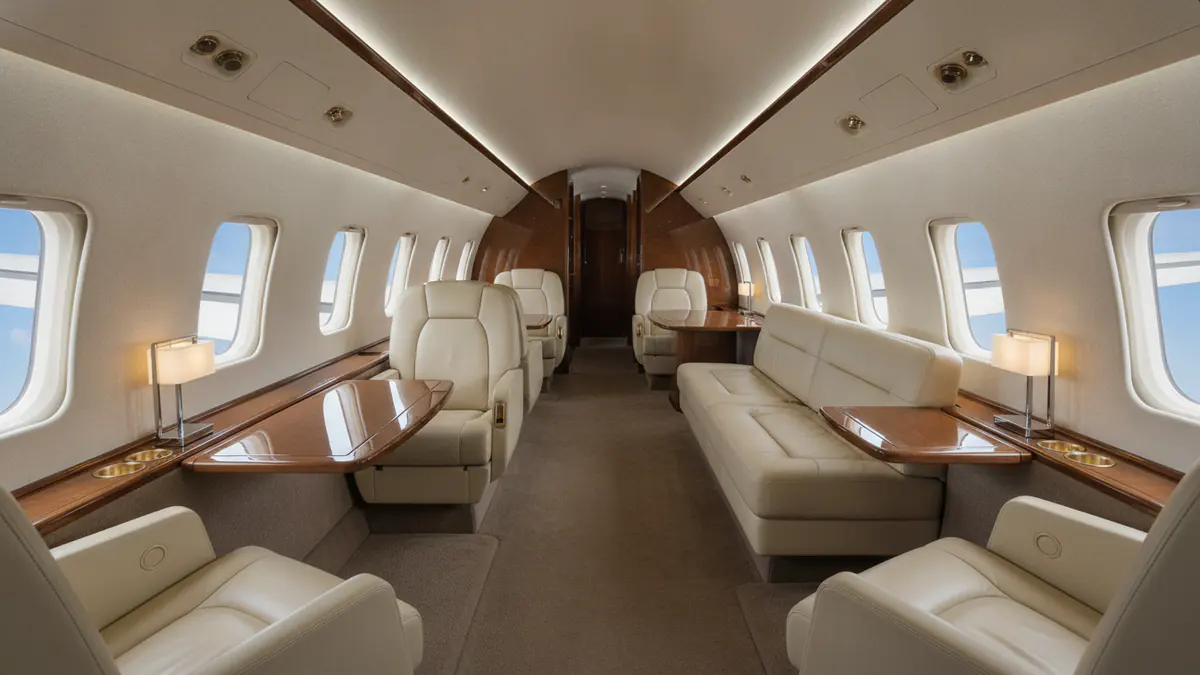
A private jet interior, explained without the brochure gloss
A private jet interior is less about gold taps and more about space: how many seats face each other, whether you can stand up, where the bags go and whether there is a proper lavatory. Photographs online tend to show the largest cabins, but most charter flights happen in something smaller, and knowing what each size really offers helps you avoid paying for space you will not use, or folding yourself into a seat for four hours.
This guide walks through the cabin you can expect in each category we arrange, from turboprops to VIP airliners, then covers layouts, galleys, lavatories, baggage and connectivity, and ends with a checklist of questions to ask before you book.
We are a charter broker. We do not own or operate aircraft; we source aircraft from licensed operators for each trip, and the cabin you get depends on the specific aircraft, its age and how its owner fitted it out. You can read more about how we work on the JetPriceCheck homepage.
Why private plane interiors vary so much
Two aircraft of the same model can feel very different inside. Manufacturers offer a range of floor plans, and owners choose finishes, seat counts and options when the aircraft is built or refurbished. An aircraft delivered fifteen years ago and refurbished last year can feel newer than a five-year-old example that has flown hard. That is why private plane interiors are best judged aircraft by aircraft rather than by model name alone.
Three things set the baseline, and no amount of leather or veneer changes them:
- Cabin cross-section. Height and width decide whether you can stand, how wide the aisle is and whether seats can recline fully.
- Cabin length. Length decides how many seating zones fit, and whether there is room for a separate galley, a lavatory with a door and a rear lounge or bedroom.
- Range and mission. Aircraft built for long flights are designed around sleeping, eating and working, so their cabins are zoned. Aircraft built for short hops focus on seats and bags.
The rest is private jets interior design: the finishes, lighting, seat upholstery, galley equipment and entertainment. Those details matter for comfort, but they sit on top of the size and shape of the tube. The Business jet entry on Wikipedia gives a neutral overview of how the aircraft types are grouped, and our own private jet sizes guide sets out the categories side by side.
Inside a private jet, category by category
The ranges below use the typical passenger counts from our category data. Real seat counts depend on the specific aircraft's configuration.
Turboprops: practical, surprisingly roomy
Turboprops such as the Pilatus PC-12 NGX and the Beechcraft King Air 350i typically seat four to eight passengers. The cabin is often squarer than a light jet's, with club seating (four seats facing each other in pairs) and sometimes a side-facing seat or bench. Many turboprops have a large rear cargo door, which makes bulky items such as skis, golf bags or equipment cases easier to load than on a small jet.
The trade-offs are headroom, noise and speed: you will usually stoop, the lavatory is often basic, and there is little galley beyond a drinks cabinet. For an hour or two, many travellers find that good value.
Light jets: the club-four cabin
Light jets, such as the HondaJet Elite II, the Embraer Phenom 300E, the Pilatus PC-24 and the Bombardier Learjet 75, typically seat four to seven. The signature private jet cabin at this size is the club four: four leather seats facing each other, with fold-out tables between them. Additional seats may be side-facing, and some aircraft have a belted seat in the lavatory area, which is certified for take-off and landing but is not somewhere most passengers want to sit.
Expect to stoop when you stand. There is usually a refreshment centre rather than a galley, so catering is cold and pre-plated. Lavatories range from a small enclosed compartment on newer designs to a curtained seat on older ones. Baggage lives in an external hold plus a small internal space, and soft bags pack far better than hard cases. You can find more on the category in our light jet charter guide.
Midsize jets: standing room and a real aisle
Midsize jets, such as the Cessna Citation XLS+ and the Cessna Citation Latitude, typically seat six to nine. This is where most travellers first get a cabin they can stand up in, or nearly, depending on the model. The Latitude, for example, was designed with a flat floor, which makes the aisle feel wider and the cabin more open.
Seating is usually a club four plus a pair of forward- or side-facing seats, or a divan (a sofa-style bench). The galley grows into a proper refreshment area with more storage and, on some aircraft, a way to warm food. The lavatory is enclosed, often at the rear, and baggage capacity rises enough for a small group with sensible luggage.
Super midsize jets: a cabin you can live in for five hours
Super midsize jets, such as the Bombardier Challenger 350, the Gulfstream G280, the Embraer Praetor 600, the Cessna Citation Longitude and the Citation X+, typically seat eight or nine. The cabin is wider and taller, with a flat floor and seats that swivel, track and recline far enough to sleep in. On many aircraft, two facing seats convert into a flat bed, and a divan can take a third sleeper.
A full galley, with an oven or microwave, a coffee maker and more storage, becomes standard. The lavatory is larger and fully enclosed, and on several models the baggage compartment can be reached during flight, which matters on longer trips. This is the size where a private jet cabin stops feeling like a car and starts feeling like a room. Our super midsize jet charter guide covers where these aircraft fly nonstop.
Heavy jets: zones, divans and a dining table
Heavy jets, such as the Embraer Legacy 650E, the Bombardier Challenger 650, the Dassault Falcon 2000LXS and 900EX, and the Gulfstream G450 and G500, typically seat ten to fourteen. The extra length lets the cabin be divided into two or three zones: a forward club section, a conference or dining group with a table that seats four, and a rear section with a divan. Doors or curtains between the zones mean one group can sleep while another works.
Galleys are designed for real meal service, most heavy jets fly with a cabin attendant, and lavatories are larger, sometimes with a vanity area. The heavy jet charter guide explains when this size makes sense.
Ultra-long-range jets: bedrooms, crew rest and showers
Ultra-long-range jets, such as the Bombardier Global 6500, 7500 and 8000, the Dassault Falcon 7X and 8X, and the Gulfstream G650 and G700, typically seat twelve to seventeen. These cabins are designed around flights of ten hours or more, so they are zoned for sleeping. Many have a private rear stateroom with a fixed bed, an en-suite lavatory and, on some aircraft, a shower. A dedicated crew rest area allows an augmented crew to fly very long sectors.
Galleys can prepare full meals, and several newer models are also marketed on a lower cabin altitude, meaning the cabin is pressurised to feel like a lower elevation than on older aircraft; the cabin pressurisation article explains the principle. See the ultra-long-range jet guide for the category overview.
VIP airliners: the largest private plane interiors
VIP airliners are narrow-body and wide-body airliners fitted out for private use, typically seating from nineteen up to fifty or more. Configurations vary enormously: some have a conference room, several bedrooms and a lounge; others keep a large business-class section for a sports team, a band or a corporate group. These aircraft are arranged case by case, and their interiors are always discussed layout by layout before booking.
Seating layouts and what they mean on a quote
Operators describe their cabins with a shorthand that is useful once you know it:
- Club four: four seats facing each other in two pairs, with a table between. Found in almost every jet cabin.
- Double club: two club-four groups, one behind the other, common on super midsize and heavy jets.
- Divan: a side-facing bench, usually for two or three people seated or one person lying down. Check whether it is certified for all its seats during take-off and landing.
- Conference group: four or six seats around a larger table, useful for working or dining.
- Stateroom: a private rear cabin, usually with a bed and its own lavatory.
The maximum passenger count on a spec sheet usually includes every certified seat, including divan places and any belted lavatory seat. On a longer flight, plan on filling fewer seats than the maximum, and on a night flight ask how many flat beds the cabin makes: often half the seat count or less.
Galleys, catering and the cabin attendant
Catering is ordered for each flight. On smaller jets it arrives chilled and ready to eat; on larger aircraft the galley can reheat and plate hot meals. Almost anything can be requested with enough lead time, and catering is usually billed separately from the aircraft rate.
On light and midsize jets the cabin is usually self-service; on heavy and ultra-long-range jets a trained cabin attendant is the norm, and can make up beds on a night flight. If service matters, say so at the quote stage.
Lavatories: the question people rarely ask but should
The lavatory is the single most common source of disappointment for first-time private flyers. On older light jets and some turboprops, it can be a seat behind a curtain or folding door at the front or rear of the cabin. Newer light jets often have a fully enclosed compartment. From midsize upwards, an enclosed lavatory with a door and a basin is standard, and larger jets add vanity areas and, occasionally, a shower.
If you are flying with children, older relatives or anyone for whom privacy matters, ask specifically whether the lavatory is enclosed.
Baggage: where it goes and what fits
Every private jet has a weight and balance limit, and baggage space is finite. Smaller aircraft have an external hold that cannot be reached in flight; larger ones often have a heated, pressurised compartment reachable from the cabin. Soft-sided bags fit oddly shaped holds better than hard cases.
Tell us in advance about skis, golf bags, instruments, pushchairs or pet carriers: some fit only certain aircraft. Hazardous-materials rules still apply, including limits on spare lithium batteries; the FAA's PackSafe pages are a good reference for what can travel and how.
Wi-Fi, entertainment and power
Connectivity is one of the most variable parts of a private jet interior. Over the continental United States, many aircraft use air-to-ground systems that work well for email and messaging. For oceanic and international flights, satellite systems are needed, and their speed ranges from basic messaging to video calls depending on the equipment fitted. Some aircraft have no internet at all.
Entertainment ranges from streaming to your own device to full cabin audio and video in larger jets, and power outlets are common on newer aircraft but not universal. If you need to work in flight, ask which system is fitted and whether usage is billed on top.
What a larger cabin costs
A bigger cabin costs more to charter, but not in a straight line. Our pricing model, which is based on published market rates, puts typical hourly rates, as estimates only, at about $2,000 to $3,500 for a turboprop, $3,500 to $5,000 for a light jet, $4,500 to $7,000 for a midsize jet, $6,000 to $8,500 for a super midsize jet, $8,500 to $13,000 for a heavy jet and $12,500 to $17,500 for an ultra-long-range jet. VIP airliners sit well above that. These are illustrative figures from our model, not quotes; real prices depend on the aircraft, dates, positioning and availability.
Choose the smallest cabin that is genuinely comfortable for your group on your flight time: a light jet is usually fine for an hour, while on a five-hour flight a stand-up cabin with a proper lavatory is often worth the step up. Our private jet cost guide explains how the estimates are built, and empty legs can sometimes put a larger cabin within reach for flexible travellers.
How to judge a cabin before you book
Photographs help, but a few direct questions tell you more. When you ask us for a quote, we pass these on to the operator:
- Year of manufacture and last refurbishment. A recent refurbishment matters more than the model year.
- Exact floor plan. The seat map, not a generic brochure.
- Lavatory. Enclosed, or a curtained seat?
- Beds. How many flat beds, and is there a stateroom?
- Connectivity. Which system, and is it included?
- Cabin attendant. Included, optional or not available?
- Baggage. Hold volume and in-flight access.
- Current photos. Of the actual aircraft, not a sister ship.
Ask, too, what happens if the booked aircraft becomes unavailable, and whether a replacement would be of the same size and standard.
From the cabin to the kerb
The interior is only part of the experience. You board at a private terminal, usually run by a fixed-base operator, rather than an airline gate; our guide to what an FBO is explains what happens there. When you are ready to plan a trip, browse our aircraft overview or our private jet charter routes, then tell us your dates and group size. We will come back with options from licensed operators, and we can request the floor plan and recent photos of each aircraft with the quote.
Private jet interior FAQ
What does the inside of a private jet look like?
It depends on the size. Small jets have four to seven leather seats, usually in a club-four layout, with a compact lavatory and a drinks cabinet. Larger jets add stand-up headroom, a full galley, divans, dining tables and, on the biggest aircraft, private bedrooms and showers.
Can you stand up in a private jet?
In most turboprops and light jets you will need to stoop. Many midsize jets and all super midsize, heavy and ultra-long-range jets have a cabin tall enough for most adults to stand, but exact headroom varies by model.
Do private jets have bathrooms?
Almost all do, but they differ a great deal. Some older small aircraft have a seat behind a curtain; most newer jets have an enclosed lavatory, and large jets may have a vanity area or a shower. Ask about the specific aircraft before you book.
Is there Wi-Fi on a private jet?
Often, but not always. Aircraft flying within the continental United States commonly use air-to-ground systems, while international flights need satellite connectivity. Ask which system is fitted, whether it covers your route and whether it is included in the price.