Airports
Private jet airports
Airports that handle private aircraft, grouped by city, with the data that matters for choosing one.
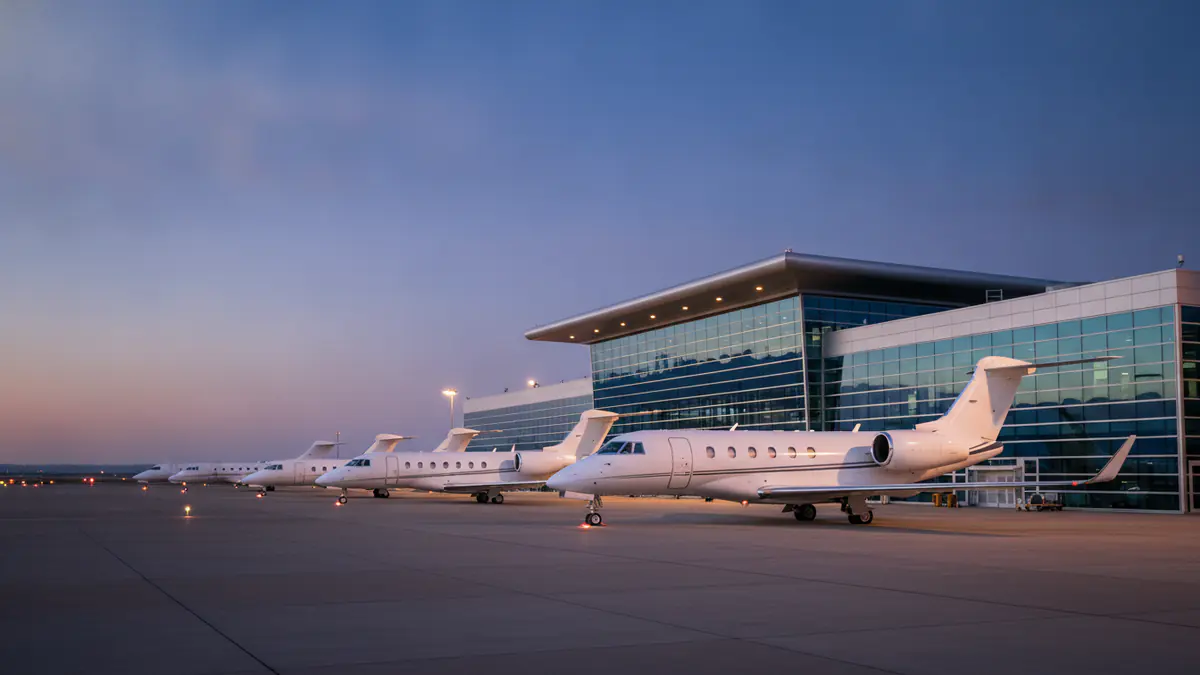
Private jet airports: why the airport matters as much as the aircraft
Private jet airports are rarely the ones you know from airline travel. Most large cities have one or more airports where business aviation is the main activity, or where it has a dedicated terminal away from the airline crowds. Choosing well can save an hour on the road, avoid a curfew or a slot problem, and even decide which aircraft you can use. This page explains how to judge an airport for a private flight, then walks through the airports we have written guides for, city by city.
The directory above lists every airport page on the site. Each page shows the airport's codes, what our data says about its runway and the aircraft categories that suit it, the drive into the city and the routes we quote through it. The copy on each page adds local know-how. Here, we focus on the questions that apply everywhere.
We are a charter broker. We do not own or operate aircraft, and we have no stake in which airport you use. When we plan a trip, we choose the airport that fits your day and your aircraft, and we say plainly when a smaller, closer field is not the right answer. You can read more about how we work on the JetPriceCheck home page.
What makes a good airport for private flights
Three features separate a comfortable private-aviation airport from one that simply accepts business jets.
A private terminal. Private passengers usually do not use the airline terminal at all. They check in, clear security and, on international flights, meet border officers at a fixed-base operator (FBO) or a dedicated business aviation terminal. The FBO also refuels and handles the aircraft. At busy airports there may be several, and the operator chooses which one to use.
Location. The right private jet airport for your trip is often the one closest to where you are going, not the biggest. Many cities have so-called reliever airports that take private traffic away from the main hub, and some of those are much closer to the business districts.
Predictable rules. Opening hours, noise limits, customs availability and parking all affect when you can fly. An airport with simple, stable rules is easier to plan around than one where every request needs a special permission.
Five checks before choosing a private jet airport
1. Runway length and the aircraft category
Every aircraft needs a certain length of runway to take off and land safely, and that length grows with weight, temperature and elevation. For screening, our data uses minimum runway lengths by category: 3,000 feet for turboprops, 3,500 feet for light jets, 4,500 feet for midsize jets, 5,000 feet for super midsize jets, 5,500 feet for heavy jets, 6,000 feet for ultra long range jets and 7,000 feet for VIP airliners. These are planning thresholds, not legal limits. The operator's performance calculations on the day decide what is actually possible, and a short, hot or high runway may also limit how much fuel and how many passengers the aircraft can carry.
This is why the airport and the aircraft are one decision. A small airport close to town might only accept a light jet; if your group needs a heavy jet, the right airport might be further out.
2. Customs and immigration
International flights need an airport where border officers are available, either all the time or on request. In the United States, private arrivals from abroad must land at an airport served by U.S. Customs and Border Protection, and CBP lists the airports that handle general aviation. Elsewhere, customs may be on site round the clock, available by prior notice or not available at all. We always check before confirming an international routing.
3. Operating hours, curfews and noise rules
Many airports close at night, or restrict which aircraft may operate at certain hours. Some apply noise rules that affect older or louder aircraft, as Van Nuys does with its published noise restrictions. Mountain airports often close at dusk. A late-evening return that looks easy on paper can be impossible at the airport you had in mind, so we plan the airport and the time together.
4. Slots and parking
At busy airports, especially in Europe, business aviation needs a slot to land or take off. During major events, parking becomes the tighter constraint: if the airport has no room to leave the aircraft, the crew drops you off and repositions somewhere else, adding flights to the bill. Riviera event weeks and the ski season at Alpine airports are classic examples.
5. Weight and size limits
Some airports limit the size or weight of aircraft for noise, runway strength or airspace reasons. Teterboro, the main business aviation airport for Manhattan, has a weight limit of 100,000 pounds, according to the Port Authority of New York and New Jersey, which rules out some of the largest business jets. Aspen limits aircraft wingspan and applies a curfew, as its operating procedures page sets out.
Private jet airports city by city
The table below summarises the airports we currently have guides for. It is qualitative on purpose: runway, customs and hours details appear on each airport page, and they are always confirmed with the operator for a specific trip.
| City | Airports with guides | What to know |
|---|---|---|
| London | Farnborough, Biggin Hill, Luton, London City | Four quite different options; choose by where you are going in London and the aircraft size |
| New York | Teterboro, Westchester County | Teterboro is closest to Manhattan but has a weight limit; Westchester suits the northern suburbs |
| Los Angeles | Van Nuys | A large business aviation airport in the San Fernando Valley with noise rules |
| Miami | Opa-locka Executive, Fort Lauderdale Executive | Both focus on private traffic and keep jets away from the airline hubs |
| Paris | Le Bourget | One of Europe's best-known business aviation airports |
| Geneva, Zurich | Geneva Airport, Zurich Airport | Main airports with dedicated business aviation areas and slot rules |
| Nice, Ibiza | Nice Côte d'Azur, Ibiza | Leisure gateways with strong seasonal peaks |
| Madrid | Cuatro Vientos | Close to the city but for small aircraft only |
| Dubai | Dubai International, Al Maktoum | Two airports with very different roles for private flights |
| Mountains | Aspen, Engadin (Samedan) | High-elevation airports that demand planning and suitable aircraft |
London
London has more business aviation choice than almost any city. Farnborough, south-west of the capital, is dedicated to business aviation and has no scheduled airline traffic. Biggin Hill serves the south-east and is popular for its relative proximity to central and south London. Luton, to the north, combines a large airline operation with an established business aviation side and handles the biggest jets. London City is closest to the financial districts, but its short runway and steep approach mean only approved aircraft types can use it.
New York
Teterboro in New Jersey is the classic Manhattan airport for private flights, a short drive from Midtown when traffic allows. Its weight limit and its busy airspace are the main planning constraints. Westchester County, north of the city, suits travellers based in Westchester and Connecticut and has its own noise abatement programme.
Los Angeles and Miami
Van Nuys is one of the busiest general aviation airports in the United States and the natural choice for the west side of Los Angeles and the Valley. In South Florida, Miami–Opa-locka Executive and Fort Lauderdale Executive both handle a large share of private traffic and offer customs for international arrivals, which matters for trips to and from the Bahamas and the Caribbean.
Paris, Geneva and Zurich
Paris–Le Bourget is north-east of the city and has served business aviation for decades; it is also home to the Paris Air Show. Geneva Airport sits right on the French border, and passengers heading to France can arrive through its French sector, a practical detail for Alpine ski trips. Zurich Airport is Switzerland's main hub with a dedicated business aviation area. Both Swiss airports apply slot and night rules.
The Riviera, the Balearics and Madrid
Nice Côte d'Azur is the gateway to Monaco, Cannes and Saint-Tropez, with a dedicated business aviation terminal and very strong summer and event demand. Ibiza Airport sees its private traffic concentrated in the summer season, when parking is the key constraint. In Madrid, Cuatro Vientos is close to the city but has a short runway, so most jets use Madrid's larger airports instead.
Dubai and the Gulf
Dubai has two airports that handle private aircraft. Dubai International is the busy airline hub closest to the city, while Al Maktoum International, also called Dubai World Central, is the home of business aviation in the emirate and usually offers easier slots and parking.
Mountain airports: Aspen and Samedan
Mountain airports put you close to the slopes but bring their own rules. Aspen/Pitkin County Airport sits at about 7,820 feet above sea level, according to Wikipedia, and its altitude, terrain, curfew and wingspan limit all shape which aircraft can fly in. Engadin Airport at Samedan, near St. Moritz, is one of Europe's highest airports and requires specific crew qualifications. At both, weather decides the day, and a backup plan through a lower airport is part of good planning.
Asia, Africa and South America
In Asia, Hong Kong International handles business jets alongside its airline traffic, Singapore Seletar is Singapore's dedicated business and general aviation airport, and Bangkok Don Mueang is the city's centre for private flights. In South Africa, Johannesburg Lanseria is the everyday business aviation airport for the northern suburbs, O. R. Tambo is the major international hub, and Cape Town International serves the Western Cape. In Brazil, São Paulo Congonhas sits close to the city's business districts.
Getting to and from the airport
Door-to-door time is where private flying earns its keep. A flight of an hour is quickly undone by an hour and a half in traffic. Each airport page shows the driving route from the city centre, and on route pages we show the ground legs at both ends. When comparing two airports, add the drive to the flight time before deciding. For some trips, a helicopter transfer can also bridge the last few miles, weather permitting.
Arrive early enough for the formalities but not much more. For a domestic flight, arriving shortly before departure is normal at most private terminals. For international flights, border checks take a little longer, and the operator will tell you what time to be there.
How the airport affects the price
The airport choice feeds straight into the quote. Landing, handling and parking fees vary widely between airports and grow with aircraft size. Event weeks and busy seasons raise them further. A more distant airport can also mean positioning costs if the aircraft is not based nearby. Our private jet cost guide explains how these fees fit into a charter price, and our aircraft guide shows which categories suit shorter runways.
Airports that see lots of one-way traffic also tend to produce empty legs, which you can track on our empty leg flights page.
Frequently asked questions
Can a private jet land at any airport?
No. The airport must be open, able to handle the aircraft's size and weight, have a long enough runway for the conditions and, for international flights, offer customs. Many airports that airlines do not use are open to private jets, which widens the choice.
What is an FBO?
A fixed-base operator is a company that runs the private terminal and aircraft services at an airport: passenger lounge, fuelling, parking and handling. You check in and board through the FBO rather than the airline terminal.
Which airport is closest to the city centre?
It depends on the city. Some airports, such as London City or Madrid–Cuatro Vientos, are very close but take only certain aircraft. Each airport page shows the drive from the city centre.
Do private jet airports have customs?
Many do, but not all, and some only on request. We check customs availability for every international flight before confirming the route.
What do the airport codes mean?
Airports have a four-letter ICAO code used in flight planning and, often, a three-letter IATA code used in tickets and baggage tags. Teterboro, for example, is KTEB and TEB.
Plan your airport around your trip
Start with the city you are flying from, check the airport guide for its rules, then look at the route directory for the corridor you need. When you are ready, ask us for a quote and we will propose the airport and aircraft that fit your day.
Sources
- Wikipedia: Fixed-base operator
- Wikipedia: ICAO airport code
- U.S. Customs and Border Protection: General aviation airports
- Port Authority of New York and New Jersey: Teterboro Airport
- Geneva Airport: French sector
- Aspen/Pitkin County Airport: Curfew
- Wikipedia: Aspen/Pitkin County Airport
- Van Nuys Airport: Noise restrictions