Comparison
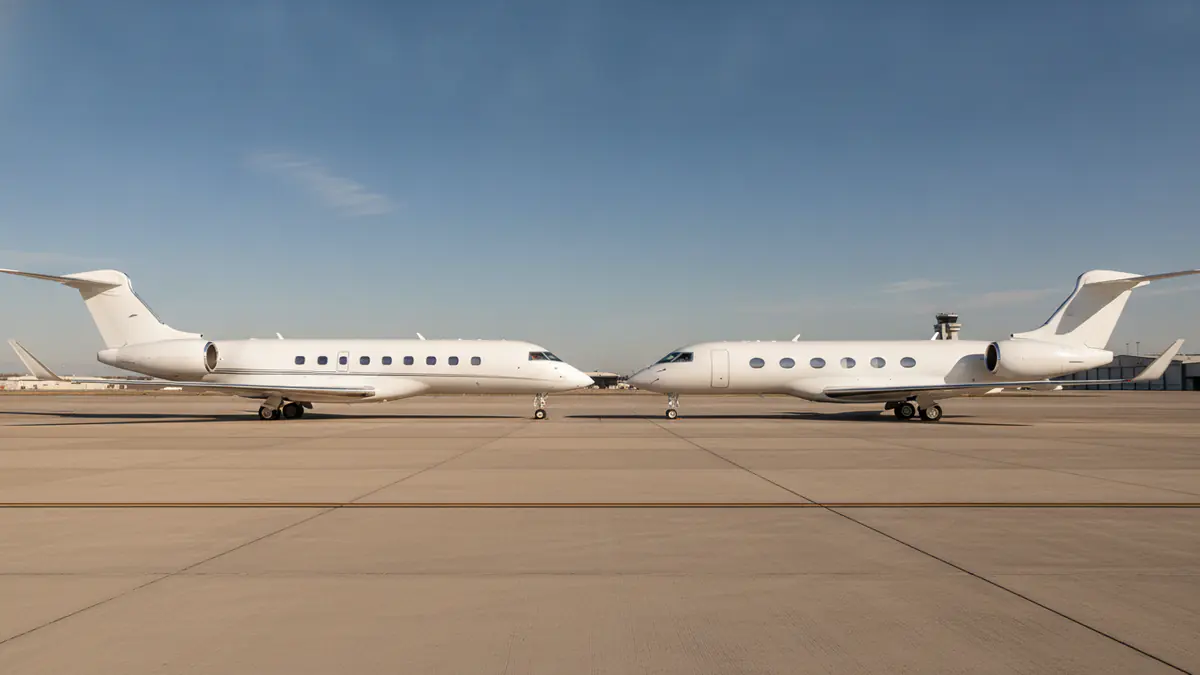
Bombardier Global 7500 vs Gulfstream G650
Both are ultra long range jets. Here is how they differ on published figures; which suits you depends on your route, group size and budget.
Unverified Figures are manufacturer published values; see each aircraft page for sources.
Specifications
| Bombardier Global 7500 | Gulfstream G650 | |
|---|---|---|
| Category | Ultra Long Range Jet | Ultra Long Range Jet |
| Published range | 7,700 nm | 7,000 nm |
| Cruise speed | Not verified | 488 kt |
| Typical passengers (max) | 17 | 16 |
| Certified maximum passengers | 19 | 19 |
| Cabin height | 6.2 ft | 6.3 ft |
| Cabin width | 8 ft | 8.2 ft |
| Cabin length | 54.4 ft | 46.8 ft |
| Baggage | Not verified | 195 cu ft |
| Charter per hour Estimate | US$12,500–US$17,500 | US$12,500–US$17,500 |
Key differences
- Bombardier Global 7500: 700 nm more range than the Gulfstream G650.
- Bombardier Global 7500: 1 more typical passengers (max) than the Gulfstream G650.
- Gulfstream G650: 0.1 ft more cabin height than the Bombardier Global 7500.
- Gulfstream G650: 0.2 ft more cabin width than the Bombardier Global 7500.
- Bombardier Global 7500: 7.6 ft more cabin length than the Gulfstream G650.
Where range makes a difference
Routes where one aircraft is typically nonstop and the other isn't.
| Route | Distance | Bombardier Global 7500 | Gulfstream G650 |
|---|---|---|---|
| New York to Dubai | 5,951 nm | Nonstop | Nonstop in good conditions |
Global 7500 vs Gulfstream G650: the short answer
The Global 7500 vs Gulfstream G650 question comes up whenever a trip is long enough to need an ultra-long-range jet, and the honest answer is that both are excellent aircraft that will do most long-haul trips equally well. The Global 7500 has more published range and a longer cabin; the G650 has a slightly roomier cross-section in published figures, a longer track record and, in most markets, more aircraft available for charter. For most clients, the right choice comes down to three questions: is your route at the very edge of range, how many people need to sleep, and which aircraft is actually available near you on your dates.
The table and key differences above set out the figures from our dataset: published manufacturer or public figures, not independently verified. This guide explains what those differences mean on a real trip, where they matter and where they do not, and how we help clients choose.
JetPriceCheck is a charter broker, not an operator. We do not own or operate aircraft. When you ask about either type, we approach licensed operators, compare what is really available and present options side by side. More on how we work is on the JetPriceCheck homepage.
Where the two aircraft come from
The Gulfstream G650 entered service in 2012 and set the benchmark for large-cabin, long-range business jets for most of the following decade. Gulfstream later added the G650ER, a longer-range version, and the last G650 family aircraft left the production line in early 2025, according to Aviation International News. Gulfstream now positions the G800 as its successor.
The Bombardier Global 7500 entered service at the end of 2018, according to its Wikipedia entry, as Bombardier's answer to demand for a longer cabin and longer legs. In late 2025 Bombardier put a development, the Global 8000, into service and said existing Global 7500s can be upgraded to that standard.
For charter, the history translates into two practical facts. First, there are more G650s in the world, spread across more operators and regions, so it is often easier to find one close to your departure. Second, G650s span a wider range of ages, so comparing individual aircraft matters more: a recently refurbished early G650 can feel as fresh as a much newer jet, while an untouched one may not.
Range: 7,700 vs 7,000 nautical miles
Our data gives the Global 7500 a published range of 7,700 nautical miles and the G650 7,000 nautical miles, a difference of about 10 per cent. Published ranges assume standard conditions, so we screen routes with a practical margin for winds, reserves and payload.
The corridor where it changes the plan
On that screening basis, both aircraft fly almost every corridor we cover nonstop. The exception shown in the "Where range makes a difference" table above is New York – Dubai, the longest corridor in our set at nearly 6,000 nautical miles great-circle. Our screen marks it nonstop for the Global 7500 and only marginal for the G650.
"Marginal" does not mean impossible. It means the trip sits between our practical range and the published maximum, so on the day it depends on passenger and baggage weight, the winds and the choice of alternate airport. An operator may fly it nonstop with a light load, restrict passengers or bags, or plan a short technical stop. If your trip is on or near that distance and a nonstop flight is essential, the Global 7500 gives more room for error.
When the range gap does not matter
For transatlantic trips such as London – New York, Europe to the Gulf, or Asia-Pacific sectors like Hong Kong – Sydney, both aircraft are comfortably within range on our screen. There, choosing the Global 7500 "for the range" buys margin you are unlikely to use, and the decision should rest on cabin, availability and price instead. Our guide to private jet range explains how published and practical range differ.
The G650ER
Some aircraft on the market are G650ERs, which Gulfstream publishes at a longer range than the standard G650 (about 7,500 nautical miles). If a trip is marginal for a G650, an ER can close most of the gap. We always tell you which variant a quote refers to.
Cabin: length against cross-section
This is where the two aircraft feel most different.
| Cabin factor (published) | Global 7500 | Gulfstream G650 | What it means |
|---|---|---|---|
| Length | About 54 ft | About 47 ft | Room for an extra living zone on the Global 7500 |
| Width | About 8.0 ft | About 8.2 ft | Marginally wider aisle and seats on the G650 |
| Height | About 6.2 ft | About 6.3 ft | Both are full stand-up cabins |
| Typical passengers | 14–17 | 14–16 | Similar in practice |
| Baggage | No published figure | About 195 cu ft | Confirm the Global 7500 hold with the operator |
We have not independently verified those figures, but the pattern matches how the aircraft are generally described. The Global 7500's extra length usually becomes an additional zone: most layouts have four living areas, often with a private stateroom at the rear and a dedicated crew rest area. The G650 typically has three zones and a slightly wider, taller tube, which some passengers notice as a more open feeling in each area.
In practice, the extra zone matters most on overnight flights with a full cabin. If eight or more people need to sleep, or you want a private suite as well as a working area and a lounge, the Global 7500's length helps. For four to eight passengers on a daytime crossing, a G650 cabin is rarely short of space.
Speed, comfort and crew
Our data has a published cruise figure only for the G650, about 488 knots; for the Global 7500 our model uses the category's typical 485 knots. On a typical trip the flight times are close enough that speed should not decide the choice. Both manufacturers design these jets to cruise high, which generally means smoother air and less traffic.
Both types can carry augmented crews on very long sectors. The Global 7500's dedicated crew rest area is a practical advantage for flights long enough to require pilots to rest in turn; on a G650, crew rest arrangements depend on the layout. Ask whether your trip needs extra crew, because it changes the quote.
Airports, seasons and the trips that test them
Range tables assume a long runway at sea level on a mild day. Real trips are often less tidy, and that is where the Global 7500 vs Gulfstream G650 choice can shift in ways a spec sheet does not show.
Hot, high and short-runway airports
Both aircraft are large and heavy compared with a midsize or super midsize jet, so neither can use every small airfield. At high-elevation or hot-weather airports, and on shorter runways, an operator may need to limit fuel or passengers on departure. That can turn a nonstop trip into one with a stop, whichever aircraft you choose. Aspen is the classic example on our corridor list: it is a demanding mountain airport with its own rules, and long-range flights into or out of it are planned case by case. If your trip involves a mountain or island airport, tell us at the outset so the operator can check performance for the specific aircraft and date.
Winter headwinds
Westbound flights across the North Atlantic and the North Pacific in winter often face strong jet-stream headwinds. A route that is comfortable in July can become tight in January. This is the other situation where the Global 7500's extra published range earns its keep: it leaves more margin for the operator to keep the flight nonstop with a full cabin. On eastbound flights the same winds help, and the difference between the two aircraft largely disappears.
Timing and slots
At busy airports, slots, parking and night restrictions often shape the day more than the aircraft does. Neither type has a particular advantage there, but a nonstop flight avoids the risk of a technical stop falling outside an airport's opening hours. For very long trips with fixed arrival times, we check the whole timeline, not only the flight time.
Connectivity and the working day
Both types are commonly fitted with satellite internet, but the system, speed and coverage depend on the individual aircraft rather than the model. If your team needs to join video calls over the ocean, ask us to confirm the system fitted to each quoted tail. On a long daytime crossing that detail can matter more than the difference in cabin length.
Cost: same category, different aircraft
Both aircraft sit in the ultra-long-range category in our pricing model, built on published market rates, so the estimate range per hour shown above is the same for each. That is deliberate. Our estimates are built by category, and they are not quotes and not offers. Real prices differ by aircraft, and the gap between two specific jets can be larger than the gap between the two types. Our private jet cost guide explains how the estimates work.
What tends to move a real quote:
- Positioning. Where the nearest available aircraft is based. Because the G650 fleet is larger, it is more often close by, which can reduce positioning hours.
- Age and refurbishment. Newer or recently refurbished aircraft can command more.
- Trip shape. A return trip or a one-way that fits the aircraft's next booking is usually better value than a one-way that returns empty.
- Crew. Augmented crew and multi-day trips add salaries, travel and hotels.
- Airports and handling. Charges scale with aircraft size and parking time.
Empty legs appear for both types when they reposition after one-way trips. They can be good value if you are flexible, but they follow someone else's schedule. Our empty-leg flights page explains the trade-offs.
Which should you charter? Scenarios
| Your trip | Leaning | Why |
|---|---|---|
| New York – Dubai or similar, full cabin, must be nonstop | Global 7500 | More range margin on the longest sectors |
| Transatlantic day flight, 4–8 passengers | Either; often G650 | Plenty of range and space; wider supply |
| Overnight flight, 8+ people need beds | Global 7500 | Extra zone and dedicated crew rest |
| Short notice, departure outside a major hub | G650 | More aircraft, more likely to be nearby |
| Price-sensitive long-haul trip | Compare both | Positioning and age decide the gap |
| A trip marginal for a G650 | Global 7500 or G650ER | Close the range gap either way |
If neither feels right, the ultra-long-range jets category page sets out the rest of the class, including the Gulfstream G700 and the Global 6500, and our aircraft guide covers every category.
How we compare quotes for you
When you ask JetPriceCheck about a Global 7500 or G650 trip, we usually quote both, and sometimes a close alternative, so you can see what insisting on one type costs. For each option we show:
- Aircraft type and variant (for example G650 or G650ER, Global 7500 or upgraded aircraft).
- Year of manufacture and last refurbishment.
- Floor plan, number of flat beds and crew rest arrangement.
- Crew complement for your sector length.
- Connectivity system.
- What the price includes: positioning, catering, fees and overnight crew costs.
You can browse our corridors and category estimates in the private jet routes directory. When you are ready, ask JetPriceCheck to quote both aircraft and we will return with real availability.
Global 7500 vs Gulfstream G650 FAQ
Is the Global 7500 faster than the G650?
Not meaningfully in our data: the G650's published cruise is about 488 knots and our model uses a similar 485 knots for the Global 7500, so flight times on the same route are very close. The difference that matters is range and cabin length.
Which has the bigger cabin, the Global 7500 or the G650?
The Global 7500's cabin is longer, which usually allows an extra living zone. The G650's cabin is marginally wider and taller in our data. Overall the Global 7500 has more usable space, especially for sleeping.
Can a G650 fly New York to Dubai nonstop?
Our screen marks it as marginal. Depending on weight, winds and alternates, an operator may fly it nonstop with restrictions or plan a technical stop. A G650ER or Global 7500 gives more margin.
Is the G650 still in production?
No. The last G650 family aircraft left Gulfstream's production line in early 2025, but many remain in service and available for charter.
Which is cheaper to charter?
Neither by rule. Both sit in the same estimate category; the real price depends on positioning, the specific aircraft and the trip shape. We quote both so you can compare.