Guide
Smallest Private Jet to Largest: Private Jet Sizes Explained
From very light jets to airliner-sized VIP aircraft: seats, cabin height, range and what each size costs to charter.
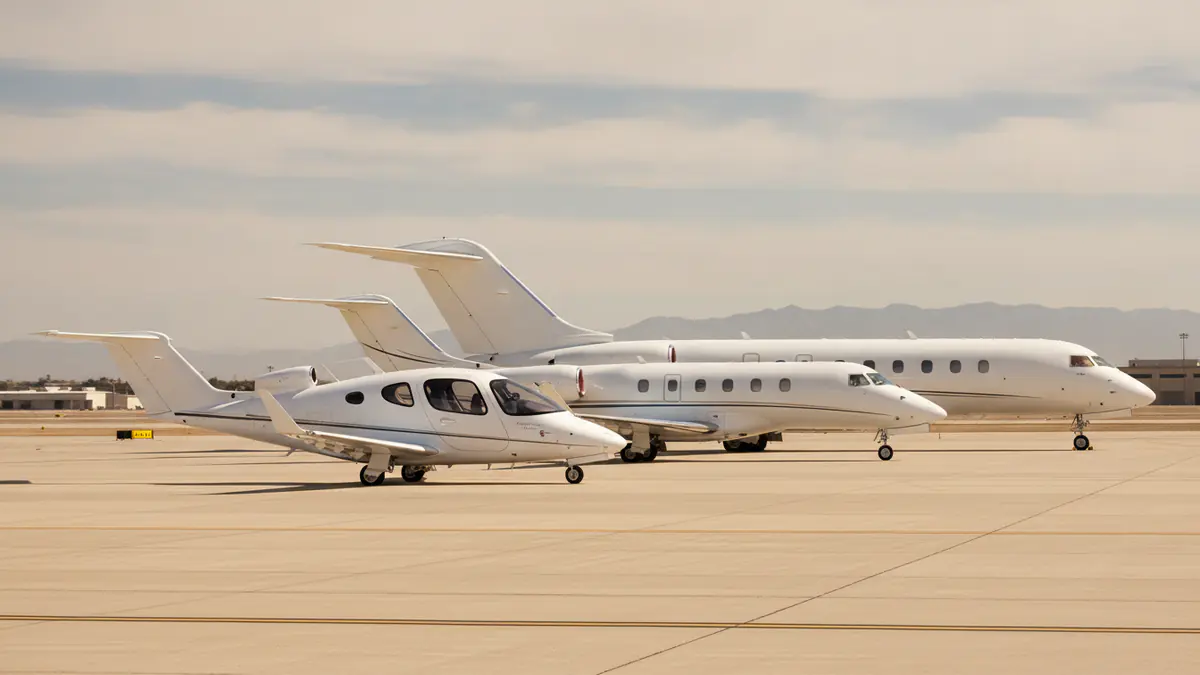
The smallest private jet, the largest, and everything in between
The smallest private jet you can buy seats a handful of people in a cabin not much bigger than an SUV, while the largest private jets are converted airliners with bedrooms, showers and conference rooms. Between those extremes sit six or seven size classes that the charter industry uses every day: turboprop, light jet, midsize, super midsize, heavy, ultra long range and VIP airliner. Knowing where each one starts and stops is the quickest way to understand why two quotes for the same trip can differ by a factor of three.
This guide walks through private jet sizes from bottom to top: who each class suits, how the cabin feels, how far it flies and what our estimates suggest it costs. It closes with a simple method for picking a size, because the common mistake is paying for a bigger aircraft than the trip needs.
We are a charter broker, not an aircraft owner: we arrange flights with licensed operators, so this advice is written from the buyer's side. See the JetPriceCheck homepage for how that works.
How private jet sizes are classified
There is no legal definition of a "light" or "heavy" business jet. The classes are a market convention built on three things that move together:
- Weight. Maximum take-off weight is the underlying driver. Heavier aircraft carry more fuel, so they fly further, and they carry bigger cabins.
- Cabin volume. Length, width and, above all, height decide whether you stoop, stand or walk around.
- Range. Longer range means fewer fuel stops, which is what opens up transatlantic and transpacific flights nonstop.
Hourly cost rises with all three, so the classes group aircraft that cost broadly the same to fly. The Business jet article on Wikipedia gives a good overview of how the categories developed.
Our aircraft guide uses seven categories, each with a typical passenger range and an estimated hourly range based on published market rates:
| Size class | Typical passengers | Estimated hourly range (USD) |
|---|---|---|
| Turboprop | 4–8 | 2,000–3,500 |
| Light jet | 4–7 | 3,500–5,000 |
| Midsize jet | 6–9 | 4,500–7,000 |
| Super midsize jet | 8–9 | 6,000–8,500 |
| Heavy jet | 10–14 | 8,500–13,000 |
| Ultra long range jet | 12–17 | 12,500–17,500 |
| VIP airliner | 19–50 | 18,000–25,000 |
These are estimates from our pricing model, which draws on published market rates; they are not quotes. A firm price only comes from an operator for a specific aircraft on a specific date.
What is the smallest private jet?
The smallest private jet in production is generally taken to be the single-engine personal jet. The best-known example is the Cirrus Vision SF50, a single-engine jet designed to be flown by its owner, with a cabin sized for a pilot and a small group of passengers.
One step up are the very light jets (VLJs): twin-engine aircraft certified for a single pilot, generally under about 10,000 lb maximum take-off weight, according to the Wikipedia entry on very light jets.
Why the smallest jets are rare on the charter market
If you want the smallest private jet because you want the cheapest flight, there is a catch. Very light and personal jets are mostly owner-flown, few are on charter operators' certificates, and many are single-pilot, which some travel policies do not accept.
In practice, the smallest aircraft you are likely to be offered for a charter are:
- Turboprops such as the Pilatus PC-12, which have a surprisingly roomy cabin for their size and can use short runways.
- Light jets such as the HondaJet Elite II or the Embraer Phenom 300E, which are the entry point for most jet charter.
So the honest answer to "what is the smallest private jet I can charter?" is usually a light jet, with a turboprop as the budget alternative on short sectors.
Small private jets and small private planes
People often use "small private plane" and "small private jet" interchangeably, but the difference matters when you book.
Turboprops: the small private plane that punches above its size
A turboprop is a propeller aircraft driven by a turbine engine. It flies lower and slower than a jet: our model uses a default cruise of about 290 knots for the category, against roughly 420 knots for light jets. Over a 45-minute hop that difference is a few minutes. Over two and a half hours, it is closer to an hour.
Turboprops shine on access: shorter, rougher and higher runways, islands and mountain resorts. Many have a taller, wider cabin than a light jet. Our turboprop charter page goes into more detail.
Light jets: the entry point for jet charter
Light jets usually seat four to seven passengers. The cabin is comfortable for sitting but most adults cannot stand upright, and the toilet, if there is one, is compact. Baggage space is the real constraint: a group of six with ski bags will fill it.
Light jets excel on short and medium sectors. For two to four people on a flight of up to about three hours, a light jet is usually the most sensible size. You can compare models on our light jet charter page.
How much does a small private jet cost to charter?
In our pricing model, a light jet is estimated at USD 3,500–5,000 per flight hour and a turboprop at USD 2,000–3,500. Those hourly figures are only the starting point. Our model adds 30 minutes per leg for taxi, climb and descent, and it prices a one-way trip at 1.6 times the flight time to reflect the aircraft flying back empty.
As a worked example, take a trip our model times at two hours, including that overhead. One way, it is billed as 3.2 hours, so a light jet comes out at an estimated USD 11,200–16,000 and a turboprop at USD 6,400–11,200. A same-day return is billed as four hours, which is why returns are relatively better value. Our private jet cost guide explains each factor.
Midsize and super midsize jets: the middle of the range
Midsize jets
A midsize jet is where comfort jumps. Cabins are taller, often close to stand-up height, with a flat floor, a proper enclosed lavatory and more baggage space. Typical capacity is six to nine passengers. A midsize jet usually covers most domestic US or European trips nonstop.
The Cessna Citation Latitude is a good example of the modern midsize cabin. The question of light jet vs midsize jet mostly comes down to three things: whether you want to stand up, how much luggage you have, and whether the trip is over about three hours. Our midsize jet charter page lists the models we track.
Super midsize jets
Super midsize jets add a wider cabin, full stand-up height and enough range for coast-to-coast flights in the United States without a fuel stop. The Bombardier Challenger 350 is one of the most common aircraft in this class. Capacity is typically eight or nine passengers in real comfort, with a galley that can serve a hot meal.
Our model puts super midsize jets at USD 6,000–8,500 per hour, against USD 8,500–13,000 for heavy jets. See our super midsize jet charter page.
Big private jets: heavy, ultra long range and VIP airliners
Heavy jets
Heavy jets, sometimes called large-cabin jets, seat around 10 to 14 passengers and are built for longer flights. Transatlantic flights are within reach of many heavy jets, depending on the model, the winds and the load. Our heavy jet charter page covers the models in this class.
Ultra long range jets
Ultra long range jets are the biggest purpose-built business jets. They seat around 12 to 17 passengers and can fly many of the world's longest city pairs nonstop, such as New York to Tokyo or London to Singapore, depending on the model and the load.
Examples include the Bombardier Global 7500, the newer Global 8000 and the Gulfstream G700. Browse the full class on our ultra long range jet page.
What is the largest private jet?
The answer depends on whether you count converted airliners.
- Largest purpose-built business jet. The Gulfstream G700 and the Bombardier Global 7500 and 8000 are the usual contenders. Gulfstream presents the G700 as having the longest cabin in its class, while Bombardier emphasises four living spaces in the Global 7500, according to the G700 and Global 7500 articles on Wikipedia.
- Largest private aircraft overall. Airliners fitted out as VIP aircraft are far bigger. The Boeing Business Jet family and the Airbus ACJ family are airliner airframes with private interiors, and a few wide-body airliners have been converted for private owners and heads of state.
For charter, VIP airliners are rare and are arranged case by case, typically for sports teams, touring productions, large delegations or group events. Our model shows them at an estimated USD 18,000–25,000 per hour, and they need airports with runways and ramps big enough for an airliner. For large groups, see our group charter page.
Cabin size: what "stand-up" really means
Cabin dimensions are the part of private jet sizes that matter most to passengers, and they are also the most misunderstood.
- Height. In most light jets you sit comfortably but cannot stand straight. From midsize upwards, many adults can stand or nearly stand. In super midsize, heavy and ultra long range cabins, standing and walking about is normal.
- Width. Width decides whether two people can pass in the aisle and how wide the seats are. It is the less obvious difference between a midsize and a super midsize jet.
- Baggage. Internal baggage (reachable in flight) versus external hold, and the total volume, are what trip you up on ski trips and golf weekends.
Layouts vary even within one model. If you want to see what these cabins look like, our private jet interior guide goes through seating, galleys, bedrooms and bathrooms.
Range and speed by size
Each step up in size adds range, with overlaps: some super midsize jets fly further than some heavy jets. Three points matter more than the brochure figure:
- Real-world range is lower than published range. Headwinds, passenger and bag weight, alternate airport requirements and fuel reserves all cut into it.
- Airport performance. A short runway, a high-altitude airport or a hot day can limit how much fuel an aircraft can take on, which limits range.
Our route pages show which categories can fly each corridor nonstop, based on screening estimates. You can explore them from the private jet charter route directory.
Estimated charter cost by size
Size is the single biggest driver of charter price. Using the estimated hourly ranges above and a trip our model times at three hours, a one-way estimate works out as follows (3 hours × 1.6 positioning factor = 4.8 billable hours):
| Size class | Estimated one-way price, 3-hour trip (USD) |
|---|---|
| Turboprop | 9,600–16,800 |
| Light jet | 16,800–24,000 |
| Midsize jet | 21,600–33,600 |
| Super midsize jet | 28,800–40,800 |
| Heavy jet | 40,800–62,400 |
| Ultra long range jet | 60,000–84,000 |
Real quotes add airport fees, crew overnights, taxes, de-icing and catering. One more lever: an empty leg is a repositioning flight an operator sells at a lower price, and larger aircraft can sometimes turn up on empty legs at prices close to a light jet's. The trade-off is that the date, time and route are set by someone else's booking.
If you fly often, ownership models change the maths. Our guides to fractional jet ownership and jet cards explain when a fixed arrangement beats paying trip by trip.
How to choose the right private jet size
Start from the trip. Four questions settle most sizing decisions:
- How many people, really? Count everyone, including assistants, security and nannies. Seating capacity on paper is often higher than comfortable capacity, so leave a seat or two spare on longer flights.
- How much luggage? Baggage decides the aircraft more often than passengers. Tell us about skis, golf clubs, strollers, pets in carriers and garment bags.
- How long is the longest leg? Under about two hours, a light jet or turboprop is usually fine. Two to four hours favours midsize or super midsize. Beyond five hours, most groups want a heavy or ultra long range cabin.
- Which airports? Short runways, mountain airports and small islands may rule out larger jets and make a turboprop or light jet the only option. Our airport guides show what each airport can handle.
When you send us a request, we also check whether a smaller aircraft with a fuel stop, or a larger one on an empty leg, gives a better result. Every size boards at a private terminal; our guide to what an FBO is explains how that works.
Frequently asked questions
What is the smallest private jet?
The smallest private jet in production is usually taken to be a single-engine personal jet such as the Cirrus Vision SF50, followed by twin-engine very light jets. For charter, the smallest aircraft you will commonly be offered is a light jet such as the HondaJet Elite II, with a turboprop such as the Pilatus PC-12 as the budget alternative on short flights.
What is the most commonly used private jet?
There is no single answer, because fleets differ by region and by operator. In charter, light, midsize and super midsize jets make up much of the flying, because they cover the most common trip lengths at a lower hourly cost than heavy jets. The Challenger 350 and the Phenom 300 family are among the models you will see often on quotes.
How much does it cost to charter a light jet?
Our pricing model estimates a light jet at USD 3,500–5,000 per flight hour. With the model's positioning factor, a one-way trip timed at two hours comes to an estimated USD 11,200–16,000. Real quotes depend on aircraft location, dates, airports and fees, so treat these as orders of magnitude and ask for a firm quote.
Is the G700 or G800 bigger?
The Gulfstream G700 has the larger cabin. The G800 trades cabin length for range, sharing its shorter cabin with the G650 family, so it can fly further but carries less space. Check the current manufacturer figures for exact dimensions, as they change with each variant.
What is the largest private jet?
Among purpose-built business jets, the Gulfstream G700 and the Bombardier Global 7500 and 8000 have the biggest cabins. Counting converted airliners, VIP versions of Boeing and Airbus airliners are much larger, but they are rarely available for charter and are arranged case by case. For any size, request a quote and we will compare what licensed operators have available.