Aircraft category
Light Jets for private charter
Small-cabin jets for short and medium trips with a few passengers. Typically 4–7 passengers.
- Passengers
- 4–7
- Longest range
- 2,040 nm
- best model in dataset
- Typical cruise
- 420 kt
- Per hour
- US$3,500+
- Estimate
Light Jets compared
| Aircraft | Range | Cruise | Passengers | Baggage |
|---|---|---|---|---|
| HondaJet Elite II | 1,547 nm | 422 kt | 4–5 | — |
| Pilatus PC-24 | 2,000 nm | 440 kt | 6–8 | 90 cu ft |
| Embraer Phenom 300E | 2,010 nm | 464 kt | 6–7 | 84 cu ft |
| Bombardier Learjet 75 | 2,040 nm | 465 kt | 6–7 | — |
Trips light jets can fly nonstop
With the longest-range model in our dataset, 76 of 104 covered city pairs are typically nonstop.
Light Jets charter cost
In our pricing model, light jets charter for US$3,500–US$5,000 per flight hour Estimate. A one-way trip usually also pays for some positioning; see any route page for trip estimates.
Light jet charter in plain terms
Light jet charter is the most direct way into private aviation: a small, fast business jet for a handful of passengers on trips of roughly one to three hours. It is the aircraft class that turns a working day in another city into something you can do without an overnight bag, and it is the class most of our short-haul quotes start with. The numbers above this guide show the category as it sits in our dataset: typical passenger count, cruise speed, the longest-range model we list and an indicative hourly band. This guide is about how to use those numbers, where a light jet shines, and the moments when it is the wrong tool.
We are a charter broker. We do not own or operate aircraft. When you ask us for a light jet, we request availability from licensed operators, compare what comes back and present the options, with the operator named on every quote.
What counts as a light jet?
There is no legal definition of a "light jet". It is a market category that brokers, operators and manufacturers use to group business jets by cabin size, range and cost. As the overview of business jet classes on Wikipedia shows, the boundaries shift from one source to another, and some aircraft sit on the line between "very light" and "light", or between "light" and "midsize".
In practice, when we say light jet we mean an aircraft that:
- seats around four to seven passengers in normal charter configuration (our category default is 4–7);
- cruises in the low-to-mid 400-knot range;
- has a cabin you sit in rather than walk around in;
- is designed for short and medium sectors rather than oceans or continents.
The model most people picture is the Embraer Phenom 300E, which has been one of the most widely delivered light jets of the past decade. It is one of four light jets in our current dataset, and the table above shows its indicative specifications. Those figures are published manufacturer or public figures, not independently verified, so please treat them as a guide rather than a promise. The Phenom's history and variants are summarised in its Wikipedia article.
Who a light jet suits, and who it doesn't
The honest answer to "is a light jet right for me?" depends on three things: how many people, how much baggage, and how long the flight is. Get those right and a light jet is an efficient, pleasant way to travel. Get them wrong and you pay for an aircraft that is cramped, stops for fuel, or both.
A good fit
- Two to five passengers with normal luggage on a trip of up to about two and a half hours. This is the category's home ground.
- Day trips for business. Out in the morning, meetings, back the same evening. The low hourly cost compared with larger jets matters most when the aircraft waits for you all day.
- Short resort hops. Think of weekend trips to the coast, a ski town or an island within a couple of hours of a major city.
- Small airports. Light jets can generally use shorter runways than large-cabin aircraft, which can open up airports closer to where you actually want to be. The operator makes the final call on each airport.
A poor fit
- Six or more adults with full luggage. A light jet may be certified for more seats than it can comfortably carry with bags and fuel. Weight, not seat count, is often the limit.
- Flights over about three hours. Most light jets can do it on paper, but comfort drops, a fuel stop becomes more likely, and a larger aircraft may cost little more in total because it flies faster and further.
- Bulky or unusual baggage. Golf bags, skis, several large hard-shell suitcases or a folding pram all need to be declared. Light jets have limited hold space and it is not always reachable in flight.
- Long westbound legs in winter. Headwinds can cut effective range significantly. A trip that flies nonstop in one direction may need a stop in the other.
If your trip sits on the edge of any of these, ask us to quote a light jet and a super midsize jet side by side. The difference in total price is often smaller than the difference in hourly rate suggests.
Light jet range: what "nonstop" really means
Every published range figure is a best case: specific weights, reserves, altitude and still air. A light jet's practical range for charter planning is lower, because it has to carry passengers, bags and legal fuel reserves, and because real winds are rarely calm.
Our reach screening above takes that into account by applying a practical-range margin. With that margin, the fact pack for this page lists more than seventy of our curated city pairs where a light jet is the smallest category we expect to fly nonstop. They are screening estimates, not operator commitments, and they cluster into a few recognisable groups:
- US East Coast shuttles: New York to Washington, D.C., Boston, Philadelphia, Toronto, Chicago and Nantucket, and Palm Beach to New York.
- California and the West: Los Angeles to San Francisco, San Diego, Las Vegas, Phoenix and Seattle; San Francisco to Reno and Seattle; Denver to Aspen.
- Florida and the Caribbean: Miami to Nassau, Orlando and Atlanta; New York to Nassau and Cancún; Miami to Cancún.
- Western Europe: London to Paris, Geneva, Nice, Milan, Madrid and Ibiza; Paris to Nice, Geneva and Milan; Zurich, Munich and Vienna links; Barcelona and Madrid to Ibiza; Milan to Rome.
- The Gulf: Dubai to Riyadh, Jeddah and Doha; Riyadh to Doha, Abu Dhabi and Jeddah.
- Asia-Pacific: Melbourne to Sydney, Singapore to Hong Kong and Bali.
Some of the pairs on that list, such as New York to Aspen, Los Angeles to Aspen or Singapore to Hong Kong, are near the top of what a light jet can do. They screen as nonstop in our model, but on a heavy-load day or into a strong headwind the operator may plan a fuel stop. Mountain airports add their own limits: runway length, elevation and temperature all reduce how much an aircraft can lift. For trips like these we always ask the operator to confirm whether the flight is planned nonstop before you commit.
You can browse the full corridor set on our private jet routes directory, where each route page shows flight time by aircraft class.
Inside the cabin: what to expect
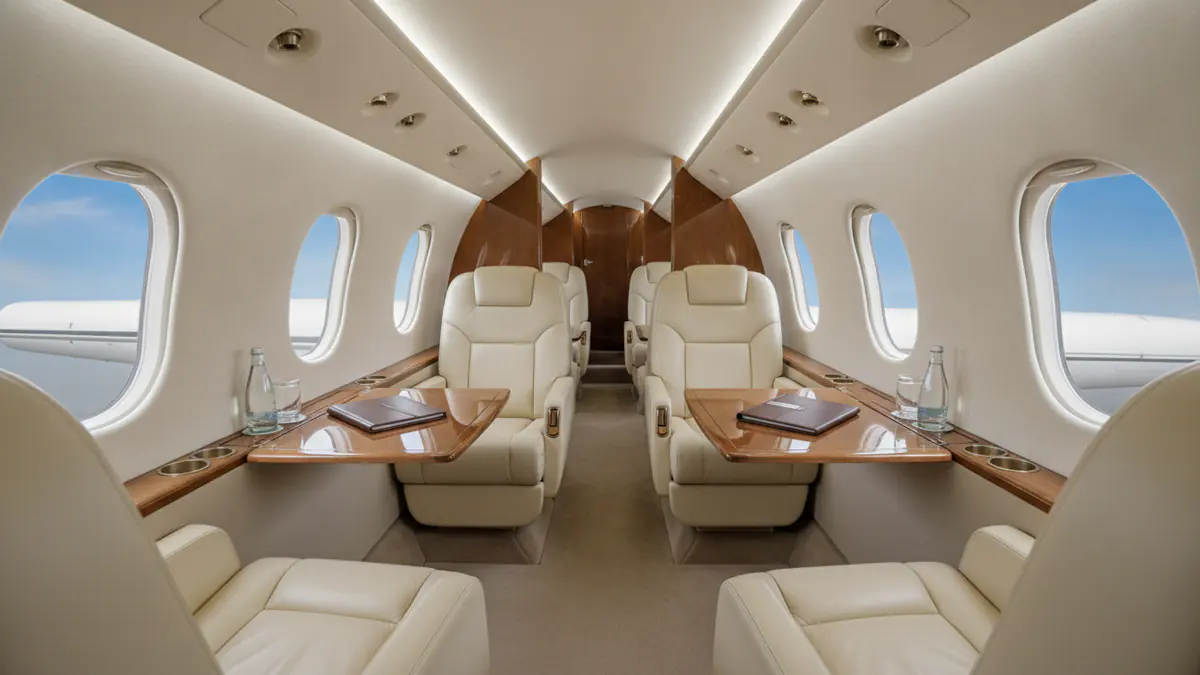
A light jet cabin is a comfortable, quiet space for sitting, working and talking. It is not a lounge. On most types you will need to stoop to move from your seat to the lavatory, and there is no separate cabin zone.
Typical features you can expect, though every aircraft differs:
- Club seating. Four seats facing each other, with a side-facing seat or two further forward or aft. Fold-out tables sit between the facing seats.
- A lavatory. Most light jets on the charter market have one, often an enclosed seat at the rear. It is worth confirming if it matters to you, because a few smaller types have only a basic facility.
- Refreshment centre. Cold snacks and drinks rather than hot meals. There is usually no flight attendant, so catering is set out before departure.
Baggage is the constraint people most often underestimate. Our data puts the Phenom 300E's hold at 84 cubic feet, which is generous for the class, but still means roughly one medium suitcase and one soft bag each for a full cabin. Soft bags pack far better than hard cases. If you are carrying sports equipment, tell us when you ask for a quote so the operator can plan weight and balance properly.
Crew, safety and who actually operates your flight
Some light jets, including the Phenom 300 series, are certified to be flown by a single pilot. On charter, many operators and regulators require or prefer two pilots, and we ask operators to state the crewing on every quote. If two pilots matter to you, say so and we will only present options that meet that standard.
In the United States, on-demand charter flights are operated under 14 CFR Part 135, which sets requirements for crew training, duty time and maintenance that go beyond those for private flying. Other countries have equivalent regimes, and we show you the certified operator on every quote. The operator has operational control of the aircraft, sets the flight plan and makes the final safety decisions, including whether a fuel stop or an alternative airport is needed.
How much does light jet charter cost?
In our pricing model, light jets sit in a USD 3,500–5,000 per flight hour band, shown above as an estimate. That band reflects published market rates, but it is not a quote: real quotes vary with the specific aircraft, its age and base, the season and the date. The hourly figure is only part of the picture, though, and three things matter more for your total:
- Positioning. If the nearest available light jet is based an hour away, you usually pay for that hour, and possibly for the return empty. On a short trip, positioning can be a large share of the price.
- Round trip versus one way. Because light jets are often used for same-day returns, a round trip with the aircraft waiting can be good value. If the aircraft would sit for several days, two one-ways may work out cheaper.
- Fees and extras. Landing and handling charges, overnight crew costs, de-icing in winter and taxes all sit on top of flight time.
Our private jet cost guide explains each of these in detail. The practical point for a light jet is this: because the hourly rate is lower, the fixed costs (fees, positioning, taxes) make up a bigger share of the total than they do on a larger jet. That is why a light jet is not always half the price of a super midsize, even when its hourly rate is.
Empty legs on light jets
Light jets fly a lot of short one-way trips, which means they also fly a lot of empty positioning legs. When an operator sells one of those legs, it becomes an empty-leg offer, often at a lower price than a normal charter. Short-haul corridors in the US Northeast, Florida, California and Western Europe tend to produce the most.
The catch is that the date, time and route are set by someone else's booking and can change or disappear. Empty legs suit flexible travellers, or anyone who wants a backup for a one-way hop. Our empty-leg flights page shows current listings and explains how to book them safely.
When to step up a size
A light jet is the right default for many trips, but not all. Consider moving up when:
- More than five or six adults are flying, or the group has a lot of luggage. A super midsize jet gives you a stand-up cabin, more baggage space and usually more range with a full load.
- The flight is longer than about three hours. Coast-to-coast in the US, or Western Europe to the Gulf, are super midsize trips. The super midsize jets page covers where that class starts to pay off.
- You need a larger group or cabin service. Heavy jets bring separate cabin zones, a proper galley and usually a flight attendant.
- You are crossing an ocean or a continent nonstop. That is the job of ultra long range jets, which are a very different product at a very different price.
If you want a structured side-by-side on the most common comparison, our light jets vs midsize jets comparison sets the two classes against each other on cabin, bags, range and cost.
How to request a light jet charter
The quickest way to get an accurate light jet quote is to give us the details that change the answer:
- Route and airports. If you have a preferred airport, name it. If not, we will suggest the airports that suit a light jet best.
- Dates and times, and whether the aircraft should wait or leave between flights.
- Passengers and bags, including anything bulky such as skis, golf clubs or pets.
- Any must-haves, such as two pilots, an enclosed lavatory, Wi-Fi or a specific aircraft age.
We then ask licensed operators for availability and send you the options with the operator, aircraft type, year and total price shown. You can start a request from the JetPriceCheck home page or use the quote form on this page, which is already set to light jets.
For a wider view of the classes, including where this category sits against the larger aircraft, see our guide to aircraft categories.
Light jet charter FAQ
How many passengers can a light jet carry?
Most light jets on the charter market seat around four to seven passengers, and our category default is 4–7. Some are certified for more seats, but in practice weight, baggage and fuel usually limit how many people can travel comfortably on a given trip.
How far can a light jet fly nonstop?
It depends on the model, the load and the winds. In our screening, a light jet is the smallest class we expect to fly nonstop on more than seventy of our curated city pairs, mostly sectors of up to about three hours. Longer trips at the edge of the range may need a fuel stop, which the operator confirms when quoting.
Can I stand up in a light jet?
Generally not fully upright. Light jet cabins are designed for sitting. You can move to the lavatory, but most adults will need to stoop. If standing room matters, a super midsize or larger jet is the better choice.
Is a light jet charter cheaper than a larger jet?
Per flight hour, yes. In total, not always: positioning, fees and taxes do not shrink much with aircraft size, and a larger jet may avoid a fuel stop or fly a little faster. We can quote both so you can compare the real totals.
Are light jets safe?
Light jets are flown on charter by operators that hold an air operator certificate, such as a Part 135 certificate in the US, and are subject to the same regulatory oversight as larger charter aircraft. We show you the operator on every quote and can share its certification details on request.