Service
Private jet charter for groups
Private charter for groups too large for a typical business jet: heavy jets, ultra long range jets and VIP airliners for teams, weddings, incentives and events.
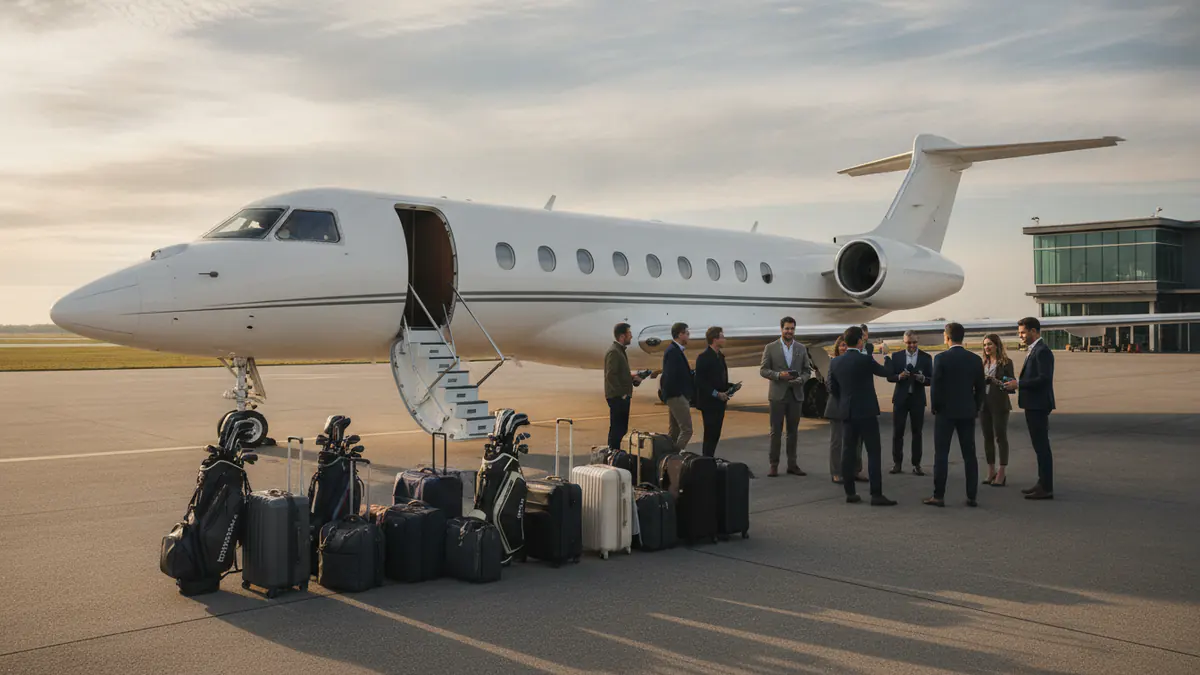
Who it's for
- Company offsites and incentive trips
- Wedding parties and family events
- Event and festival groups
- Groups that need to travel together on one schedule
How it works
- 1. Share the group size, baggage and dates.
- 2. A specialist checks which large-cabin aircraft or VIP airliners are available and whether splitting the group across two aircraft is cheaper.
- 3. You receive quotes from operators and confirm.
Aircraft that suit it
| Category | Passengers | Longest range in dataset | Per flight hour |
|---|---|---|---|
| Heavy Jets | 10–14 | 5,300 nm | US$8,500–US$13,000 |
| Ultra Long Range Jets | 12–17 | 8,000 nm | US$12,500–US$17,500 |
| VIP Airliners | 19–50 | — | US$18,000–US$25,000 |
Estimate Hourly figures from pricing model market-2026-09. Method.
Example trips
| Route | Aircraft | Time | One way from |
|---|---|---|---|
| Washington, D.C. to New York | Heavy Jet | 55 min | US$13,500 |
| Palm Beach to New York | Heavy Jet | 2 h 30 min | US$34,000 |
| Los Angeles to Las Vegas | Heavy Jet | 55 min | US$13,500 |
| Toronto to New York | Heavy Jet | 1 h 10 min | US$16,000 |
| San Jose to Los Angeles | Heavy Jet | 1 h 5 min | US$14,500 |
| Boston to New York | Heavy Jet | 50 min | US$13,500 |
| New York to Los Angeles | Heavy Jet | 5 h 15 min | US$71,000 |
| Austin to Dallas | Heavy Jet | 50 min | US$13,500 |
Worth knowing
- Above roughly 16 to 19 passengers, the choice narrows to VIP airliners and regional aircraft, which have fewer airports they can use.
- Baggage volume often decides the aircraft before seat count does.
- Two smaller aircraft can cost less than one large one and give schedule flexibility.
Private jet charter for groups: how it differs from a standard charter
Private jet charter for groups starts where a typical business jet runs out of seats. Most private jets carry somewhere between four and sixteen passengers, and only a handful of large-cabin types go beyond that. Once a group reaches twenty, fifty or a hundred people, the aircraft change: VIP-configured airliners, regional airliners and, sometimes, two or three business jets flying in formation on the schedule. The aircraft table above shows the categories most used for groups, with their typical seat counts and hourly estimates from our demonstration pricing model. This guide explains how to choose between them, when splitting a group is the better plan, why baggage often decides the aircraft, and what to check before you book.
We are a charter broker. We do not own or operate aircraft. We find licensed operators with aircraft that fit your group, compare their quotes, and coordinate the details until everyone is home. The operator named on each quote flies the trip.
Who uses a group private jet
A group private jet makes sense when the group has to arrive together, on a time you choose, at an airport close to where it is going. Typical group trips include:
- Company offsites and incentive trips. A sales team rewarded with a weekend away, or a leadership team meeting at a resort, travels on one schedule and starts the programme on arrival.
- Weddings and family celebrations. Guests from one city fly together to a destination wedding, often with a lot of luggage and a few very young or elderly passengers who benefit from a short walk to the aircraft.
- Event groups. Hospitality programmes for major sporting and cultural events move guests in and out on fixed days, often into airports that are congested that week.
- Production crews and touring groups. Film crews, bands and their equipment need an aircraft chosen for cargo as much as for seats.
- Delegations. Government, trade and NGO delegations sometimes need to travel together for security or protocol reasons.
For professional and university teams, see our dedicated page on sports team charter. Team travel has its own patterns, including equipment volumes and league schedules.
How big is the group? Matching seats to aircraft
The first question in any large group private jet charter is headcount, including anyone travelling with the group, such as planners, security or photographers. Seat counts are a rough guide only, because the same aircraft type can have very different cabin layouts.
| Group size | Typical options | What to know |
|---|---|---|
| Up to about 8 | Midsize and super midsize jets | Standard private charter; wide choice of aircraft and airports |
| About 8 to 16 | Heavy and long-range jets | Large cabins with separate zones; fewer aircraft available on a given day |
| About 16 to 19 | The largest business jets, or two smaller jets | Few aircraft; splitting the group is often cheaper and easier |
| About 20 to 50 | VIP airliners or regional airliners in VIP or business layout | Fewer suitable airports; longer lead times |
| 50 and above | Regional or narrow-body airliners in charter configuration | Airline-style operations; the booking works more like an airline charter |
Above roughly sixteen to nineteen passengers, the choice narrows to airliner-derived aircraft. At the top end are VIP airliners such as the Boeing Business Jet and the Airbus Corporate Jets family. These are airliner airframes fitted with lounges, dining areas and bedrooms, and they can carry a group over very long distances in comfort. Regional airliners in business or all-premium layouts are the more common answer for groups of thirty to seventy on shorter sectors. For an overview of every size class, see our guide to private jet types.
Baggage often decides before seats do
With private aircraft for large groups, the baggage hold is often the real limit. A heavy jet with fourteen seats may not take fourteen people's luggage for a two-week holiday, let alone golf bags, ski equipment or wedding outfits in garment bags. Weight matters as well as volume: on long sectors or from short runways, the operator may have to limit payload so the aircraft can carry enough fuel.
Give us a realistic baggage count at the start. Split it into standard suitcases, soft bags and oversized items, and say if anything is fragile, valuable or unusual, such as musical instruments, camera cases or display equipment. On some trips the answer is to send bulky items ahead by courier, or to add a small second aircraft for luggage and a few passengers.
One large aircraft or two smaller ones?
Splitting a group across aircraft sounds more expensive. Often it is not. Two smaller jets can cost less than one large aircraft, especially when the large aircraft would have to fly a long way empty to reach you. Splitting also brings practical benefits:
- More airports. Smaller jets can use airports close to the destination that a large airliner cannot.
- Flexible timing. Half the group can leave early and half can stay for dinner.
- Resilience. If one aircraft has a technical delay, not everyone is stuck.
- Separation. Executives and guests, or families and friends, can travel in their own cabins.
Keeping everyone together has advantages too: one boarding time, one arrival, one set of ground transport, and the shared experience of the flight itself, which matters for a wedding party or an incentive trip. When we request quotes, we ask for both options where the group size allows, so you can compare cost and practicality side by side.
Airports and ground handling for large groups
Large aircraft need longer runways, larger parking stands and handling equipment such as steps and baggage loaders. Some of the small airports popular with business jets cannot take a VIP airliner at all, or can only do so with prior permission. That can mean using the main commercial airport instead of the nearby general aviation field. At a busy commercial airport, a group may still use a private terminal or a dedicated channel, but the process is closer to an airline experience.
Ground transport needs as much planning as the flight. A coach for forty guests has to be allowed to the aircraft or to the terminal kerb, and immigration for a large international group takes longer than for a family of four. We ask the operator and the handling agent how the group will move through the airport and plan cars and coaches around it.
To see routes in our network, with flight times and estimate ranges by aircraft size, browse the directory of charter routes. The example trips table above shows routes where the group categories fly nonstop.
Comfort and cabin layout for a group private jet
Seat count tells you whether the group fits; cabin layout tells you whether the trip will feel right. Business jets usually have club seating in facing pairs, sofas that may convert to beds, and one or two washrooms. On a flight of five or six hours with fourteen people, the number of washrooms and the space to move around matter more than the finish of the seats. VIP airliners add separate lounges, dining areas and sometimes private bedrooms, which suits a group that includes a principal or a family who want some privacy from other guests.
Ask for the seating plan with every quote. Check how many seats are certified for take-off and landing, because a divan counted as three seats may be less comfortable for three adults on a long flight. If the group wants to sit together, talk or work, a cabin with several club areas is better than one long row of single seats.
Pricing a large group private jet charter
Group charter is priced the same way as any private charter, per aircraft and not per seat. The main drivers are flight hours, positioning of the aircraft to your departure airport, airport and handling charges, crew expenses for any nights away, and catering. Our private jet cost guide explains each fee in detail.
Two group-specific points are worth knowing.
Per-person cost falls as the group grows, up to a point. Filling every seat of a large aircraft spreads the cost well. A half-empty VIP airliner is an expensive way to move fifteen people. The right aircraft is the one your group nearly fills, with the baggage it actually brings.
Catering and cabin service scale with the group. An airliner carrying sixty guests needs cabin crew in line with its size and type, and catering for a full cabin. These costs are usually included in the quote, but check what is covered.
Who pays, and can you sell seats?
Most group charters are paid by one party: the company, the host family or the event organiser. That is a private charter, and everyone on board is a guest of the charterer.
If you plan to sell seats to individuals, the rules change. In the United States, selling individual seats to the public on a charter flight falls under the public charter rules in 14 CFR Part 380, which include filing and consumer-protection requirements. Other countries have their own rules on selling seats. If you are organising a trip where each traveller pays for their own seat, tell us at the start so that the structure is set up correctly with the operator.
Checking the operator
Every group flight must be operated by a company licensed for commercial air transport with that aircraft. In the United States, on-demand charter operators with smaller aircraft hold a certificate under 14 CFR Part 135; larger airliners are usually flown under stricter airline-type rules. In the UK, the Civil Aviation Authority explains how passengers can check a flight is legal. For background on how the charter market works, see the air charter overview on Wikipedia. Every quote we present names the operator that will fly the trip.
Planning timeline for group air charter
- Several months ahead. For weddings, incentives and event weeks, agree dates and a rough headcount. Large aircraft are few, and good ones are booked early in peak seasons.
- Six to eight weeks ahead. Confirm headcount bands and baggage. Decide whether to split the group. Confirm airports and ground transport.
- Two to four weeks ahead. Collect passenger names and passport details. Confirm dietary needs, special assistance and any pets. Check entry requirements for every nationality in the group.
- The week of travel. Share the final manifest, boarding times and the meeting point. Name one person in the group as the contact for the crew.
Short-notice group travel is possible, particularly with smaller jets. See our last-minute charter page for what to expect. For business itineraries with a smaller team, our corporate charter guide covers multi-city days.
Empty legs and groups
Empty legs, the one-way positioning flights operators sell at a discount, are sometimes available on large aircraft. They can suit a flexible group, but the dates and times are set by the original booking and can change. For a group with fixed dates, treat an empty leg as a bonus rather than the plan. Our empty leg flights page explains how they work.
Requesting a quote for private jet charter for groups
Send us the group size, a baggage estimate, the dates and the airports or places you want to reach. Say whether the group must fly together, and whether anyone has mobility needs. We ask licensed operators for options, including a split-aircraft plan where it helps, and present them with the aircraft, the operator, the seating and what is included. You confirm, and the operator flies the trip. To start, use the quote form on this page, or return to the JetPriceCheck homepage.
Frequently asked questions about group private jet charter
What is the largest private aircraft available for charter?
VIP airliners based on narrow-body and wide-body airliners are the largest private aircraft. Availability is limited, so they need early booking.
Can a group include children and elderly passengers?
Yes. Tell us about infants, car seats, wheelchairs or special assistance so the operator can plan boarding and seating.
How do we handle passports for a large international group?
Collect passport details early and check entry rules for each nationality. The operator submits passenger data to the border authorities before departure, so the manifest must be final and accurate.
Can we brand the aircraft or cabin for an event?
Some operators allow cabin touches such as menus or amenity kits. Changes to the aircraft exterior are rarely possible on charter. Ask at the quote stage.
Is a group private jet cheaper than business class?
Sometimes, for a full aircraft on a short route. On long routes, business class is often cheaper per person. The private option wins on time, airport choice and keeping the group together.
Questions
How many people can fly on a private jet?
Most business jets carry up to about 19 passengers. Larger groups need a VIP airliner or regional airliner, or the group can be split across aircraft.