Service
Private jet charter for sports teams
Charter flights for teams, staff and equipment, planned around fixtures, training camps and tournament travel.
Who it's for
- Professional and academy teams
- Individual athletes and their staff
- Tournament and training-camp travel
How it works
- 1. Share the fixture list or travel window, squad size and equipment.
- 2. A specialist matches aircraft to passenger and baggage load and plans airports near venues.
- 3. Quotes come from licensed operators; schedules can be set for a whole season.
Aircraft that suit it
| Category | Passengers | Longest range in dataset | Per flight hour |
|---|---|---|---|
| Heavy Jets | 10–14 | 5,300 nm | US$8,500–US$13,000 |
| Ultra Long Range Jets | 12–17 | 8,000 nm | US$12,500–US$17,500 |
| VIP Airliners | 19–50 | — | US$18,000–US$25,000 |
Estimate Hourly figures from pricing model market-2026-09. Method.
Example trips
| Route | Aircraft | Time | One way from |
|---|---|---|---|
| Washington, D.C. to New York | Heavy Jet | 55 min | US$13,500 |
| Palm Beach to New York | Heavy Jet | 2 h 30 min | US$34,000 |
| Los Angeles to Las Vegas | Heavy Jet | 55 min | US$13,500 |
| Toronto to New York | Heavy Jet | 1 h 10 min | US$16,000 |
| San Jose to Los Angeles | Heavy Jet | 1 h 5 min | US$14,500 |
| Boston to New York | Heavy Jet | 50 min | US$13,500 |
| New York to Los Angeles | Heavy Jet | 5 h 15 min | US$71,000 |
| Austin to Dallas | Heavy Jet | 50 min | US$13,500 |
Worth knowing
- Equipment volume (bags, bikes, medical kit) often decides the aircraft.
- Late-night departures after fixtures depend on airport opening hours.
- Season-long planning can secure aircraft for peak weekends.
Private jet charter for sports teams: what it actually solves
Private jet charter for sports teams is less about luxury than about control. A squad that travels on scheduled flights spends its week fitting around someone else's timetable: early check-ins, split seating, connections through busy hubs, kit that travels separately and a real chance that something important arrives a day late. A charter reverses that. The aircraft leaves when the team is ready, the staff and the equipment travel together, and the day is built around training, recovery and the fixture rather than around the airline.
The sections above give the short version; this guide explains how team managers and athletes' representatives plan charter travel, what drives the aircraft choice, where the risks sit and how pricing works. We are a charter broker. We do not own or operate aircraft; we source aircraft from licensed operators, compare what is available, and look after the trip from the first enquiry to the last landing. You can read more about how we work on the JetPriceCheck homepage.
Who charters, and why the reasons differ
Professional squads and matchday travel
For a full squad the key metric is the whole journey, not the flight time. A charter can depart from an airport closer to the training ground, board the team together without public terminals, and land at an airport chosen for the venue rather than for the airline network. After an away fixture it can leave the same night, which means players sleep in their own beds and start recovery at home the next morning. Over a season, the hours saved add up to training sessions that would otherwise be lost to travel.
Individual athletes and small entourages
A single athlete travelling with a coach, a physiotherapist and perhaps a family member has different priorities: privacy, a predictable routine and the ability to rest on board. Golfers, tennis players, racing drivers and combat-sport athletes often move between events on tight turnarounds, sometimes across several countries in a month. For them, athlete private jet charter is a way to keep the schedule intact when one event overruns and the next starts in another time zone.
Academies, age-group teams and events
Academies and age-group teams usually charter for specific trips: a tournament abroad, a pre-season camp or a run of away cup games. These trips often combine large groups with tight budgets, so they benefit most from early planning.
Matching the aircraft to the squad and the kit
Why baggage often decides before seats do
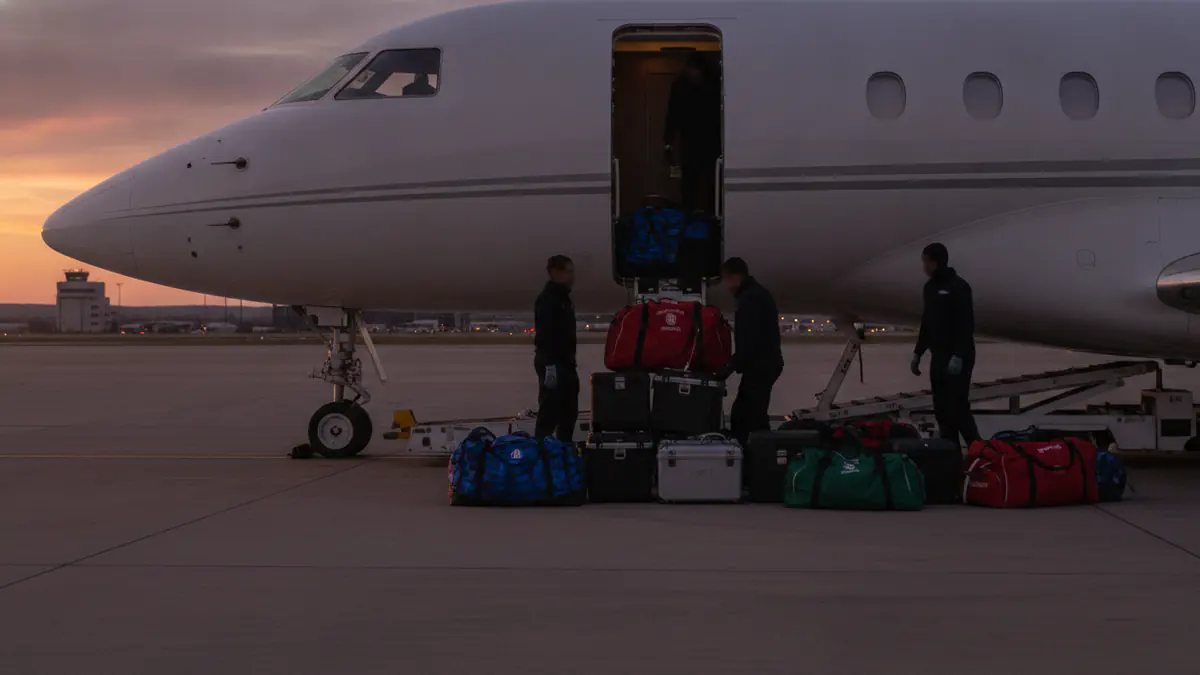
The most common mistake in sports team jet charter is to count seats and forget the kit. A squad carries personal luggage, training and match kit, medical and physiotherapy equipment, recovery devices, analysis equipment and, in some sports, bikes, golf bags, sticks or skis. Business jets are designed around a few executives and their suitcases, not 30 kit bags and a physio table. So our first two questions are the passenger list and the baggage list, with sizes for anything unusual; with both, the operator can confirm what fits and what weight the aircraft can carry on that sector.
Heavy and ultra-long-range jets for athletes and staff groups
For an individual athlete with a support team, or a small staff group travelling ahead of the squad, a large-cabin business jet is usually the right tool. Heavy jets offer stand-up cabins, separate seating areas and room to sleep on longer sectors. Where the trip crosses an ocean or a continent nonstop, an ultra-long-range jet removes a fuel stop and adds cabin space for proper rest. Both have hold capacity that suits golf bags, cases and medical kit for a small group, though not for a whole squad's equipment.
VIP and regional airliners for a full squad
A full squad with staff, typically somewhere between 30 and 60 people depending on the sport, almost always needs an airliner rather than a business jet. That means either a regional airliner in an all-business or mixed configuration, or a larger aircraft in a VIP layout. These aircraft are arranged case by case, since fewer operators hold them and their availability varies widely by region and season. The service's FAQ above makes the same point: full squads usually need a VIP or regional airliner, while individual athletes and small staff groups often use heavy or super midsize jets.
You can see the full ladder of categories, from light jets to VIP airliners, in our aircraft guide.
A quick guide to sizing the aircraft
| Travelling party | Typical aircraft | What usually decides it |
|---|---|---|
| Athlete plus two or three staff | Super midsize or heavy jet | Rest on board, range, bag volume |
| Athlete plus larger entourage (up to about a dozen) | Heavy or ultra-long-range jet | Seats, sleeping space, nonstop range |
| Staff advance party or medical team | Heavy jet | Equipment weight and volume |
| Matchday squad with staff | Regional or VIP airliner | Seats plus hold volume for kit |
| Several teams or a tournament group | Airliner, or several aircraft | Number of groups and timing |
This table is a planning starting point, not a rule. Some sports travel light and some travel with a small warehouse; the operator's weight-and-balance calculation for your actual list is what settles it.
Planning charter travel around fixtures
Post-match departures and airport opening hours
Leaving straight after an evening fixture is one of the strongest reasons to charter, and also one of the hardest parts to plan. Many airports restrict night movements, have limited opening hours for business aviation, or need advance notice for handling and customs outside normal hours. The fact list above flags this: late-night departures after fixtures depend on airport opening hours.
For every post-match departure we check that both airports are open and staffed at the likely times, and how a delayed finish affects the plan. If either is uncertain, we plan an alternative: a nearby airport with longer hours, or an early-morning departure.
Crew duty time and the late finish
Crews have legal duty limits. A crew that flew in during the morning and is then asked to depart late at night can run out of duty time, especially if a match goes to extra time. The fix may be positioning the aircraft later or using a fresh crew; when the plan depends on leaving soon after the final whistle, we ask the operator to confirm the margin in writing.
Recovery and rest on board
On longer sectors the cabin becomes part of the recovery plan. Performance staff often ask for specific meals, space for recovery equipment and a cabin that can be dimmed for sleep. Operators can usually plan catering around the team's nutrition guidelines if they are supplied in advance.
Season-long schedules
For clubs with a regular away programme, charter is most efficient when it is planned for the season rather than fixture by fixture. Sharing the fixture list early lets operators hold suitable aircraft for peak weekends, when demand from other charter clients is also high. It also lets us flag difficult trips, such as midweek fixtures abroad or back-to-back away games, before they become last-minute problems. Where a fixture is moved at short notice, which happens with broadcast scheduling and cup replays, our last-minute private jet service covers the gap.
Choosing airports near venues and training bases
A charter's great advantage over scheduled travel is the choice of airport. A team based far from its nearest hub can often depart from a smaller airport much closer to the training ground, and many stadiums and venues sit closer to a business aviation airport than to the main airline hub. The limit is runway length, handling capability and opening hours, particularly for airliner-size aircraft, which need longer runways and suitable ground handling for a large group and its baggage.
We look at drive time to the hotel or venue, runway and weight limits for the proposed aircraft, the handling agent's ability to process a large group quickly, and customs availability at the times you need. Our route directory shows the corridors we cover and the airports we typically use at each end.
Medical kit, batteries and restricted items
Sports teams carry more regulated items than most charter passengers. Medical bags may contain prescription medicines, injectable products or controlled drugs, each of which can have import rules at the destination. Recovery and performance equipment often contains large lithium batteries, and the rules for carrying them, including limits on battery size and the general requirement to keep spare lithium batteries in the cabin rather than the hold, are set out in the IATA lithium battery guidance that operators follow.
The simple rule is to send the operator a full list of anything unusual well before departure, including battery ratings where you have them. The operator decides what can travel and how, and it is far easier to solve a problem a week before the trip than on the apron. Teams in shooting sports or biathlon travel with firearms that need permits in every country on the route; that planning starts weeks ahead.
Crossing borders with a squad
International team travel adds paperwork that grows with the size of the group. Operators must send passenger information to the authorities at each end, so we need full passport details for every traveller in advance, and any change to the squad list after that has to be passed on quickly. Visa requirements vary by nationality, and a mixed-nationality squad can include players who need visas for a destination that most of the team can enter freely. Each traveller's entry requirements should be checked with the relevant government before travel.
Equipment can raise customs questions too. Professional equipment brought into a country temporarily may be covered by an ATA Carnet in countries that accept it, which can simplify temporary import for high-value kit such as broadcast, timing or analysis equipment. Your governing body or logistics provider can advise whether it applies to your trip.
How team charter is priced
Sports charter is priced like any other charter: the operator charges for the aircraft's flying time, including any positioning flights to reach you and return to base, plus landing, handling and parking fees, crew costs for overnight stays, catering and taxes. The size of the aircraft is the largest single factor. Our pricing model, which draws on published market rates, estimates a heavy jet at USD 8,500–13,000 per flight hour, an ultra-long-range jet at USD 12,500–17,500 and a VIP airliner at USD 18,000–25,000. They are estimates to show scale, not quotes; only the operator's quote is firm. Our private jet cost guide explains how estimates are built and what sits on top of the hourly rate.
For a large squad the useful number is the cost per traveller. An airliner's hourly rate is high, but spread across a full squad it can compare reasonably with a block of flexible scheduled seats, once you count the hotel nights avoided by flying home the same night.
A few factors specific to teams move the price:
- Positioning. Airliners and large jets are based at fewer airports, so the flight to reach your departure point can add materially to the cost.
- Waiting and splitting trips. Keeping an aircraft with the team between outbound and return adds crew and parking costs; releasing it and bringing it back adds positioning. We price both.
- Event demand. When major tournaments or finals concentrate demand in one region, suitable aircraft become scarce and rates rise.
Empty legs rarely suit a whole squad, because they depend on a specific aircraft flying a specific route at a specific time. They can occasionally suit a small staff group or an individual athlete with flexible timing. When you are ready for real numbers, use the quote form beside this page.
Safety and operator checks
Every flight we arrange is operated by an operator that holds the relevant air operator certificate for commercial passenger flights, for example under FAA Part 135 in the United States or an AOC issued by the national authority in Europe and the UK. The UK Civil Aviation Authority publishes guidance on making sure a flight is legal, which is worth reading for anyone responsible for moving a group. For team travel we also confirm insurance cover for the passenger count and the operator's plan if the aircraft becomes unavailable, because a technical problem the night before an away fixture can leave a squad with no way to travel. For critical trips we agree back-up options in advance.
Related charter services
For non-sporting groups, see group private jet charter. Club executives and sponsors who travel separately from the squad are covered by our corporate jet charter service. Athletes who travel with a dog can read our pet-friendly private jet guide for the rules that apply to animals in the cabin.
Questions about sports team charter
How early should a team book a charter?
For a single trip, a few weeks is usually enough outside peak periods, but airliner-size aircraft for a full squad can be hard to find at short notice. For a regular away programme, share the fixture list as early as possible so operators can plan aircraft and crews for the busiest weekends.
Can the aircraft wait for us if the match runs late?
Usually, yes, as long as the plan allows for the crew's duty time and the airport's opening hours. We check both before confirming and agree with the operator what happens if the fixture overruns.
Can we take medical kit and recovery equipment?
Generally yes, but send the operator a full list first. Medicines, controlled drugs, lithium batteries and compressed gases each have rules, and the operator decides what can travel and how.
Is private jet charter for sports teams only for professional clubs?
No. Academies, age-group teams, individual athletes and tournament organisers all charter, usually for specific trips rather than a whole season.
Do you own the aircraft?
No. We are a broker: we arrange flights with licensed operators and act on your behalf when comparing and booking them. The operator is responsible for flying the aircraft.
To start planning, send your travel window and squad details through the quote form, or return to the JetPriceCheck homepage to explore other services.
Questions
What aircraft do sports teams charter?
Full squads usually need a VIP or regional airliner. Individual athletes and small staff groups often use heavy or super midsize jets.