Aircraft category
Turboprops for private charter
Propeller-driven aircraft suited to short sectors and short runways. Typically 4–8 passengers.
- Passengers
- 4–8
- Longest range
- 1,806 nm
- best model in dataset
- Typical cruise
- 290 kt
- Per hour
- US$2,000+
- Estimate
Turboprops compared
| Aircraft | Range | Cruise | Passengers | Baggage |
|---|---|---|---|---|
| Pilatus PC-12 | 1,765 nm | 290 kt | 6–8 | 34.3 cu ft |
| Beechcraft King Air 350i | 1,806 nm | 312 kt | 6–8 | — |
Trips turboprops can fly nonstop
With the longest-range model in our dataset, 71 of 104 covered city pairs are typically nonstop.
Turboprops charter cost
In our pricing model, turboprops charter for US$2,000–US$3,500 per flight hour Estimate. A one-way trip usually also pays for some positioning; see any route page for trip estimates.
Turboprop charter in plain terms
Turboprop charter is the most economical way to fly privately in a turbine aircraft, and on short trips it is often the smartest one. A turboprop uses a jet-style turbine engine to turn a propeller. The result is an aircraft that burns less fuel than a jet, uses shorter runways, and flies at around 250 to 320 knots rather than the 400-plus of a jet. For a 45-minute hop to an island, a ski town or a regional airport, that trade usually works in your favour.
The tables above show the two turboprops in our dataset, the Pilatus PC-12 and the Beechcraft King Air 350i, the trips where a turboprop is the smallest aircraft that can fly nonstop, and the hourly band our pricing model uses. The figures are published manufacturer or public figures, not independently verified, and the prices are estimates, not quotes. This guide explains what they mean for real decisions: when a propeller aircraft is the right call, when it is not, and how to compare it with a light jet.
We are a charter broker. We do not own or operate aircraft. We ask licensed operators for aircraft that fit your trip, set the options side by side and stay with the booking until you land. You can read more about how we work on the JetPriceCheck homepage.
What a turboprop is, and why it is not a piston plane
People often picture a small, noisy propeller plane when they hear "prop plane". Business turboprops are a different class. The engine is a gas turbine, the same principle as a jet engine, but most of its power drives a propeller through a gearbox rather than coming out as exhaust thrust, as the Wikipedia article on turboprops explains. Turbine engines run on jet fuel, are very reliable and power pressurised cabins.
The most common engine in this class is the Pratt & Whitney Canada PT6, which powers both aircraft in our dataset and many others. For you as a passenger, the practical differences from a jet are:
- Speed. Turboprops are slower, typically a third or so below a light jet's cruise speed.
- Altitude. They fly lower than jets but still above much of the low weather, and the cabin is pressurised.
- Cabin noise. More than in a modern jet, though many aircraft have noise treatment and operators often supply headsets.
- Efficiency. They are most efficient at lower speeds and shorter distances, which is exactly where short-hop charter lives.
- Runways. Propellers give strong performance on short and, for some types, unpaved runways.
People sometimes search for "jets with propellers" or a "turboprop private jet". Strictly, a turboprop is not a jet, but in charter terms it does the same job on short trips: a private cabin, your schedule and small airports close to where you are going.
Turboprop models in our dataset
The comparison table above lists the turboprops we currently track. Each has its own page with cabin, range and route detail.
Pilatus PC-12. A single-engine turboprop from Switzerland with a wide, flat-floored cabin and a large rear cargo door. It is approved for short and unpaved strips and is common in charter fleets on several continents. It suits up to six passengers in comfort with bulky kit, such as skis, bikes or pets, and remote or rough airfields.
Beechcraft King Air 350i. A twin-engine turboprop from the King Air family, which dates back to the 1960s. Its cabin is longer and narrower than the PC-12's, with seats for eight in comfort and a published maximum of eleven. It suits larger groups, corporate travel policies that ask for two engines, and short regional shuttles.
Operators also fly other turboprops you may see in a quote, such as the smaller King Air B200, the single-engine Daher TBM series (fast, with four to six seats), the Cessna Caravan (an unpressurised utility aircraft common on island and safari flying) and the Piaggio P.180 Avanti (a twin with near-jet speed). We describe these only in general terms, because they are not in our dataset. If one is offered, we check the cabin, pressurisation and age with the operator.
Single engine or twin?
This is the first question many clients ask. Both are used for commercial passenger charter, under rules that differ by country.
- In the United States, 14 CFR Part 135 allows single-engine turbine aircraft to carry charter passengers in instrument conditions when the operator meets specific equipment and approval requirements.
- In Europe, commercial single-engine turbine operations at night and in cloud have been permitted since around 2017 under specific operator approvals, often called SET-IMC.
Some corporate travel policies still require two engines, and some passengers simply prefer them. A twin like the King Air costs a little more per hour; a single like the PC-12 is lighter on fuel and often has the roomier cabin. We confirm the operator's approvals for your route and conditions, whichever you choose.
Where turboprops fly nonstop
The reach chips above show corridors where a turboprop is the smallest category that can fly nonstop in our screening. Our fact pack lists 71 of them. Screening applies a practical-range margin to published range, and the results are estimates, not operating promises. Typical examples:
- US shuttles: Washington, D.C. to New York, Boston and Philadelphia to New York, Austin to Dallas, Los Angeles to Las Vegas, San Diego and San Francisco.
- Resort and island hops: New York to Nantucket, Denver to Aspen, Miami to Nassau, San Francisco to Reno for Lake Tahoe.
- Europe: London to Paris and Geneva, Paris to Nice, Milan to Rome, Barcelona to Ibiza, Geneva to Olbia.
- Middle East and Asia-Pacific: Dubai to Doha and Riyadh, Singapore to Bali, Melbourne to Sydney.
What the list leaves out is as useful. New York to Aspen, Miami to Aspen and Miami to Cabo San Lucas pass the screen for light jets but not for turboprops in our data, and transatlantic or coast-to-coast trips are well beyond them. Some corridors that do pass, such as New York to Cancún, are four hours or more at turboprop speed; the range works, but most clients would rather fly a jet. Our private jet range guide explains the screening method.
What turboprop charter costs
Our pricing model, built from published market rates, uses USD 2,000–3,500 per flight hour for turboprops, against USD 3,500–5,000 for light jets. Those are estimates, not quotes. A real price comes only from a licensed operator for a specific aircraft and date, and our private jet cost guide explains how the ranges are built.
The hourly rate is only half the picture, because a turboprop takes longer to cover the same distance. A simple illustration using those hourly bands and nominal cruise speeds of 290 knots for a turboprop and about 420 knots for a light jet (no taxi, climb, positioning or fees):
| Trip length | Turboprop time and cost | Light jet time and cost |
|---|---|---|
| About 200 nm | About 40 min, roughly USD 1,400–2,400 | About 30 min, roughly USD 1,700–2,400 |
| About 600 nm | About 2 h, roughly USD 4,100–7,200 | About 1 h 25 min, roughly USD 5,000–7,100 |
| About 1,000 nm | About 3 h 25 min, roughly USD 6,900–12,100 | About 2 h 20 min, roughly USD 8,300–11,900 |
The pattern holds in real quotes: at the lower end of each band the turboprop stays cheaper, but at the upper end the jet's speed cancels out its higher hourly rate from around 600 nm. The shorter the trip, the safer the turboprop's advantage; as distance grows, the jet's time saving starts to matter more. Real quotes add positioning, minimum billing hours, airport and handling fees, crew overnights and peak-date surcharges, so treat this table as a way of thinking, not a price list.
Other things that move the price
- Positioning. Turboprops are often based at regional airports, so a nearby aircraft can mean little positioning cost.
- Minimum charges. Many operators bill a minimum of an hour or more per day, which matters on very short hops.
- Return trips. A same-day return usually costs well under twice a one-way.
- Empty legs. Seasonal island and mountain routes produce one-way repositioning flights that can be priced below the usual rate. See our empty leg flights page.
Turboprop or light jet: how to decide
| Your priority | Turboprop | Light jet |
|---|---|---|
| Trip under 90 minutes | Usually the better value | Faster, but you pay more |
| Trip over 2.5 hours | Long flight | Usually the better choice |
| Short or unpaved runway | Strong | More limited |
| Bulky sports kit | Often easier (cargo door, flexible cabin) | Can be tight |
| Two engines required | Choose a twin such as the King Air | Always two engines |
| Quietest cabin | Louder | Quieter |
If you are flying under two hours with a group of up to eight and want value, a turboprop charter is often the right-sized choice. If the trip is longer or speed matters more, our light jet charter guide is the next step, and groups that want a stand-up cabin should look at midsize jets. For long-range travel, the super midsize, heavy and ultra-long-range categories take over. The full aircraft guide covers every size.
Mountains, islands and seasonal trips
Turboprops earn their keep on trips where the airport, not the distance, is the hard part. Mountain airports with short runways, steep approaches and high summer temperatures limit what larger jets can do, and island strips are often short and exposed to crosswinds. A turboprop's short-field performance widens the choice of airport and sometimes lets you land at the strip nearest the house rather than the main airport an hour's drive away. The flip side is seasonality: on peak ski weekends and summer island Fridays, turboprops are booked early, so give us as much notice as you can.
Inside a turboprop cabin
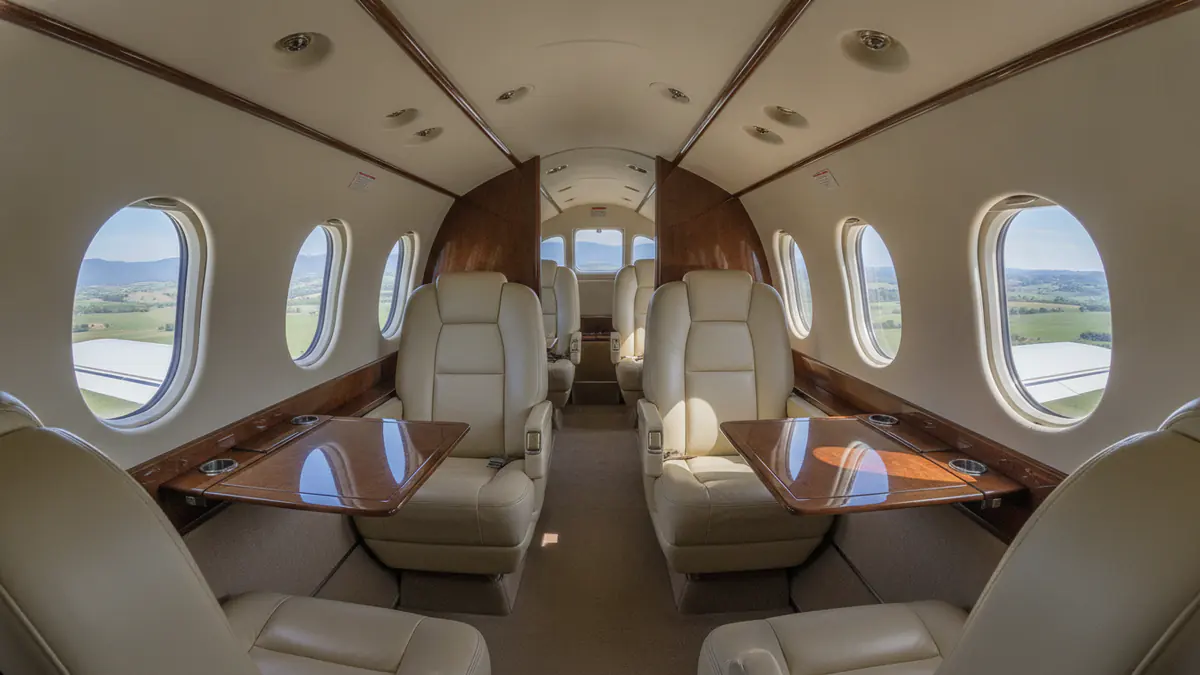
Turboprop plane interiors are more comfortable than many people expect. Both aircraft in our dataset have cabins about 4.8 feet high: not stand-up, but similar to many light jets. Executive layouts usually have club seating facing a table, leather seats and large windows. Most executive turboprops have a toilet, though it is often compact and behind a curtain or partition rather than a separate room, and some utility layouts have none. Refreshments are usually drinks and snacks. Wi-Fi varies by aircraft.
If you have specific needs, such as a lavatory, a pet in the cabin, a lot of luggage or a child seat, tell us at the start. We check them with the operator before you commit, not afterwards.
How we arrange a turboprop charter
- Share the trip. Dates, airports, passengers and luggage.
- We ask licensed operators. We search for turboprops and, where it makes sense, light jets, so you can compare time and cost.
- You compare. We show the aircraft, its age and layout where available, what is included and any positioning or overnight costs.
- You confirm on the operator's terms. The operator runs the flight; we coordinate.
- We stay with the trip. Weather, runway conditions and schedule changes are handled with the operator.
Browse the private jet route directory for route estimates, or send your trip to JetPriceCheck and we will do the searching.
Turboprop charter FAQ
Is a turboprop a private jet?
Not technically. A turboprop uses a turbine engine to drive a propeller, while a jet produces thrust directly. In charter terms, it offers the same private, on-demand service on shorter trips.
Is a turboprop cheaper to charter than a jet?
Usually, per hour. Our model, drawn from published market rates, uses USD 2,000–3,500 per flight hour for turboprops against USD 3,500–5,000 for light jets. On short trips the saving is clear; on longer trips the slower speed narrows it.
How far can a turboprop fly?
The two turboprops in our dataset publish ranges of about 1,750 to 1,800 nautical miles, but most charter trips in them are under two hours. Our screening lists 71 corridors where a turboprop is the smallest aircraft that can fly nonstop.
Are turboprops safe?
Business turboprops use turbine engines with a long service record and are flown commercially under the same regulatory framework as charter jets. Safety depends on the operator, so we work only with licensed operators and can share their certification details.
Do turboprops have bathrooms?
Most executive turboprops have a compact toilet, but not all. Ask us to confirm the layout of the aircraft offered.
When should I choose a turboprop over a jet?
For short trips, short or unpaved runways, bulky luggage and when value matters more than speed. For trips over about two and a half hours, a jet is usually the better choice.