Aircraft category
Heavy Jets for private charter
Large cabins for bigger groups and longer flights. Typically 10–14 passengers.
- Passengers
- 10–14
- Longest range
- 5,300 nm
- best model in dataset
- Typical cruise
- 470 kt
- Per hour
- US$8,500+
- Estimate
Heavy Jets compared
| Aircraft | Range | Cruise | Passengers | Baggage |
|---|---|---|---|---|
| Embraer Legacy 650E | 3,900 nm | — | 13–14 | 286 cu ft |
| Bombardier Challenger 650 | 4,000 nm | — | 9–10 | 115 cu ft |
| Dassault Falcon 2000LXS | 4,000 nm | — | 8–10 | 130.6 cu ft |
| Gulfstream G450 | 4,350 nm | — | 12–14 | — |
| Dassault Falcon 900EX | 4,500 nm | 482 kt | 10–12 | 127 cu ft |
| Gulfstream G500 | 5,300 nm | — | 12–14 | 175 cu ft |
Trips heavy jets can fly nonstop
With the longest-range model in our dataset, 101 of 104 covered city pairs are typically nonstop.
Heavy Jets charter cost
In our pricing model, heavy jets charter for US$8,500–US$13,000 per flight hour Estimate. A one-way trip usually also pays for some positioning; see any route page for trip estimates.
Heavy jet charter: when the group or the cabin matters most
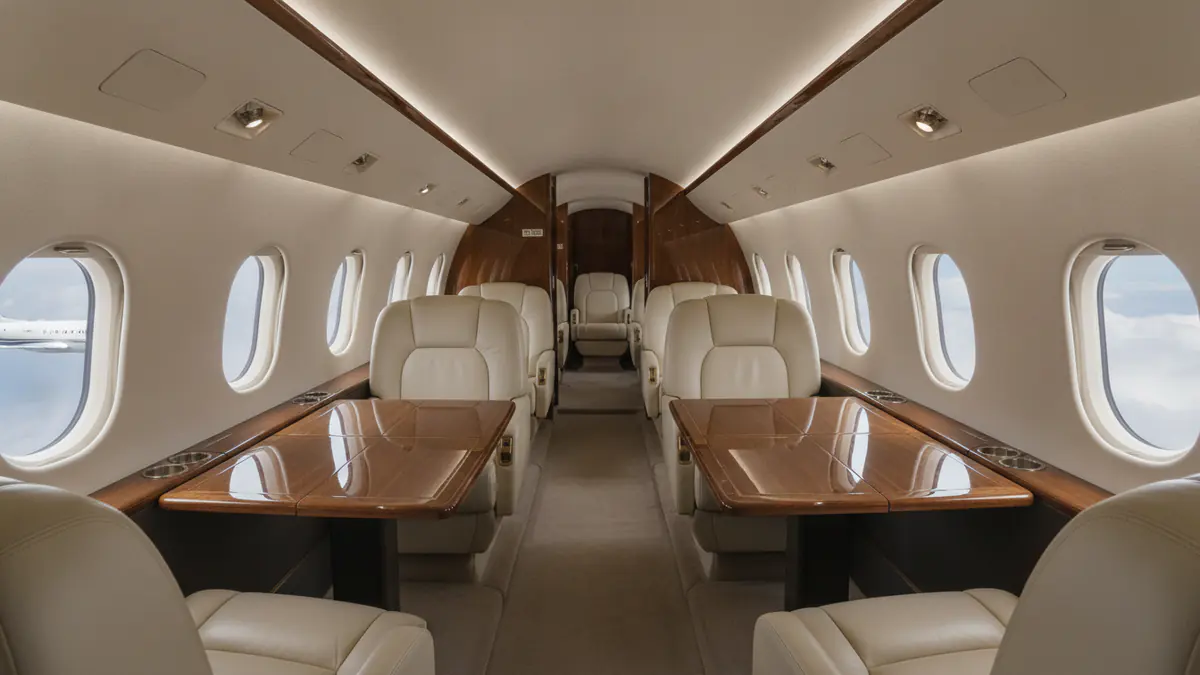
Heavy jet charter is about space: space for ten to fourteen people, space to divide the cabin into areas for working, eating and resting, and space for the bags that come with a family holiday or a team trip. These are the largest business jets short of the ultra long range flagships, and they are built for long sectors, for groups, and for trips where the cabin is part of the reason you are flying privately.
The panels above show the class as it sits in our dataset: typical passengers, typical cruise, the longest-range model we list, an indicative hourly band and six models compared. This guide explains how to read them, who the class suits, and the questions worth asking before you choose a heavy jet over a smaller or larger aircraft.
We are a charter broker. We do not own or operate aircraft. We ask licensed operators for availability, compare what comes back and show you the operator's name on every quote.
What "heavy" means, and what it doesn't
In the charter market, "heavy jet" is a size label. It means a large-cabin business jet, with transcontinental or transatlantic range, typically seating ten or more passengers. Broad definitions of the business jet classes are collected in Wikipedia's business jet article, and as with every class, the boundaries vary from source to source.
It is not the same as the "Heavy" you may hear on air traffic control frequencies. That word refers to an aircraft's wake turbulence category, which is based on maximum take-off weight. The ICAO "Heavy" category is reserved for aircraft far larger than any business jet; the jets on this page fall into the medium category for air traffic purposes. The confusion is common, and it does not affect your trip, but it helps to know that "heavy jet" on a charter quote is a description of the cabin rather than an official class.
The models you will see on heavy jet quotes
Our dataset lists six heavy jet types. The table above shows their range, cruise, passengers and baggage where a figure is published; several have no published cruise figure. These are published manufacturer or public figures, not independently verified, so treat them as a guide. In character:
- Bombardier Challenger 650. The latest version of a long-running family, summarised in Wikipedia's Challenger 600 series article. It has a wide cabin for the class and a large charter fleet, so it is often the first heavy jet a quote shows.
- Embraer Legacy 650E. Derived from Embraer's regional jet, with a long cabin in three zones and a very large baggage hold (our figure is 286 cubic feet). The family background is in Wikipedia's Legacy 600 article. It suits groups with a lot of luggage.
- Gulfstream G450. A well-established large-cabin Gulfstream, popular on transatlantic charter, with the oval windows the brand is known for.
- Dassault Falcon 2000LXS. A comfortable large-cabin Falcon with good short-runway performance for its size.
- Dassault Falcon 900EX. A three-engine Falcon, now out of production, with transatlantic range.
- Gulfstream G500. A newer, longer-range Gulfstream and the longest-range model in this class in our dataset. It sits close to the ultra long range class, and some brokers place it there.
Out-of-production aircraft are normal on charter
Our data shows the Legacy 650E, G450 and Falcon 900EX as no longer in production. That is not a warning sign. Large business jets fly for decades, and much of the charter fleet in this class is made up of aircraft built years ago, often with refurbished cabins. What matters is the individual aircraft: its year of manufacture, when the interior was last refurbished, its connectivity and the operator's maintenance record. We show the year on every quote, and we can ask for recent cabin photographs.
Who heavy jet charter suits
A heavy jet is the right choice when one or more of these apply:
- The group is ten or more. Our category default is 10–14 passengers. A super midsize tops out around eight or nine in comfort.
- The trip is long and people need to rest. Most heavy jets can make up several beds, and the cabin can be split into zones so some people sleep while others work.
- Cabin service matters. A flight attendant is usual on heavy jets, and the galley is large enough to serve proper meals rather than just snacks.
- There is a lot of baggage. Families with children, teams with equipment and anyone travelling for several weeks benefit from the bigger hold.
- You want to hold meetings on board. A forward club area with a table, separated from the rest of the cabin, works as a small meeting room.
It is less suited to short hops with small groups. You would be paying for space you do not use, and for a larger aircraft's fees at every airport. For those trips a light jet or a super midsize jet is usually better value.
Planning for a group
Groups change how a charter works. A few habits save time and money:
- Confirm the final head count early. The operator plans weight, catering and seating around it, and adding people late can mean a different aircraft.
- Collect passport details in advance. International flights need passenger information before departure, and chasing it on the day causes delays.
- List the baggage, not just the passengers. Twelve people with skis or equipment cases can fill even a large hold.
- Decide who makes decisions. One contact for the whole group makes changes on the day much quicker to handle.
If the group is larger than a heavy jet can carry, we can quote two aircraft flying the same route, or a larger airliner-type aircraft where that makes sense.
Where a heavy jet flies nonstop
For this page, the fact pack lists six of our curated city pairs where a heavy jet is the smallest category we expect to fly nonstop after a practical-range margin. These are screening estimates, not operator commitments:
| Corridor | Why it needs a heavy jet |
|---|---|
| London – Miami | A long transatlantic sector beyond typical super midsize reach |
| Geneva – New York | Transatlantic from continental Europe, with westbound headwinds |
| Nice – New York | Similar to Geneva, a long sector from the Mediterranean |
| New York – São Paulo | A long north–south flight across the equator |
| Hong Kong – Sydney | A long overwater sector in the Asia-Pacific |
| London – Aspen | Transatlantic to a high-altitude mountain airport |
A heavy jet can of course also fly all the shorter trips that smaller aircraft do, including every transatlantic and Gulf-to-Europe corridor on the super midsize list. Groups often choose one on those routes for the space alone.
A note on mountain airports. High-altitude airports, such as those serving Aspen, limit the size and weight of aircraft that can use them, and hot weather or snow reduce take-off performance further. A trip that screens as nonstop in our model may need a different arrival airport or a stop, depending on the aircraft, the season and the airport's rules at the time. We always ask the operator to confirm the plan.
The private jet routes directory shows all our corridors, with flight time for each aircraft class.
What the cabin is like
Every aircraft is different, but on a typical heavy jet you can expect:
- Two or three cabin zones. A forward club section of four seats, a middle section with a conference table or more club seats, and an aft area with a divan.
- Several beds. Seats and divans convert for sleeping on overnight flights. The number of flat beds is usually lower than the number of seats, so tell us how many people need to sleep.
- A full galley with ovens and more storage than smaller jets.
- One or two lavatories, often with a larger aft lavatory.
- High-speed connectivity on many aircraft, though not all.
- Baggage access in flight on many types.
Heavy jet charter cost
In our pricing model, heavy jets fall in a USD 8,500–13,000 per flight hour band, shown above as an estimate. It is drawn from published market rates, but it is not a quote. Real quotes depend on the specific aircraft, its age, where it is based, the season and how far it has to reposition.
Some cost drivers are sharper in this class:
- Positioning. Heavy jets are fewer than light or super midsize jets, so the nearest suitable aircraft may be further away. On a one-way booking, the cost of bringing it to you and sending it home can be significant.
- Airport fees. Landing, parking and handling charges usually rise with aircraft weight or size. At busy airports in peak season, parking a large aircraft can be expensive, or unavailable.
- Crew costs. A flight attendant is usually included, and a long trip with the aircraft waiting means hotel and allowances for three or more crew.
- Catering. Full meals for a large group can add a noticeable amount, and the operator passes that cost on.
Per passenger, though, a heavy jet with twelve people on board can compare well with two smaller jets flying in formation, which some groups consider. It also keeps everyone together. The private jet cost guide explains every item you are likely to see on a quote.
Heavy jet or ultra long range jet?
The next step up is the ultra long range class, and the choice usually comes down to distance and budget.
A heavy jet makes sense when the trip is up to about eight or nine hours and your group fits its cabin. It covers the US from Europe on most East Coast routes, most of Europe from the Gulf, and many long regional sectors.
An ultra long range jet makes sense when you want a nonstop flight beyond that, such as London to Los Angeles or New York to Dubai; when you want the largest cabin with the most beds; or when you want to avoid a fuel stop on a trip that a heavy jet would have to break.
When the choice is close, we quote both. A heavy jet with a short fuel stop is sometimes much cheaper than an ultra long range nonstop, and some travellers are happy with that trade.
Empty legs on heavy jets
Heavy jets often fly long one-way trips, and their positioning legs can be long too. An empty transatlantic or cross-country leg is uncommon but valuable. As always with empty legs, dates and times are fixed by the original booking and can change. Our empty-leg flights page shows current listings.
How to request a heavy jet charter
For an accurate heavy jet quote, tell us:
- The full itinerary, including every leg and whether the aircraft should wait.
- Passengers and luggage, including children, pets and sports or production equipment.
- How many people need to sleep, if the flight is overnight.
- Service needs, such as catering preferences, a flight attendant, connectivity or a minimum year of build or refurbishment.
We ask licensed operators for availability and send you options with operator, type, year and total price shown. You can start your request on the JetPriceCheck home page or use the quote form here, which is already set to heavy jets. To compare every class at a glance, see our aircraft categories guide.
Heavy jet charter FAQ
How many passengers does a heavy jet carry?
Typically ten to fourteen in charter configuration, which is our category default. Some aircraft are certified for more, but on long flights comfort and weight usually set the limit.
Is a heavy jet the same as a large-cabin jet?
In charter usage, yes. Both terms describe the large-cabin business jets on this page. It is a market term, not an official class, and it is different from the "Heavy" wake turbulence category used by air traffic control.
Do heavy jets have a flight attendant?
It is usual on heavy jet charter, especially on long flights, but crewing varies by operator. We state it on every quote.
Can a heavy jet fly across the Atlantic nonstop?
Yes, on many city pairs. In our screening, heavy jets are the smallest class that flies routes such as London to Miami and Geneva to New York nonstop. The operator confirms the plan for each direction, as winds and loads vary.
Are older heavy jets a concern?
Not by themselves. Large business jets have long service lives, and many charter aircraft have refurbished cabins. We show the year of manufacture on every quote, and the operator is responsible for maintaining the aircraft to its certification standards.