Service
VIP private jet charter
Charter for high-profile travellers and delegations: discreet handling, private terminals, larger cabins and the security coordination that comes with them.
Who it's for
- Public figures who need discreet handling
- Government and corporate delegations
- Principals travelling with security teams
- Guests with privacy or protocol requirements
How it works
- 1. Tell us the itinerary, party size and any security or protocol needs.
- 2. We quote aircraft from licensed operators and coordinate FBO handling, ground transport and security arrangements.
- 3. The operator flies the trip; we manage changes and on-the-day coordination.
Aircraft that suit it
| Category | Passengers | Longest range in dataset | Per flight hour |
|---|---|---|---|
| Super Midsize Jets | 8–9 | 4,018 nm | US$6,000–US$8,500 |
| Heavy Jets | 10–14 | 5,300 nm | US$8,500–US$13,000 |
| Ultra Long Range Jets | 12–17 | 8,000 nm | US$12,500–US$17,500 |
| VIP Airliners | 19–50 | — | US$18,000–US$25,000 |
Estimate Hourly figures from pricing model market-2026-09. Method.
Example trips
| Route | Aircraft | Time | One way from |
|---|---|---|---|
| Washington, D.C. to New York | Super Midsize Jet | 55 min | US$9,500 |
| Palm Beach to New York | Super Midsize Jet | 2 h 30 min | US$24,500 |
| Los Angeles to Las Vegas | Super Midsize Jet | 55 min | US$9,500 |
| Toronto to New York | Super Midsize Jet | 1 h 10 min | US$11,500 |
| San Jose to Los Angeles | Super Midsize Jet | 1 h 5 min | US$10,500 |
| Boston to New York | Super Midsize Jet | 50 min | US$9,500 |
| New York to Los Angeles | Super Midsize Jet | 5 h 20 min | US$51,000 |
| Austin to Dallas | Super Midsize Jet | 50 min | US$9,500 |
Worth knowing
- Private terminals keep arrivals and departures away from public airline terminals.
- Security teams' names, weapons rules and vehicle access must be cleared with the airport and the operator well in advance.
- Non-disclosure terms can be agreed with the operator and handling agents before booking.
VIP private jet charter: what the word VIP actually changes
VIP private jet charter is not a different kind of aircraft; it is a different way of planning the trip around it. Any charter flight gives you a schedule of your own. A VIP trip adds a second layer: who sees the passengers arrive, who knows the itinerary in advance, how a security detail moves through the airport, how a delegation is received at the other end, and what happens when any of those details leaks or slips. The flight itself might last three hours. The planning that keeps it quiet and orderly can take days.
This page explains how that planning works in practice, and what to ask before you commit to an aircraft. The sections above summarise the service; the detail below covers private terminals and handling, confidentiality, the passenger data authorities still require, security teams, permits for official delegations, cabin choice, catering and protocol, and how to question an operator about its crew. We are a charter broker. We do not own or operate aircraft and we do not employ security staff. We source aircraft from licensed operators, coordinate the handling agents and ground arrangements around them, and stay with the trip until the last passenger has left the airport. You can read more about how we work on the JetPriceCheck homepage.
Who books VIP jet charter, and what each group needs
The phrase covers several quite different travellers. Their priorities overlap, but not completely, and it helps to be clear which one you are planning for.
High-profile individuals
For a well-known individual the main risk is exposure: being photographed at a public terminal, having an arrival time circulate online, or being recognised by other passengers. The answer is usually a combination of a private terminal at each end, a car that meets the aircraft or waits at a controlled door, and an itinerary shared with as few people as possible. Comfort matters, but privacy is the part that cannot be fixed afterwards.
Government, corporate and cultural delegations
A delegation is a group with a hierarchy. The head of the delegation, the advisers, the support staff and sometimes journalists travel together, and each has a place in the cabin and in the arrival sequence. Delegations often need a larger aircraft, fixed seating plans, a reception party at the destination and, for official visits, permits that ordinary charter flights do not. Our group private jet charter page covers large parties more generally; this page focuses on the protocol and clearance side.
Principals travelling with security teams
When a principal travels with close protection officers, the aircraft has to suit the team as much as the principal: seats for the detail, a cabin layout that lets them see the door, and airport arrangements that let vehicles and officers stay close. The legal questions, especially around weapons, sit with the team and the operator and are covered below.
Guests with privacy or protocol requirements
Some travellers are not public figures at all: a family moving children away from attention, guests of a head of state, a bride travelling to a private wedding, an executive whose travel is market-sensitive. Their requirements are narrower, but the same tools apply. Where the trip is ordinary business travel rather than a sensitive one, our corporate jet charter page is the better starting point.
Private terminals, FBOs and VIP terminals
The single most visible difference in a VIP trip is where the passengers enter the airport. Business aviation traffic at most airports is processed through a fixed-base operator, a private handling facility with its own lounge, security screening, and often its own customs and immigration arrangements. The general role of these facilities is described in the fixed-base operator entry; in practice they range from a small lounge beside the apron to a full private terminal.
Some large airports also have a dedicated VIP terminal or government pavilion, separate from both the airline terminals and the business aviation FBOs. These are typically used for official delegations and state visits, and access is arranged through the airport or the relevant ministry rather than booked like a lounge.
What to check at each end
- Vehicle access. Can the passenger's car drive airside to the aircraft, or must passengers walk through the lounge? Airside access usually needs vehicle and driver details submitted in advance, and some airports do not allow it at all.
- Customs and immigration. Are officers present in the FBO at the planned time, or do passengers need to be escorted to a public terminal? At smaller airports, after-hours customs may need extra notice.
- Separate entrances. Does the facility have a discreet entrance away from public view, and can the lounge be closed to other customers for the arrival?
- Screening. Which screening applies to passengers and bags, and can the security team be screened separately?
- Photographers. Is the apron visible from public roads or car parks? At some airports the only way to avoid long lenses is to park the aircraft in a hangar for boarding.
We ask these questions for every airport on the itinerary and, where the answer at the obvious airport is poor, we look at alternatives nearby. Our route directory shows the corridors we cover and the airports usually used at each end.
Discreet handling and confidentiality
Who needs to know what
A charter trip cannot be completely secret. The operator needs the passenger names to file the flight, the handling agents need them to arrange customs and access, and the authorities need them by law. What can be controlled is how far the information travels beyond those parties, and how it is labelled on the way.
Common measures include booking under a company or a code name rather than the principal's name in quotes and internal messages, restricting the passenger manifest to the people who strictly need it, asking the operator not to use the principal's name on flight plans where it is not required, and briefing the handling agents on who can be told what. The operator will still hold full records, because it must.
Non-disclosure agreements
Non-disclosure terms can be agreed with the operator and the handling agents before booking. In practice, many operators already have confidentiality clauses in their standard terms; a separate agreement is useful when the client wants explicit terms covering crew, subcontractors and social media. It is best to send your standard NDA early, because an operator's legal review can take longer than the charter quote.
An NDA does not override the law. It cannot stop an operator from giving passenger data to the authorities that require it, and it will not bind a public airport's staff or other passengers. It works alongside discreet handling rather than replacing it.
What discretion cannot hide
Some traces of a private flight are public by design. Aircraft transponder data can be received by anyone with the right equipment, and flight tracking websites publish many business aviation movements. Some programmes, such as those run by aviation authorities for privacy-conscious owners, can limit what is displayed, but they apply to the aircraft, not to a single charter, and the operator decides whether its fleet uses them. It is sensible to assume that the aircraft's movements may be visible and plan the ground side accordingly.
Passenger data the authorities still require
However private the trip, border and security authorities receive the passenger list. For international flights, operators send advance passenger information to the authorities at departure and arrival; in the United States this is the Advance Passenger Information System run by Customs and Border Protection, and other countries run comparable systems. That means we need the full name, date of birth, nationality and passport details of every traveller, including security staff and crew guests, before departure.
Late changes to the passenger list are the most common cause of friction on a VIP trip. A principal who adds a guest at the last minute, or a security team that swaps an officer, has to be reported before the aircraft leaves. Build a deadline for final names into the plan, and name one person on your side who can confirm changes. Visa and entry requirements also apply to every traveller individually; a private flight does not remove them, and each person should check the rules for their own nationality with the relevant government.
Travelling with a security team
Seats, layout and the aircraft door
A close protection team changes the aircraft choice. Officers need seats, and on long sectors they need rest as well. A heavy jet that seats the principal and guests comfortably can become cramped once four officers are added. Team leaders often want to sit between the cabin door and the principal, and to see the cockpit door. Send the security team's layout preferences with the passenger count and the operator can confirm which configurations work.
Names, vehicles and airside access
Security teams' names, weapons rules and vehicle access must be cleared with the airport and the operator well in advance. Airside access for protection vehicles, escort cars or police escorts is decided by the airport authority and sometimes by the national police, not by the handling agent alone. Allow time: at busy airports these approvals can take several working days.
Armed protection: general rules only
Whether a security officer may carry a weapon on board depends on the laws of every country involved, the rules of each airport and the operator's own policy. Many operators do not allow firearms in the cabin at all; some allow weapons only in the hold, declared and cleared; a few consider armed carriage only for specific trips with full permits in place. Permits are usually needed in each country where the aircraft lands, and sometimes for overflights, and they are applied for by the security provider with the operator's support.
We check the position per trip and put the question to the operator at the quote stage, so that it does not become a surprise on the apron. We never promise that armed carriage will be possible, and we do not provide security staff ourselves; the protection team is yours or your chosen provider's.
Official delegations, state flights and permits
International aviation law treats civil and state aircraft differently. The Convention on International Civil Aviation, the treaty behind most international air law, applies to civil aircraft and leaves state aircraft outside its scope. In broad terms, a flight carrying an official delegation may be operated as an ordinary civil charter or, where a government designates it, with a diplomatic status that needs diplomatic clearance from each country the aircraft lands in or overflies.
Which status applies is decided by the governments involved, not by the broker or the operator. Diplomatic clearances are usually requested through foreign ministries or embassies, and lead times vary by country from a few days to several weeks. Even on an ordinary civil charter, some countries require landing or overflight permits for non-scheduled flights, and certain destinations need them well in advance. When a delegation's travel office tells us which status it needs, we ask the operator to confirm it can fly under that status and what paperwork it expects from the client side.
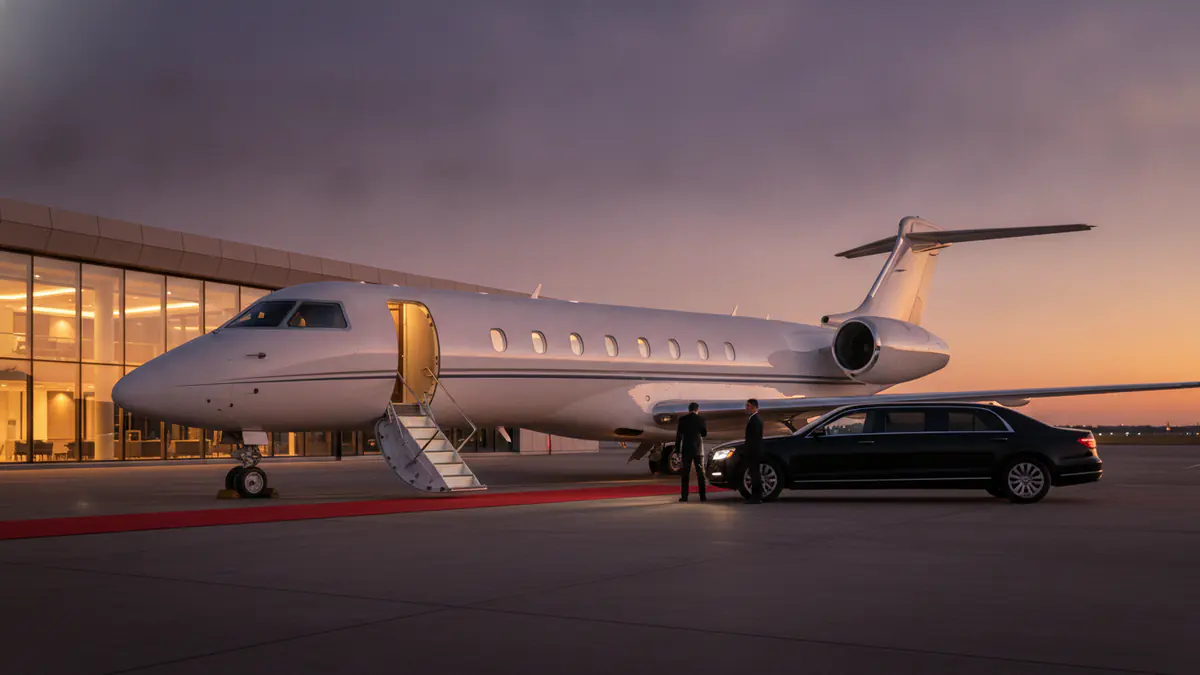
For official visits the arrival itself often has a script: a reception party at the aircraft steps, a red carpet or flags, a motorcade. These are arranged with the airport and the host side, and the aircraft's arrival time has to fit them. That makes timing discipline more important than on a normal trip: an arrival ten minutes early can be as awkward as ten minutes late.
Choosing the cabin for a VIP trip
The service record above lists the categories we usually propose for VIP work. What decides between them is the size of the party, the distance, and how much private space the principal needs on board.
Super midsize jets for small, fast trips
For a principal with one or two companions on a short or medium sector, a super midsize jet offers a quiet cabin and enough range for most domestic and regional trips. The limit is space: a security detail of more than two people, or a need for a separate private area, usually points to something larger.
Heavy and ultra-long-range jets
Heavy jets are the usual choice for an executive VIP jet trip: a stand-up cabin, several seating zones, a galley that can serve proper meals and, on many types, a divan that converts to a bed. An ultra-long-range jet adds the range to cross oceans and continents nonstop, which also reduces the number of foreign airports the party passes through, and often a private stateroom at the rear. For VIP jet charter on long sectors, fewer stops is as much a security benefit as a time saving.
VIP airliners for delegations
A delegation of dozens, or a principal who wants a private office, bedroom and meeting room on board, needs a VIP airliner: a narrowbody or widebody airliner fitted out as a private cabin. Fewer operators hold them, they are based at fewer airports and they need longer runways and larger stands. Availability has to be checked case by case, often weeks ahead. You can see all the categories in our aircraft guide.
A quick sizing guide
| Travelling party | Typical aircraft | What usually decides it |
|---|---|---|
| Principal plus one or two companions | Super midsize jet | Privacy, range for the sector |
| Principal, guests and a small security detail | Heavy jet | Seats for officers, separate cabin zones |
| Long-haul principal with staff | Ultra-long-range jet | Nonstop range, private stateroom, crew rest |
| Official delegation or large entourage | VIP airliner | Seat count, cabin zoning, protocol areas |
| Several groups arriving separately | Two or more aircraft | Arrival order and protocol sequence |
This table is a starting point, not a rule. The operator confirms what fits your list and the runways involved.
Catering, cabin service and protocol on board
On a VIP flight the cabin crew are part of the protocol. Tell the operator in advance who the principal is in the seating plan, who is served first, and any forms of address to use. For delegations from different cultures, dietary rules, alcohol service, prayer times on long sectors and the separation of male and female passengers may all matter; give the operator the details rather than assume they will know.
Catering on business jets is ordered from specialist caterers or restaurants near the departure airport, so almost anything can be arranged with notice. Allergies, religious dietary requirements and preferences should go in writing with the passenger list. For a principal who is sensitive about food security, some clients ask for sealed deliveries, a named caterer or their own staff to supervise preparation; raise it early, because not every airport allows outside suppliers airside.
Gifts, diplomatic bags and official documents also need planning. Anything unusual in the hold, including high-value items and large quantities of gifts, should be declared to the operator and, where relevant, to customs at the destination.
Crew vetting: questions to ask the operator
The crew on a VIP flight will see the passengers at close quarters for hours. Operators are responsible for their crews, but it is reasonable to ask how they select and brief them. Useful questions include:
- Experience on type and on VIP work. How long have the captain and first officer flown this aircraft type, and has the crew flown sensitive or high-profile trips before?
- Background checks. What employment and background checks does the operator carry out, and are they renewed?
- Confidentiality. Are crew bound by confidentiality terms in their contracts, and will they sign your NDA if you ask?
- Cabin crew. Is a trained flight attendant included, and what are their language skills and experience with protocol?
- Continuity. Can the same crew operate all legs of a multi-day trip, and what happens if a crew member becomes unavailable?
- Phones and social media. What is the operator's policy on crew photographs and social media during and after the trip?
We put these questions to the operator on your behalf and pass on the answers in writing. We cannot vouch for individuals ourselves, but we can make sure the operator has answered clearly before you book.
Checking that the operator is legal
Every flight we arrange is operated by an operator that holds the air operator certificate needed for commercial passenger flights, for example under FAA Part 135 in the United States or an AOC issued by a national authority in Europe or the UK. The UK Civil Aviation Authority's guidance on making sure a flight is legal explains why this matters: an illegal charter can leave passengers uninsured. For VIP trips the reputational risk of an unlicensed flight is at least as serious as the financial one.
How VIP charter is priced
A VIP trip is priced like any other charter: flying time for the aircraft, positioning to reach you and return to base, landing, handling and parking fees, crew overnight costs, catering and taxes. Aircraft size is the largest single factor, so the cabin choice above drives most of the cost. VIP requirements add their own items: hangar space for private boarding, closure of an FBO lounge, after-hours customs, airside vehicle access, extra cabin crew, special catering and the time spent on permits. Each of these is quoted separately so you can see what the discretion costs.
Our private jet cost guide explains how estimates are built and shows indicative figures by category; treat them as estimates, not quotes. Empty legs rarely suit VIP work, because the aircraft, timing and handling are fixed by someone else's trip, but they can occasionally work for a flexible leg without security or protocol needs. For real numbers, use the quote form beside this page.
Related charter services
A few services often combine with a VIP trip. Our private jet with chauffeur service covers ground transport from the aircraft door. Private jet and yacht trips join a flight to a yacht embarkation. Artists and touring productions are covered by entertainment private jet charter, and athletes by sports team private jet charter. Where a trip must happen within hours, see last-minute private jet; where a traveller needs medical support, see medical private jet charter. If the principal travels with a dog, the pet-friendly private jet guide explains the rules.
Questions about VIP private jet charter
Can the booking be confidential?
Yes, within the law. Passenger details are shared only with the operator, the handling agents and the authorities that require them, and confidentiality terms can be agreed in writing with the operator and handling agents before booking.
Can we avoid the public terminal completely?
At most airports that handle business aviation, yes: passengers use a private terminal or FBO, and at some airports cars can drive to the aircraft. Where customs are only available in a public terminal, we look for an escorted route or a nearby airport with better facilities.
Can security staff travel armed?
Only where the laws of every country involved, the airports and the operator's policy allow it, with permits arranged beforehand. Many operators decline. We check this per trip at the quote stage.
How far ahead should we book a VIP trip?
A simple trip can be arranged in days. Trips that need VIP airliners, diplomatic clearances, airside vehicle approvals or armed protection permits need much longer, often weeks, so share the plan as early as you can, even if details are still moving.
Do you provide the security team or the aircraft?
Neither. We are a broker: licensed operators fly the aircraft, and security teams are provided by the client or a specialist firm the client chooses. We coordinate the operator, the handling agents and the ground arrangements so that everything fits together.
To start planning a VIP private jet charter, send the itinerary, party size and any security or protocol needs through the quote form, or return to the JetPriceCheck homepage to explore other services.
Questions
Can the booking be confidential?
Yes. Passenger details are shared only with the operator, the handling agents and the authorities that require them, and confidentiality terms can be agreed in writing.
Can security staff travel armed?
Only where the laws of every country involved and the operator's policy allow it, with permits arranged beforehand. We check this per trip.