Region
Private jet charter in Asia
10 airports in Asia are in our dataset.
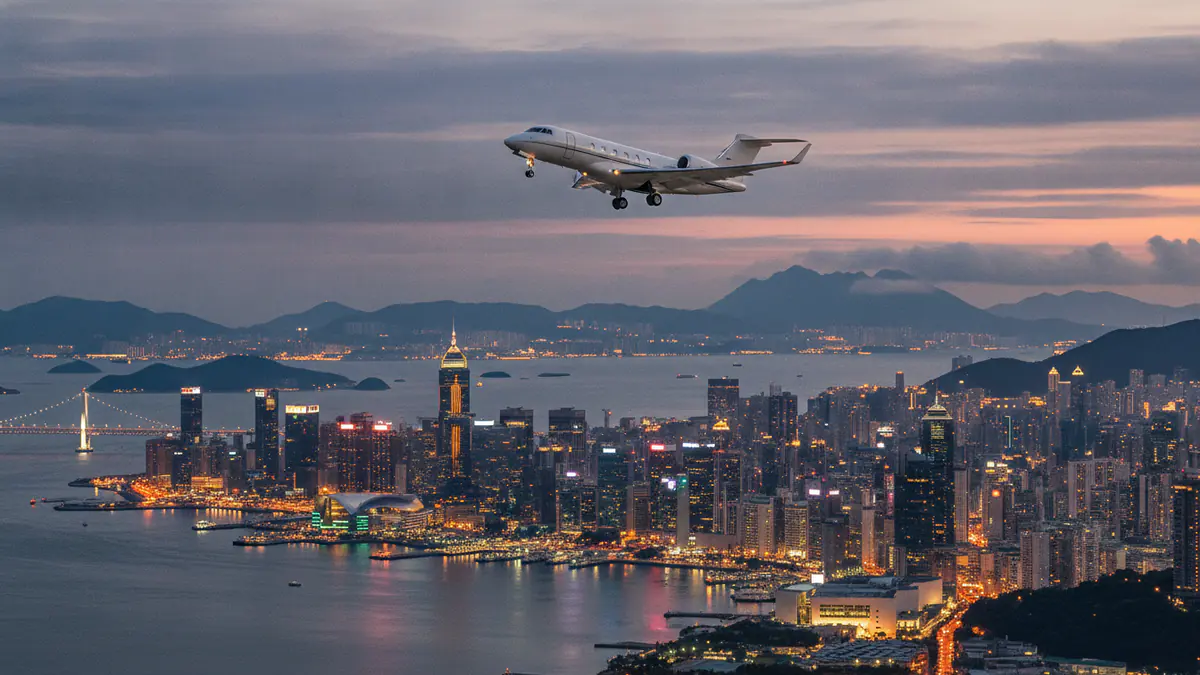
- Airports
- 10
- 1 business-aviation only
- Routes covered
- 4
- Cities
- 7
Airports for private jets in Asia
| Airport | Codes | Type | Runway | From centre |
|---|---|---|---|---|
| Velana International Airport | VRMM / MLE | Mixed | 11,155 ft | 2036 nm |
| Singapore Changi Airport | WSSS / SIN | Commercial hub | 13,123 ft | 765 nm |
| Seletar Airport | WSSL / XSP | Business aviation | 6,023 ft | 763 nm |
| Chhatrapati Shivaji Maharaj International Airport | VABB / BOM | Commercial hub | 11,511 ft | 1958 nm |
| Hong Kong International Airport | VHHH / HKG | Commercial hub | 12,467 ft | 661 nm |
| Don Mueang International Airport | VTBD / DMK | Mixed | 12,139 ft | 343 nm |
| Suvarnabhumi Airport | VTBS / BKK | Commercial hub | 13,123 ft | 335 nm |
| I Gusti Ngurah Rai International Airport | WADD / DPS | Commercial hub | 9,790 ft | 1452 nm |
| Haneda Airport | RJTT / HND | Commercial hub | 11,024 ft | 2217 nm |
| Narita International Airport | RJAA / NRT | Commercial hub | 13,123 ft | 2249 nm |
Distances are straight-line. Drive times are shown only once verified from a routing source.
Popular routes from Asia
| Route | Distance | Time | From |
|---|---|---|---|
| Singapore to Bali | 903 nm | 3 h 45 min | US$12,000 |
| Singapore to Hong Kong | 1,385 nm | 5 h 30 min | US$17,500 |
| Tokyo to Singapore | 2,862 nm | 7 h | US$67,000 |
| Hong Kong to Sydney | 3,993 nm | 9 h 25 min | US$128,000 |
Estimate Lowest one-way estimate for the smallest aircraft category that can fly the route nonstop.
Empty legs from Asia
No live empty legs are connected for this search yet. Empty legs appear here only from real operator inventory; we never show made-up availability. A specialist can still check one-way opportunities for your dates.
Private jet charter Asia: big distances, busy hubs, strict rules
Private jet charter Asia trips cover the widest range of any region we serve. A two-hour hop from Singapore to Bali and a ten-hour flight from Tokyo to Mumbai are both "flights in Asia", but they need different aircraft, different paperwork and very different budgets. Add some of the world's busiest airports, strict slot and permit systems, island resorts reached by seaplane, and a mix of business and holiday travel, and planning matters more here than almost anywhere else.
This page explains how private flying works across the Asian cities in our network: which airports suit private aircraft, the corridors we cover, how permits and slots affect a plan, which aircraft fit which distance, and what drives the price. The tables above list the airports and example estimates; this text gives you the context to read them.
We are a charter broker. We do not own or operate aircraft. We ask licensed operators what they can fly, compare the options with you, and stay with the trip until you land. The JetPriceCheck homepage explains our process.
The Asian cities we cover
Singapore
Singapore is Southeast Asia's main business aviation centre. Private flights have a choice of two airports: Changi, the international airline hub, and Seletar, the city's business and general aviation airport. According to the airport, Seletar has a dedicated Business Aviation Centre with its own immigration and security screening. Our Singapore hub and Seletar airport guide cover both airports in detail.
Hong Kong
Hong Kong is the region's financial capital and a key link to mainland China. Private flights use Hong Kong International Airport, which is one of the world's busiest airports and has a separate business aviation facility. Slots and aircraft parking can be tight. See the Hong Kong hub and our Hong Kong International airport guide.
Tokyo
Tokyo has two main airports. Haneda is much closer to the city centre, while Narita, further east, often has more flexibility for business aviation. Which one your flight uses depends on slot availability and timing. The Tokyo hub explains the choice.
Bangkok
Bangkok also has two airports. Suvarnabhumi is the main international hub; Don Mueang, the older airport to the north, is widely used for business aviation. See the Bangkok hub and our Don Mueang airport guide.
Mumbai
Mumbai is India's financial centre and a busy, slot-constrained airport. Private flights link it with the Gulf, Southeast Asia and other Indian cities. See the Mumbai hub.
Bali
Bali is a holiday destination first. Private flights use Ngurah Rai International, the island's main airport, near Denpasar. Parking for private aircraft can be limited in peak holiday periods, so operators sometimes drop passengers and reposition. See the Bali hub.
The Maldives
Malé's Velana International Airport is the gateway to the Maldives. Most resorts sit on separate islands, so the last stage is usually a seaplane, a domestic flight or a speedboat. We coordinate the jet arrival with the resort transfer. Our Dubai to Malé route covers one of the most popular ways in.
Corridors we cover in and around Asia
Our route pages cover the corridors with the most demand in our data:
- Tokyo–Singapore: a long business corridor between two financial capitals.
- Singapore–Hong Kong: the core Southeast Asia–Greater China link.
- Singapore to Bali: a short leisure hop.
- Hong Kong–Sydney: a long flight south to Australia.
- Dubai–Singapore, Dubai–Mumbai and Dubai–Malé: Gulf links to Asia and the Indian Ocean.
Each page covers flight times, the aircraft that can fly the route nonstop, estimate ranges and the airports at each end.
How far things are: example trips from Singapore
Singapore is central to much of the region, so it makes a useful reference point. These examples come from our pricing model.
| Example trip from Singapore | Smallest nonstop category (our model) | Estimated flight time | One-way estimate (USD) |
|---|---|---|---|
| Hong Kong | Turboprop | 5 h 30 min | 17,500–31,000 |
| Mumbai | Midsize jet | 5 h 30 min | 40,000–62,000 |
| Tokyo | Super midsize jet | 7 h | 67,000–95,000 |
| Dubai | Super midsize jet | 7 h 40 min | 73,000–104,000 |
| Abu Dhabi | Super midsize jet | 7 h 40 min | 74,000–104,000 |
| Melbourne | Heavy jet | 7 h 50 min | 106,000–162,000 |
These are estimates from our pricing model, which uses published market rates; they are not quotes. Melbourne and Abu Dhabi have no route page of their own.
Two points stand out. First, even "regional" trips in Asia are long: five to eight hours is common. Second, many routes cross open sea. Singapore to Hong Kong runs over the South China Sea; our model shows a turboprop can fly it nonstop, but for over-water sectors operators carry extra fuel reserves, and most travellers and operators choose a jet for a flight of this length. Each trip is checked by the operator against the aircraft, the load and the winds.
Permits, slots and cabotage
Asia has some of the most tightly regulated airspace and airports for private flying. Three rules shape most plans.
Permits. Many Asian countries require a landing permit for private or charter flights, especially for foreign-registered aircraft. Singapore's regulator, the Civil Aviation Authority of Singapore, requires permit and slot approval for non-scheduled charter flights by foreign operators. Lead times differ by country, and some are measured in days rather than hours.
Slots and parking. Hong Kong, Tokyo, Mumbai and other major hubs are busy with airline traffic. Private flights need a slot to land and take off, and aircraft parking can be limited. An aircraft may drop you off, fly to another airport to park, and return to collect you.
Cabotage. In general, a foreign-registered aircraft cannot carry passengers on a purely domestic flight within another country. A trip from Tokyo to Osaka, or between two cities in India, may need a locally registered aircraft. The rules vary, and the operator checks each case.
These rules are why short-notice trips in Asia need more planning than in the United States or Europe. Tell us early, and share every passenger's nationality so we can flag visa questions. Our guide to security and passports on private flights covers the general principles.
Choosing the aircraft for Asia
- Light jets suit short hops, such as Singapore to Bali or Kuala Lumpur, but their range limits them on most regional trips.
- Midsize and super midsize jets cover much of the region nonstop: Singapore to Mumbai or Tokyo in our model. They are often the most cost-effective choice for trips of five to eight hours.
- Heavy jets handle the longer sectors, including Southeast Asia to Australia, with more cabin space for sleeping.
- Ultra long range jets connect Asia nonstop with Europe and North America.
Long flights make the cabin important. Our private jet sizes guide explains the categories, the interior guide shows the cabins, and the aircraft section compares individual models.
Seasons and weather
Asia's climate is shaped by monsoons and typhoons rather than a single summer and winter.
- Southeast Asia has wet and dry seasons that differ between countries and even coasts. Heavy tropical storms can delay flights and affect island airports.
- The Western Pacific, including Hong Kong, Taiwan and Japan, is exposed to typhoons, mainly in the summer and early autumn. Airports can close for a day or more.
- The Maldives and Bali have their own high seasons, with peak demand around the year-end holidays.
- Business travel peaks around conferences, financial events and the start and end of the working year, and slows around Lunar New Year in much of East Asia.
In storm season, keep some slack in your schedule. We watch the forecast with the operator and suggest changes early rather than on the day.
Who flies privately in Asia
- Executives and investors moving between Singapore, Hong Kong, Tokyo, Mumbai and the Gulf. See corporate jet charter.
- Families and groups heading to Bali, Phuket, the Maldives and other islands. See group private jet charter.
- Touring artists and teams moving between Asian cities on tight schedules. See our entertainment charter and sports team charter services.
- High-profile travellers needing discretion. See VIP private jet charter.
- Yacht guests joining a charter in Southeast Asia or the Indian Ocean. Our private jet and yacht service coordinates the flight with the boat.
What drives the price of a private jet in Asia
- Aircraft category, the largest factor.
- Positioning. Asia has a smaller charter fleet per traveller than the United States or Europe. The right aircraft may need to fly in from another country, and home again after a one-way trip.
- Permits, slots and handling. Fees at major hubs are high, and parking at a secondary airport adds positioning flights.
- Crew and time away. Multi-day trips add accommodation and daily costs.
- Season. Holiday peaks and big events reduce availability.
Our private jet cost guide explains typical costs by category and flight time, and our methodology explains how the estimates are built. Flexible travellers can check the empty legs page.
How we plan a trip in Asia
- You share the trip: each leg, dates and the times that matter, passengers and nationalities, luggage and any resort or yacht transfer.
- We check with operators which aircraft suit each leg, and the permits, slots and parking at each airport.
- You compare options side by side, such as a nonstop heavy jet against a smaller jet with a stop.
- You confirm, and the operator flies. We stay with the trip and manage changes, including weather.
Planning checklist for private flights in Asia
- Start with the permits. Ask for options as soon as the dates are firm, especially for trips that cross several countries.
- Confirm which airport at each end. Seletar or Changi, Haneda or Narita, Don Mueang or Suvarnabhumi: the right choice depends on the aircraft, the slot and where you are staying.
- Check for domestic legs. If the trip includes a flight inside one country, ask whether a locally registered aircraft is needed.
- Plan around the weather. In typhoon and monsoon seasons, leave a spare day before an important meeting or connection.
- Share nationalities early. Visa and entry rules vary widely across the region, and a multi-country trip may involve several.
- Coordinate the last mile. Island resorts, yachts and remote hotels need a transfer timed to the jet's arrival; our private jet with chauffeur service covers the ground side in cities.
- Ask about a stop on long flights. A super midsize jet with one planned fuel stop can cost much less than a heavy or ultra long range jet flying nonstop.
Private jet charter Asia: frequently asked questions
How much does it cost to charter a private jet in Asia?
It depends on the aircraft and distance. Our model estimates Singapore to Tokyo at about USD 67,000 to 95,000 one way in a super midsize jet, and Singapore to Mumbai at about USD 40,000 to 62,000 in a midsize jet. These are estimates, not quotes.
Which airports do private jets use in Singapore and Bangkok?
In Singapore, Seletar is the business aviation airport and Changi the airline hub; both handle private flights. In Bangkok, Don Mueang is widely used for business aviation, with Suvarnabhumi as the main international hub.
How far in advance should I book a private jet in Asia?
As early as possible for international trips, because landing permits and slots can take days to arrange. Short-notice flights are possible, but options narrow. Our last-minute private jet page explains what is realistic.
Can I fly a private jet between two cities in the same Asian country?
Often yes, but cabotage rules usually require a locally registered aircraft for a purely domestic flight. The operator checks the rules for each country.
How do I reach a Maldives resort by private jet?
Fly into Velana International at Malé, then transfer to your resort by seaplane, domestic flight or boat. We coordinate the timing with the resort.