Service
Private jet and yacht charter
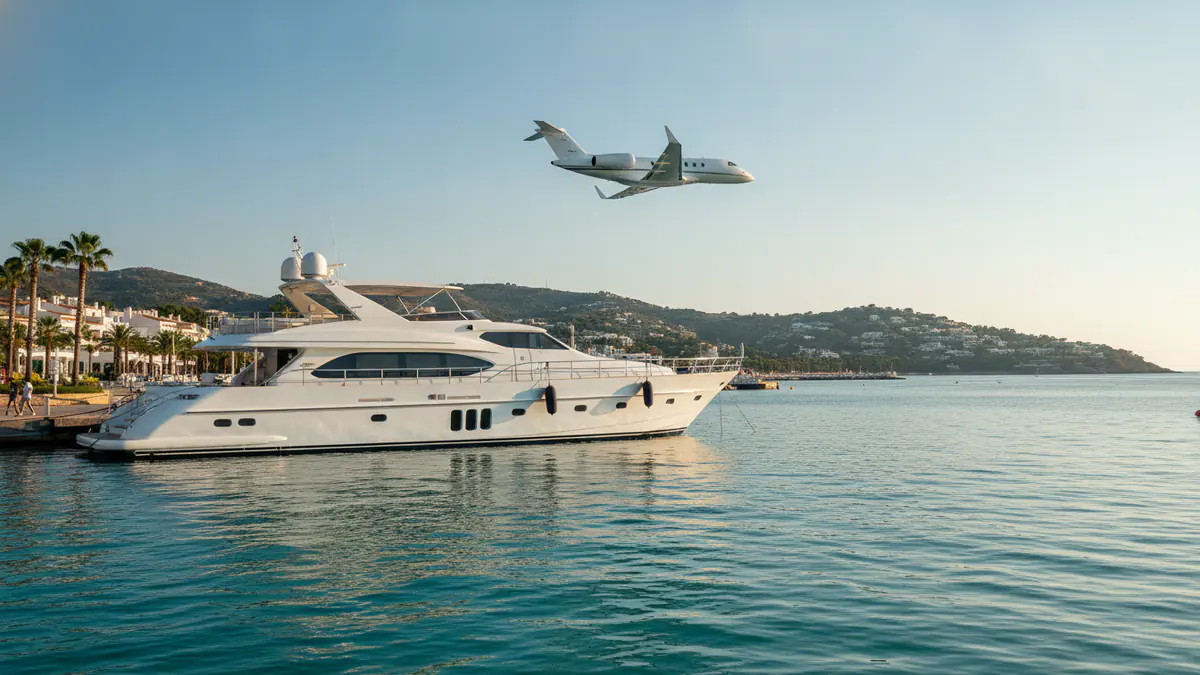
Fly private to the marina: flights timed to a yacht charter's embarkation and disembarkation, to airports close to the harbour in the Mediterranean, the Caribbean and beyond.
Who it's for
- Yacht charter guests joining in the Riviera, Sardinia, the Balearics or the Caribbean
- Owners and guests changing over mid-season
- Groups flying in together for a week on board
How it works
- 1. Tell us the embarkation and disembarkation ports and dates, and how many guests are flying.
- 2. We match airports close to the marina and quote the flights with licensed operators; the yacht itself is chartered through a yacht broker.
- 3. Flights and transfers are timed to the yacht's schedule, including a car or helicopter to the quay where one is available.
Aircraft that suit it
| Category | Passengers | Longest range in dataset | Per flight hour |
|---|---|---|---|
| Light Jets | 4–7 | 2,040 nm | US$3,500–US$5,000 |
| Midsize Jets | 6–9 | 2,700 nm | US$4,500–US$7,000 |
| Super Midsize Jets | 8–9 | 4,018 nm | US$6,000–US$8,500 |
| Heavy Jets | 10–14 | 5,300 nm | US$8,500–US$13,000 |
Estimate Hourly figures from pricing model market-2026-09. Method.
Worth knowing
- Yachts often embark on Saturdays, so peak-season weekend slots at airports such as Nice, Olbia or Ibiza go early.
- Soft luggage fits both aircraft holds and yacht storage far better than hard cases.
- We arrange the flights; the yacht charter is contracted separately with a yacht broker or the yacht's management company.
Private jet yacht charter: flights built around the boat
Private jet yacht charter means planning the flight around the yacht, not the other way round. A week on board has fixed edges: the yacht is ready for guests at a set time on embarkation day, and it needs its guests off at a set time on the last morning so the crew can turn it round for the next charter. Scheduled flights rarely line up with either edge. A private jet can: it leaves when your group is ready, lands at the airport closest to the marina, and puts you on the quay with your bags while the crew is still laying out the welcome drinks.
We are a charter broker. We do not own aircraft and we do not own or operate yachts. We arrange the flights with licensed operators, match the airport to the harbour, and time the ground or helicopter transfer to the yacht's schedule. The yacht itself is chartered separately, through a yacht broker or the yacht's management company, usually under a standard charter contract such as the one published by MYBA, the Worldwide Yachting Association. You can read more about how we work on the JetPriceCheck homepage.
The sections above cover the service in short. This guide goes further: how embarkation day actually runs, which airports serve which cruising grounds, where runways limit the aircraft, how borders work when a yacht crosses them, and how to keep the flight cost in proportion to the week on board.
Who books a private jet and yacht trip
Charter guests joining for a week
The typical private jet and yacht trip is a group of family or friends flying in for a week in the western Mediterranean in July or August. The yacht is booked months ahead; the flights are often booked last, which is exactly when the popular weekend slots at the smaller airports have gone. The earlier the flight is planned after the yacht contract is signed, the more choice there is.
Owners and guests changing over mid-season
Owners who keep a yacht in the Mediterranean for the summer often host several groups in turn. Each changeover is a small logistics exercise: one group flies out from the nearest airport as the next flies in, sometimes on the same aircraft. A single aircraft that drops the new group and collects the departing one is often the most efficient way to run it.
Groups flying in together
Larger yachts carry up to a dozen guests, and some groups are bigger still, split across two yachts. When everyone travels together, the aircraft choice is driven by seats and luggage at the same time. For big parties see our notes on group private jet charter; the principles are the same, with the added constraint of the yacht's timetable.
How embarkation day works on a private jet yacht charter
The Saturday changeover
In the Mediterranean most weekly charters start and end on a Saturday, although many yachts are flexible outside peak weeks. That single fact shapes the whole trip. On a peak Saturday in July or August, hundreds of yachts turn around in the same harbours at the same time, and their guests all want to fly in and out of the same handful of airports. Business aviation parking, slots and handling at airports such as Nice, Olbia and Ibiza fill early, and helicopters and cars to the quay are booked well ahead.
If the yacht contract allows it, a Sunday or Friday start can make every part of the travel easier. If it does not, book the flight as soon as the yacht is confirmed.
Embarkation and disembarkation times
Yacht charter contracts set a time for guests to board and a time to leave, commonly around midday for boarding and mid-morning for leaving, but the exact times are in your contract. Plan the flight to land with enough margin for the transfer and a delay, and plan the return flight to leave after you have left the yacht, with time to settle the final accounts with the captain. We ask for both times, plus the port or anchorage, before we look for aircraft.
Joining away from the base port
A yacht does not have to start where it is based. If the itinerary begins somewhere else, the yacht may charge a delivery fee to reposition, and your flight may change too. It is worth checking both before agreeing an itinerary: sometimes a start port with a closer airport saves more in flying time than the delivery costs.
Airports close to the main yacht harbours
The table below matches the main cruising grounds to the airports usually used for private flights. The right choice depends on the aircraft, the date and the exact marina.
| Cruising ground | Typical embarkation ports | Airports usually used | Transfer to the quay |
|---|---|---|---|
| French Riviera and Monaco | Monaco, Antibes, Cannes, Saint-Tropez | Nice Côte d'Azur; Cannes-Mandelieu for smaller aircraft | Car, or helicopter to Monaco and Saint-Tropez |
| Sardinia and Corsica | Porto Cervo, Olbia, Bonifacio | Olbia Costa Smeralda; Figari for southern Corsica | Car; short drives to the Costa Smeralda marinas |
| Balearics | Palma, Port Adriano, Ibiza, Formentera | Palma de Mallorca; Ibiza | Car; boat or helicopter to Formentera |
| Amalfi Coast and Capri | Naples, Sorrento, Amalfi | Naples | Car, fast boat or helicopter |
| Croatia | Split, Dubrovnik, Hvar | Split; Dubrovnik | Car or boat to the islands |
| Montenegro | Porto Montenegro (Tivat), Kotor | Tivat; Dubrovnik for larger aircraft | Car |
| Greece | Athens marinas, Mykonos, the Cyclades | Athens; Mykonos for smaller aircraft | Car in Athens; boat between islands |
| Leeward Islands | Sint Maarten, Antigua, St Barths | Sint Maarten (Princess Juliana); Antigua (V. C. Bird) | Car; short turboprop hop or boat to St Barths |
The French Riviera and Monaco
Nice Côte d'Azur is the main airport for the Riviera and handles every size of business jet. From Nice, Antibes and Cannes are a drive, and Monaco is a drive or a helicopter flight of a few minutes to the Monaco heliport; Monaco has no airport of its own. Cannes-Mandelieu is closer to Cannes but is limited to smaller jets and turboprops and has noise and operating-hour restrictions, so it suits a light jet or a midsize jet rather than a large-cabin aircraft. Saint-Tropez is usually reached by helicopter from Nice or by car.
Sardinia and Corsica
Olbia serves the Costa Smeralda and Porto Cervo and becomes very busy with private traffic on summer weekends. Figari serves southern Corsica and Bonifacio, and suits itineraries that cross the Strait of Bonifacio between Corsica and Sardinia.
The Balearics
Palma de Mallorca is the Balearics' main hub for yachts, with several large marinas close to the airport. Ibiza is the gateway for Ibiza and Formentera; Formentera has no airport, so guests finish the trip by boat or helicopter, or the yacht collects them in Ibiza.
The Adriatic: Split, Dubrovnik and Tivat
Croatian charters usually start in Split or Dubrovnik, both of which handle business jets. Tivat, in Montenegro, sits next to Porto Montenegro, one of the region's main superyacht marinas. Its runway and approach between mountains limit the larger aircraft, so some flights use Dubrovnik instead and cross the border by road. The operator decides which airports its aircraft and crew can use.
Greece
Athens serves the marinas around the capital and the Saronic Gulf. Mykonos is closer to the Cyclades but has a shorter runway and limited parking in high summer, so larger jets often land in Athens and guests either join the yacht there or continue on a smaller aircraft.
The Caribbean and the St Barths runway
In the Caribbean, Princess Juliana International on Sint Maarten and V. C. Bird International on Antigua are the usual arrival points for jets from North America and Europe. St Barths is the classic exception. Its Gustaf III Airport has a runway of about 650 metres with a steep approach over a hill, so it accepts only small turboprops and short-take-off aircraft, and pilots need a specific local qualification. A jet cannot fly you there. The usual plan is a jet to Sint Maarten and a short hop by turboprop such as a PC-12, or a ferry or the yacht's own tender, to Gustavia. We plan both legs as one trip so the connection holds.
Choosing the aircraft for a private jet and yacht trip
Seats, range and runway
The group size and the distance usually point to the category. A couple or a family of four flying a short hop within Europe fits a light jet. A family of six to eight flying from northern Europe to the Mediterranean is typically a midsize or super midsize jet. A transatlantic flight to the Caribbean, or a full group of a dozen, points to a heavy jet. Runway length at the destination can override all of that, as at Cannes-Mandelieu, Mykonos, Tivat or St Barths. Our aircraft guide compares the categories side by side.
Soft luggage, twice over
Luggage matters twice on a yacht trip. Small jets have limited hold space, and yachts have limited storage: crew cabins and lockers are designed for soft bags that fold away, not hard cases. Ask every guest to pack soft bags. Hard cases that cannot be folded often end up stored ashore for the week, and on a smaller jet they can be what stops the bags from fitting at all. Tell us about anything bulky early: golf bags, diving equipment, kitesurf kit or a folding bike each change the aircraft calculation.
Pets on board
Some guests travel with a dog, and some yachts accept pets while many do not. Check the yacht first, then read our pet-friendly private jet guide for the entry rules that apply to animals, which differ between EU countries, the UK and Caribbean islands.
Transfers from the private jet to the yacht
By car
Most yacht transfers are a car from the aircraft steps to the marina. On a peak Saturday the coast roads around Nice, Saint-Tropez, Porto Cervo and Palma can be slow, so the transfer time we plan is the realistic Saturday time, not the empty-road one. Where a guest wants a driver for the whole day, our private jet with chauffeur service covers it.
By helicopter
Helicopters shorten the Riviera and a few other coastlines dramatically: Nice to Monaco, Nice to Saint-Tropez, Naples to Capri, or Sint Maarten to St Barths in turboprop form. Some large yachts carry a helideck, but many do not, and landing on a yacht needs the yacht, the helicopter operator and the local rules to agree. The simpler plan is usually a helicopter to the nearest heliport and a car or the yacht's tender for the last stretch.
By tender
When the yacht is anchored rather than berthed, the crew often collects guests by tender from a public quay or a beach club pontoon. Share the tender rendezvous with us and we will time the ground leg to meet it.
Customs, Schengen and private jet yacht charter itineraries
A yacht week can cross a border without anyone noticing, which is why the paperwork deserves a moment before the trip. France, Monaco (through its arrangement with France), Italy, Spain, Greece and Croatia are all part of the Schengen Area, so a Riviera to Sardinia itinerary has no internal passport checks. Montenegro is not in Schengen, so a Croatia and Montenegro itinerary crosses an external border, and so does a yacht that leaves the EU for Albania or Turkey.
Flights follow the same logic. If you fly into Schengen from outside it, for example from London, New York or Dubai, you clear immigration at the first Schengen airport you land at. Non-EU travellers are also registered at the external border by the EU's Entry/Exit System, so allow for that on the first arrival. Within Schengen there is no passport control, but every guest still needs a valid passport or ID card, and the operator will ask for full passport details to file passenger information in advance.
The yacht has its own paperwork. The captain keeps a crew and guest list for port authorities and may need passport details too, particularly when the itinerary crosses a border. Send the same list to both of us at the same time. In the Caribbean, most islands are separate jurisdictions, so a trip that combines Sint Maarten, St Barths and Antigua involves several immigration clearances; the yacht's captain and our operator handle their side of each.
One-way flights, positioning and empty legs
Private jet yacht charter trips are rarely neat returns. You may board in Palma and leave from Ibiza, or join in Split and leave from Dubrovnik. That is fine for private aviation, but it matters for cost. An aircraft that drops you on Saturday and flies home empty, then comes back empty a week later to collect you, charges for those positioning flights. Two one-way bookings with aircraft already nearby, or one aircraft kept for a shorter trip, can each be cheaper depending on the dates. We price the options side by side.
Saturday traffic also creates empty legs: aircraft that have just dropped one yacht group and are flying back empty. They can suit a flexible group, but they depend on a specific aircraft flying a specific route at a specific time and can change at short notice, so they are best treated as a bonus rather than the plan for a fixed embarkation.
What a private jet yacht charter costs
The flight
The flight is priced like any charter: the aircraft's flying time including positioning, landing, handling and parking fees, crew overnight costs if the aircraft waits, catering and taxes. Peak Saturdays in July and August add scarcity, because the aircraft types in demand at Nice, Olbia or Ibiza are all booked by the same kind of client. Our private jet cost guide explains how each factor moves the price, and the quote form beside this page returns real numbers for your dates. Any figure shown before a quote is an estimate, not an offer.
The yacht, and the APA
The yacht is contracted separately. Mediterranean charters are commonly priced on a "plus expenses" basis: a charter fee for the yacht and crew, plus an advance provisioning allowance (APA) paid before boarding. The captain spends the APA on fuel, food and drink, berthing and similar running costs during the week, keeps the receipts, and reconciles it at the end, refunding any balance or asking for a top-up. VAT and a crew gratuity are usually on top. Your yacht broker sets out the exact terms, and we do not quote or collect yacht costs.
Keeping the two contracts separate is deliberate. The yacht broker is responsible for the yacht, and the licensed aircraft operator is responsible for the flight; we act on your behalf in arranging the flight and in timing it to the boat.
How we arrange a private jet and yacht trip
- Send the yacht details. The embarkation and disembarkation ports or anchorages, dates and times, the number of guests flying, and the airports you would like to leave from.
- We match airports and aircraft. We compare the airports near each end of the yacht itinerary against the aircraft that can use them, and ask operators for availability.
- You choose the option. Each option shows the aircraft, the airport, the transfer and the timing against the yacht's schedule.
- We book the transfers. Car, helicopter or tender to the quay, timed to the flight and the yacht.
- We watch the day. If a flight is delayed, we tell the captain and the transfer company so the yacht is ready when you arrive.
Every flight is operated by an operator holding the air operator certificate for commercial passenger flights, for example under FAA Part 135 in the United States or an AOC from the national authority in Europe and the UK. The UK Civil Aviation Authority explains how to check that a flight is legal.
Related charter services
If the week on board follows a business trip, our corporate jet charter service covers the working legs. When a yacht plan is made at short notice, see last-minute private jet for what can be arranged within a day or two. The route directory shows the city pairs we cover, including many routes into the Riviera and the Balearics.
Questions about private jet yacht charter
Which airports are closest to the main yacht harbours?
Nice for Monaco, Antibes, Cannes and Saint-Tropez; Olbia for the Costa Smeralda; Palma and Ibiza for the Balearics; Split, Dubrovnik and Tivat for the Adriatic; Athens and Mykonos for Greece; Sint Maarten and Antigua for the Leeward Islands. Smaller airports such as Cannes-Mandelieu and Mykonos take only some aircraft.
Do you charter the yacht as well?
No. We arrange the flights and the transfers. The yacht is chartered through a yacht broker or the yacht's management company, and we time the flights to its embarkation and disembarkation.
Can a private jet fly directly to St Barths?
No. St Barths' runway is only about 650 metres long and takes small turboprops only. Jets land in Sint Maarten or Antigua, and guests continue by turboprop, ferry or the yacht's tender.
How early should we book the flight?
As soon as the yacht is confirmed. Peak Saturdays in July and August fill parking, slots and helicopter transfers at Nice, Olbia and Ibiza first. Outside the peak, a few weeks' notice is usually enough.
Can the aircraft wait for us during the week?
It can, with daily parking and crew costs. For a week-long charter it is often cheaper to let the aircraft go and book the return separately. We price both.
What should we pack?
Soft bags. They fit small aircraft holds and yacht storage; hard cases often do not. Tell us about golf bags, sports equipment or anything unusual before we choose the aircraft.
To plan your flights, send the yacht's dates and ports through the quote form, or return to the JetPriceCheck homepage to see our other services.
Sources
- MYBA The Worldwide Yachting Association
- Wikipedia: Advance provisioning allowance
- Wikipedia: Gustaf III Airport
- European Commission: Schengen Area
- European Union: Entry/Exit System (EES)
- FAA: 14 CFR Part 135 Air Carrier and Operator Certification
- UK Civil Aviation Authority: Making sure your flight is legal
Questions
Which airports are closest to the main yacht harbours?
On the French Riviera, Nice Côte d'Azur serves Monaco, Antibes and Cannes. Olbia serves the Costa Smeralda, and Ibiza and Palma serve the Balearics. In the Caribbean, St Maarten, Antigua and St Barths are common starting points.
Do you charter the yacht as well?
We arrange the flights. The yacht is chartered through a yacht broker, and we time the flights to the embarkation and disembarkation.