Service
Private jet charter for entertainment
Charter flights for tours, productions and events: artists, bands, crews and equipment moved between cities on a schedule that follows the show, not the airline timetable.
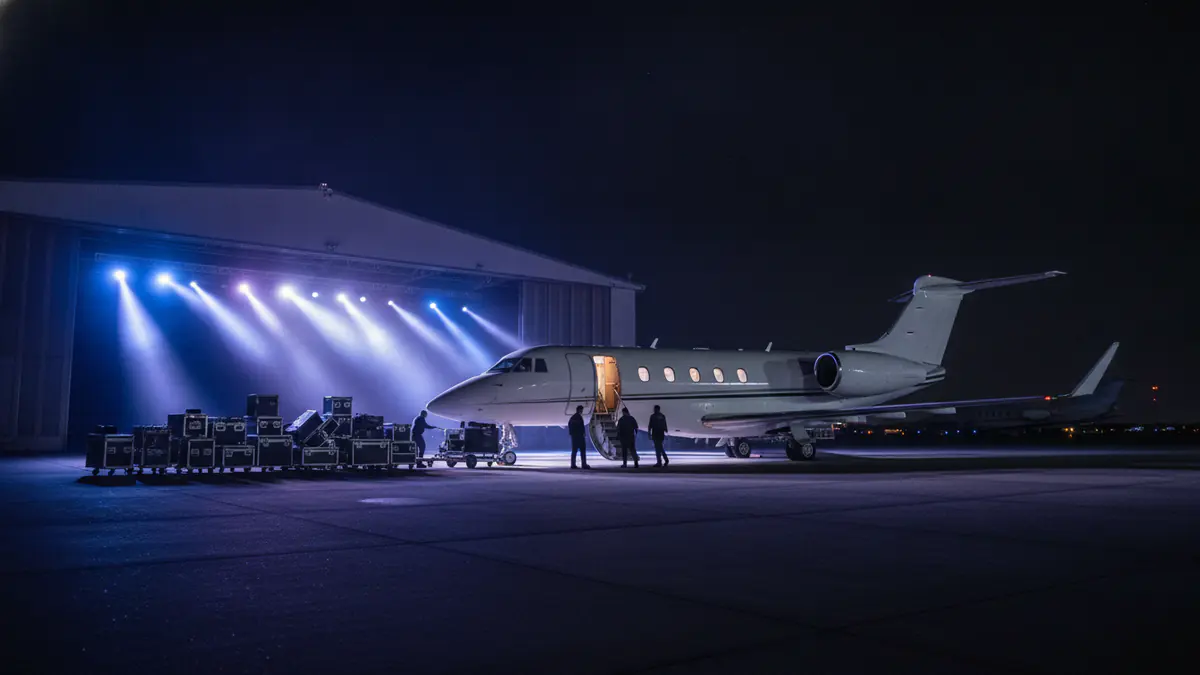
Who it's for
- Touring artists and bands playing several cities a week
- Film and TV productions moving cast and crew between locations
- Sports teams and event organisers
- Management companies booking recurring tour legs
How it works
- 1. Send the tour or production schedule with passenger numbers and equipment.
- 2. We quote each leg or the whole run with licensed operators, sizing aircraft for people and cargo.
- 3. Changes to the schedule are handled through one contact, and each leg is flown by the operator.
Aircraft that suit it
| Category | Passengers | Longest range in dataset | Per flight hour |
|---|---|---|---|
| Midsize Jets | 6–9 | 2,700 nm | US$4,500–US$7,000 |
| Super Midsize Jets | 8–9 | 4,018 nm | US$6,000–US$8,500 |
| Heavy Jets | 10–14 | 5,300 nm | US$8,500–US$13,000 |
| VIP Airliners | 19–50 | — | US$18,000–US$25,000 |
Estimate Hourly figures from pricing model market-2026-09. Method.
Example trips
| Route | Aircraft | Time | One way from |
|---|---|---|---|
| Washington, D.C. to New York | Midsize Jet | 1 h | US$7,000 |
| Palm Beach to New York | Midsize Jet | 2 h 40 min | US$19,000 |
| Los Angeles to Las Vegas | Midsize Jet | 1 h | US$7,000 |
| Toronto to New York | Midsize Jet | 1 h 15 min | US$9,000 |
| San Jose to Los Angeles | Midsize Jet | 1 h 5 min | US$8,000 |
| Boston to New York | Midsize Jet | 55 min | US$7,000 |
| New York to Los Angeles | Midsize Jet | 5 h 35 min | US$40,000 |
| Austin to Dallas | Midsize Jet | 55 min | US$7,000 |
Worth knowing
- Instruments, cases and production kit decide the aircraft as much as the passenger count; send dimensions and weights early.
- Late-night departures after a show need airports that are open, or can open, at that hour.
- Crew duty limits apply on back-to-back show days and can mean a second crew on long runs.
Private jet charter for entertainment: flying on the show's schedule
Private jet charter for entertainment exists because a show's calendar and an airline's timetable almost never agree. A band that finishes its encore at eleven at night, needs to soundcheck in another country the next afternoon and has a dozen cases of guitars and in-ear kit cannot rely on a morning scheduled flight with connections and a baggage belt. A film unit that has to move cast and key crew from one location to another between shooting days cannot lose a whole day to airports. A charter lets the aircraft leave when the work is done, from an airport chosen for the venue, with the people and their essential equipment travelling together.
This page goes beyond the summary above. It explains how tour managers, production coordinators and artist managers plan charter flying: routing a tour, getting out of town after a late show, the crew duty rules that shape back-to-back show days, what to do with backline and production cases, the dangerous goods rules that catch touring parties out, and how film and TV crews use charter between locations. We are a charter broker. We do not own or operate aircraft; we source aircraft from licensed operators, compare options and coordinate every leg on your behalf. You can read more about how we work on the JetPriceCheck homepage.
Who uses entertainment charter, and what each needs
Touring artists and bands
For a touring act the aircraft is a tool for protecting the show. The priorities are rest, reliability and a routine the artist can repeat night after night. On a dense run, a charter can turn a punishing overnight drive or a dawn flight into a short hop after the show, so the artist wakes up in the next city with a full day before doors. Tour private jet charter usually covers the artist, the tour manager, security, key band members and sometimes wardrobe or a personal assistant. The rest of the crew and the main production usually travel by tour bus and truck, which is why the passenger list is often smaller than people expect.
Film and TV productions
Productions charter for different reasons. A unit may need to move principal cast between two locations on consecutive days, fly a second unit to a remote landscape, or get a director and department heads to a scout and back within one day. The passenger list is shaped by the call sheet, and it changes often. Production jet charter works best when the coordinator shares the schedule early and accepts that some legs will be firm while others stay provisional until the shooting order locks.
Promoters, event organisers and management companies
Promoters and event organisers charter to bring performers to one-off shows, festivals, private events and award ceremonies, often on tight windows between other commitments. Management companies book recurring tour legs for several artists across a season. For them, the value is one point of contact who knows the whole run, can re-quote quickly when a date moves and keeps the paperwork consistent from leg to leg.
For sports squads, whose fixtures, kit and medical requirements differ, see our separate private jet charter for sports teams page.
Routing a tour around the aircraft
Hub-and-spoke versus point-to-point
There are two common ways to fly a tour. In a point-to-point pattern, the artist flies from each show city to the next, checking out of a hotel every morning. In a hub-and-spoke pattern, the travelling party stays in one base city and flies out to shows within reach, returning the same night. The second pattern is popular on regional runs because it keeps the artist in one hotel, one gym and one routine for several nights, and it lets the aircraft and crew return to a known airport each night.
The right choice depends on the geography. A cluster of cities within a short flight of each other suits a base. A run that marches across a continent suits point-to-point. Many tours mix both: a base for a regional block, then a longer repositioning flight to the next block. When you send us the itinerary, we map the legs both ways and show which pattern needs fewer positioning flights and fewer crew overnights.
Back-to-back show days
The hardest stretch of any tour is several shows on consecutive nights with travel in between. Each night's departure depends on the show ending on time, the load-out of anything travelling on the aircraft, the drive to the airport and the airport being open. Each morning's rest depends on how late the previous night's flight landed. On a run like this, we plan the whole block together rather than leg by leg, because a late finish on night one changes the crew's available duty time for night two.
When the itinerary changes
Tour and production schedules move: a show is added, a festival slot changes, a shoot overruns. Charter handles changes better than scheduled travel, but every change is a new calculation for the operator, covering aircraft availability, crew duty, airport slots and positioning. The quickest way to absorb changes is to route them through one contact. We take the updated schedule, check it with the operator and come back with what the change affects. For dates added at short notice, our last-minute private jet service covers the gap.
Late departures, curfews and airport hours
Getting out after the encore
Flying out straight after the show is one of the main reasons to charter, and it is where most plans go wrong. Many airports restrict or ban movements at night to limit noise; the general pattern is described in this overview of night flying restrictions. Others are technically open but have no handling agent, customs or fuel on duty after a certain hour unless it is booked in advance, sometimes at extra cost.
For every late departure we check both ends of the leg: whether the departure airport is open or can extend its hours, whether the arrival airport accepts a landing at that time, and whether customs and immigration are available for international legs. If an airport cannot work, we look at a nearby alternative with longer hours, even if the drive from the venue is longer.
Building a buffer for the show running late
Shows run late. Curfews do not move. The plan should include a realistic time from last song to wheels up: the artist leaving the stage, security moving the convoy, the drive, any bags loaded at the aircraft and the passenger checks. We ask for the stage time and the venue-to-airport drive, then agree with the operator a latest departure time that still works for the airport and the crew. If the margin is thin, the fallback might be an overnight stay and an early departure; it is better to agree that option before the tour than to invent it at midnight.
Crew duty limits on a busy run
Why a late show can ground the next morning's flight
Pilots have legal limits on how long they can be on duty and how much rest they need between duty periods. In the United States these rules sit in 14 CFR Part 135, Subpart F; in Europe the equivalent framework is published by EASA under flight time limitations. The details vary by country and operator, but the effect on touring is the same everywhere: a crew that flies the band out at midnight cannot also fly an early-morning leg the next day without the required rest.
Second crews and positioning
On long runs, or when late departures and early starts are stacked together, the operator may put a second crew on the tour, rotate crews in by scheduled flight, or position a fresh crew to meet the aircraft. Each option costs money, but it is usually cheaper than losing a show day. We raise this at the planning stage so it is part of the quote rather than a surprise halfway through the run.
Backline, cases and production kit
Why the case list decides the aircraft
On an entertainment charter the passenger count is rarely the constraint. The equipment is. The service notes above say it plainly: instruments, cases and production kit decide the aircraft as much as the passenger count. A business jet cabin designed for a handful of passengers and their suitcases may be comfortable for eight people, but a hold that takes those eight people's luggage may not take three guitar cases, a pedalboard flight case, a keyboard and a merchandise sample case as well.
What matters is the external dimensions and weight of each case, not a description of the instrument. Long, rigid items such as keyboard cases, bass cases and camera cranes can fail on hold door size even when the total volume looks fine. Send the full list with dimensions and weights early, and the operator can confirm what fits, what goes in the cabin and what the aircraft can carry on that sector once fuel is loaded.
Matching the aircraft to people and cases
| Travelling party | Typical aircraft | What usually decides it |
|---|---|---|
| Artist plus two or three staff, personal bags | Midsize jet | Short regional legs, airport access |
| Artist, tour manager, security and a few band members | Super midsize jet | Seats plus hold volume for instruments |
| Larger band party with in-ear kit and priority cases | Heavy jet | Hold volume, longer range, rest on board |
| Full band and core crew with selected backline | VIP airliner | Seat count and hold volume together |
| Full production: staging, lighting, audio, video | Cargo charter or freight forwarder | Weight and pallet size, not seats |
These are starting points, not rules. Two acts with the same passenger count can need different aircraft because one plays with a laptop and the other carries a drum kit. The operator's weight-and-balance calculation for your actual list is what settles it. You can compare categories in our aircraft guide.
When a cargo charter makes more sense
For most tours, the stage production never goes near a passenger aircraft. It travels by truck, sea freight or, on intercontinental runs, air freight through a specialist forwarder. When the kit must fly and has to arrive at the same time as the artist, a separate cargo charter is often cheaper than upsizing the passenger aircraft. The practical split is usually this: the passenger jet carries people, personal luggage and the essential items the show cannot run without, such as specific instruments, in-ear monitors and playback rigs, while everything else moves separately. Ask us early if you think the tour needs both, so the two schedules are planned together.
Carnets and temporary import
Professional equipment crossing borders temporarily can attract customs duty or deposits unless it travels under the right documents. In participating countries, an ATA Carnet lets professional equipment enter temporarily without paying import duties, provided it leaves again. Carnets are commonly used for musical instruments, audio and lighting gear and camera equipment. The carnet has to match what is actually carried, so the case list you send us and the list on the carnet should be the same document, not two versions. Your freight forwarder or the issuing chamber of commerce can confirm whether one applies to your route.
Dangerous goods on tour and on set
Lithium batteries in cameras, in-ears and effects
Entertainment kit is full of lithium batteries: camera batteries, wireless microphone and in-ear packs, drones, LED fixtures, portable power banks and battery-powered effects. Aviation dangerous goods rules, set out internationally by ICAO and applied through the IATA Dangerous Goods Regulations, limit battery size and quantity and specify how they must be packed. The IATA lithium battery guidance explains the general rule that spare batteries travel in the cabin, protected against short circuit, rather than in the hold. Large camera and lighting batteries above certain ratings may need operator approval, and some cannot fly on a passenger aircraft at all.
Pyrotechnics, gas and effects
Stage pyrotechnics, confetti cannons powered by compressed gas, fog fluids, aerosols and some cleaning products are regulated as dangerous goods. Pyrotechnics in particular usually cannot travel with passengers and move separately under specialist shipping arrangements, or are sourced locally by a licensed effects supplier at each venue. Treat anything that burns, pressurises or explodes as something to discuss with the operator before it is packed.
Declare it early
The operator decides what can travel and how, not the broker and not the tour. The simplest rule is to send a full list of anything unusual, with battery ratings where you have them, well before the first leg. It is far easier to solve a battery or effects question a week ahead than on the apron with a departure slot running out.
Film crews and location moves
Moving cast and key crew between locations
For productions, charter is a scheduling tool. It can move principal cast between two units on the same day, return actors to a studio base overnight, or cut a long road transfer to a remote location down to a short flight. Smaller jets and turboprops can reach shorter runways closer to some locations, though the operator will check runway length, surface and weather for each airfield. Our route directory shows the corridors we cover and the airports typically used at each end.
Camera kit, drones and call sheet changes
Camera packages, lenses and drones are high-value and often battery-heavy, so they need the same case list and dangerous goods check as a band's backline. Drones also raise questions at the destination about local permits to fly them, which sit with the production, not the aircraft operator. Because call sheets change daily, we suggest agreeing with the operator which legs are firm and which are provisional, and what the cut-off is for changing each one.
Privacy and discretion
A large part of celebrity private jet charter is privacy rather than luxury. Charter flights usually depart from a fixed-base operator (FBO) or private terminal rather than the main passenger terminal, which keeps the travelling party away from public areas. Vehicles can often be arranged to meet the aircraft where the airport allows, and our private jet with chauffeur service covers ground transfers at each end.
Discretion also covers information. Passenger names, schedules and destinations are shared only with the people who need them to operate the flight: the operator, handling agents and the border authorities that require passenger data. We can work with confidentiality agreements and with travel names where the operator and the authorities allow, though legal names must still be given for passenger manifests and immigration. For principals who want a fully tailored service, see our VIP private jet charter page.
Borders, visas and work permits
International tours and shoots add paperwork at every border. Operators must send passenger details to the authorities in advance, so we need passport details for everyone on board, and any late change to the travelling party has to be passed on quickly. Visa requirements depend on nationality, and a mixed-nationality band or crew may include people who need a visa where others do not.
Performers and crew working in another country usually need permission to work there, separate from permission to enter. Many countries run specific routes for artists, entertainers and crew; the UK's Creative Worker visa is one example. These rules differ widely and change, so the promoter, production or an immigration adviser should confirm what each traveller needs for each country. A charter flight does not change what a traveller is allowed to do on arrival.
How entertainment charter is priced
Entertainment charter is priced like any other charter. The operator charges for the aircraft's flying time, including positioning flights to reach you and return to base, plus landing, handling and parking fees, crew costs for overnights, catering and taxes. Several factors specific to tours and productions move the price:
- Positioning between blocks. When a tour jumps regions, the aircraft may fly empty to meet the next block, and that time is charged.
- Keeping the aircraft on tour. Holding one aircraft and crew for the whole run adds daily crew and parking costs but removes repeated positioning. Releasing it between blocks does the opposite. We price both.
- Night operations. Out-of-hours handling, customs and airport extensions can add fees.
- Second crews. Stacked late and early legs may need extra crew, as explained above.
- Event demand. When a major festival or event concentrates demand in one region, suitable aircraft become scarce.
We don't publish prices for entertainment charter on this page, because the aircraft, the schedule and the equipment change the answer more than for almost any other trip. Our private jet cost guide explains how charter estimates are built, and any figure we give before a firm quote is an estimate, not a price. Empty legs occasionally suit a small party with flexible timing, but tours rarely have that flexibility. When you are ready for real numbers, send the schedule and the case list through the quote form beside this page.
Operator checks and safety
Every flight we arrange is flown by an operator holding the certificate required for commercial passenger flights, for example under FAA Part 135 in the United States or an air operator certificate issued by the national authority in the UK and Europe. The UK Civil Aviation Authority's guidance on making sure your flight is legal is worth reading for anyone booking flights for other people. For tours we also confirm insurance for the passenger count and the operator's plan if the aircraft becomes unavailable mid-run, because a technical problem the night before a show needs a backup that has been thought about in advance.
Related charter services
Groups that are not touring or filming, such as guests travelling to an event, are covered by group private jet charter. Executives from labels, studios and sponsors who travel separately can use our corporate jet charter service. Artists who tour with a dog can read the pet-friendly private jet guide.
Questions about private jet charter for entertainment
What should we send to get an accurate quote?
The schedule with show or shoot times, the passenger list with nationalities, the case list with dimensions and weights, and anything unusual such as large batteries or effects. The more of this we have at the start, the fewer surprises there are later.
Can one aircraft stay with us for the whole tour?
Yes, operators can dedicate an aircraft and crew to a tour for a set period. Whether that beats booking leg by leg depends on the gaps between shows and the distance between blocks. We price both approaches so you can compare.
Can we bring our instruments in the cabin?
Often, for smaller instruments, if there are spare seats and the operator agrees. Larger cases go in the hold, and some will not fit any business jet door. Send the dimensions and the operator will confirm.
Can we carry pyrotechnics or stage effects?
Usually not with passengers. Pyrotechnics and pressurised effects are dangerous goods and normally move separately through specialist shipping, or are supplied locally at each venue.
Do you own the aircraft?
No. We are a broker: we arrange flights with licensed operators and act on your behalf when comparing and booking them. The operator is responsible for flying the aircraft.
To start planning, send the tour or production schedule through the quote form, or return to the JetPriceCheck homepage to explore other services.
Sources
- FAA: 14 CFR Part 135 Air Carrier and Operator Certification
- eCFR: 14 CFR Part 135 Subpart F – Flight Crewmember Flight Time Limitations and Rest Requirements
- EASA: Flight time limitations
- UK Civil Aviation Authority: Making sure your flight is legal
- IATA: Dangerous Goods Regulations (DGR)
- IATA: Lithium batteries
- ATA Carnet (Wikipedia)
- Night flying restrictions (Wikipedia)
- GOV.UK: Temporary Work – Creative Worker visa
Questions
Can the aircraft carry our equipment?
Heavy jets and VIP airliners have the largest holds. For large production loads a separate cargo charter is often cheaper. Send us the case list and we'll check it against the aircraft options.
Can we fly straight after the show?
Usually, if the departure airport is open late or can extend its hours. We check airport hours and the crew's duty time for each leg.