Service
Private jet with chauffeur
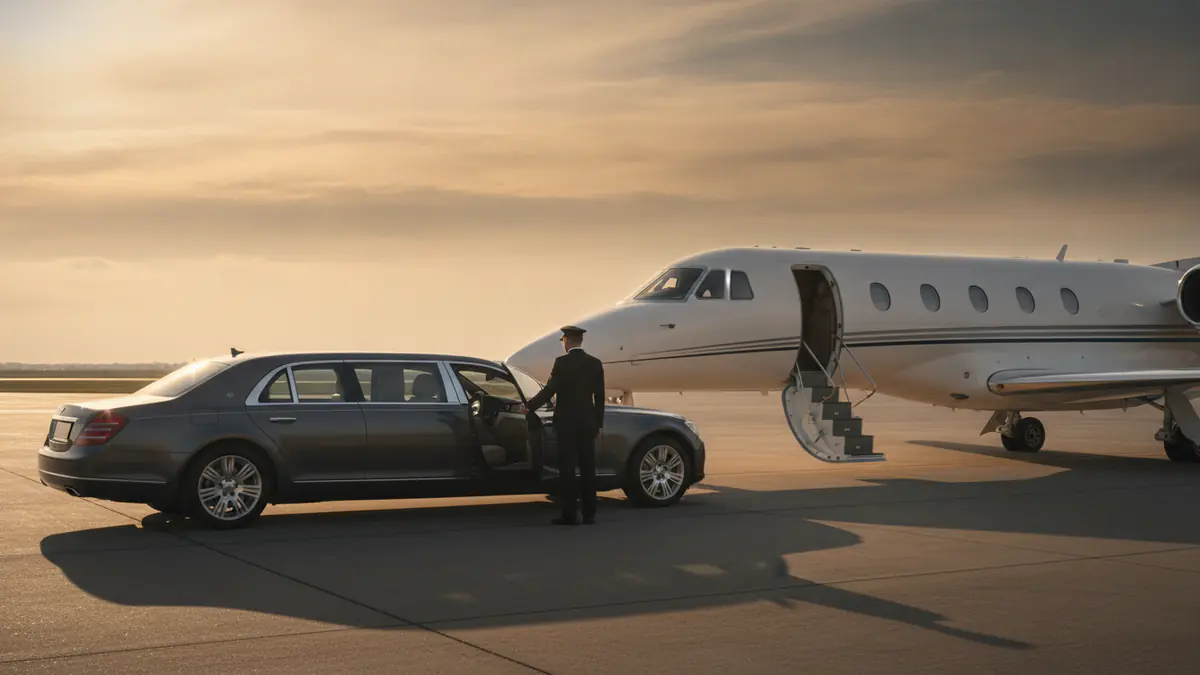
A private flight with the ground legs arranged too: a chauffeured car from your door to the aircraft, and another waiting planeside or at the terminal when you land.
Who it's for
- Travellers who want one booking for door-to-door travel
- Executives heading straight from the aircraft to a meeting
- Families travelling with luggage, children or pets
- Arrivals in cities they don't know
How it works
- 1. Tell us the flight and the pick-up and drop-off addresses at both ends.
- 2. We quote the flight with licensed operators and book the car through a chauffeur company at each end.
- 3. On the day, the car meets you at the door and at the aircraft or the FBO; timings follow the flight if it moves.
Aircraft that suit it
| Category | Passengers | Longest range in dataset | Per flight hour |
|---|---|---|---|
| Light Jets | 4–7 | 2,040 nm | US$3,500–US$5,000 |
| Midsize Jets | 6–9 | 2,700 nm | US$4,500–US$7,000 |
| Super Midsize Jets | 8–9 | 4,018 nm | US$6,000–US$8,500 |
| Heavy Jets | 10–14 | 5,300 nm | US$8,500–US$13,000 |
Estimate Hourly figures from pricing model market-2026-09. Method.
Example trips
| Route | Aircraft | Time | One way from |
|---|---|---|---|
| Washington, D.C. to New York | Light Jet | 1 h | US$5,500 |
| Palm Beach to New York | Light Jet | 2 h 45 min | US$15,500 |
| Los Angeles to Las Vegas | Light Jet | 1 h | US$5,500 |
| Toronto to New York | Light Jet | 1 h 15 min | US$7,000 |
| San Jose to Los Angeles | Light Jet | 1 h 10 min | US$6,500 |
| Boston to New York | Light Jet | 55 min | US$5,500 |
| New York to Los Angeles | Midsize Jet | 5 h 35 min | US$40,000 |
| Austin to Dallas | Light Jet | 55 min | US$5,500 |
Worth knowing
- Planeside pick-up depends on the airport and the FBO; some airports only allow cars at the terminal kerb.
- Chauffeur services are provided by local car companies, not by the operator or by us.
- Drive times to smaller business aviation airports are often shorter than to the main airline airport, which can decide which airport to use.
Private jet with chauffeur: the whole journey, not just the flight
A private jet with chauffeur means the trip starts at your front door and ends at the door you are going to, with nobody waiting on a taxi rank in between. The flight is the part people picture, but on a short or medium sector the ground legs often take as long as the time in the air. A car that is late at the villa, a driver who goes to the airline terminal instead of the private one, or a vehicle too small for the luggage can undo most of the time a charter was meant to save.
The summary above covers the basics of the service. This page goes further: how door-to-door timing is planned, when a car can actually drive up to the aircraft, what happens at customs, how luggage decides the vehicle, how delays are handled and how to check that the car company at each end is properly licensed. We are a charter broker. We do not own aircraft or cars. We arrange the flight with licensed operators and book the car at each end through a licensed local chauffeur company, then keep both in step on the day. You can read more about how we work on the JetPriceCheck homepage.
Why the ground legs matter as much as the flight
Private aviation sells time. You avoid the check-in queue, the security line and the gate, and you board a few minutes after arriving. But that saving only reaches you if the car delivers you to the right building at the right moment, and if another car is ready when you land.
Think of a door-to-door private jet journey as five legs:
- Home or office to the departure airport. The longest ground leg is often this one, and it is the one most affected by traffic.
- Kerb or ramp to the aircraft. A few minutes at a private terminal, or no walk at all where the car can go to the aircraft.
- The flight.
- Aircraft to the car at the other end. This includes any customs and immigration check on an international arrival.
- Arrival airport to the final address. Usually in a city you know less well, which is where a waiting driver helps most.
A jet charter chauffeur booking joins legs 1, 2, 4 and 5 to the flight, so the timings are planned together rather than by three different people. If the departure slips by forty minutes, both drivers need to know. If the arrival airport changes because of weather, the second car needs to go somewhere else. One point of contact for all of it is the real benefit of booking a private jet and chauffeur together.
Who books a private jet and chauffeur together
The service's "for whom" list above names the typical travellers. In practice the reasons break down like this:
- Executives heading straight to a meeting. The car is the second half of the schedule. A driver who knows the route from the arrival airport to the office and can wait while the meeting runs is worth more than a faster aircraft. Our corporate jet charter page covers how business itineraries are planned.
- Families with luggage, children or pets. Car seats, pushchairs, pet carriers and a week's luggage need a vehicle chosen in advance, not whatever arrives at a rank. If a dog is travelling, see the pet-friendly private jet guide for the flight side.
- Arrivals in unfamiliar cities. Being met by name, in your language where possible, by someone who knows where the private terminal is removes the most stressful part of arriving somewhere new.
- Groups. A group flight needs several cars or a minibus timed to the same arrival. The group private jet charter page explains the aircraft side.
- Travellers who value privacy. Walking from a car to an aircraft, or through a small private terminal, keeps you out of public spaces. Clients looking for a higher level of discretion can also read about VIP private jet charter.
How a booking works, step by step
1. Tell us both addresses, not just both airports
The most useful information for a private jet chauffeur service is the exact pick-up address and the exact drop-off address. With those, we can compare the drive time to each airport that could serve the trip, and the choice of airport often changes as a result. We also ask for the passenger count, the luggage list (including anything bulky, such as golf bags, skis or instrument cases) and any child seats needed.
2. We quote the flight and book the cars
We ask licensed operators to quote the flight and present the options side by side, with the operator named on each quote. For the ground legs we book a licensed chauffeur company at each end. The cars are provided by those local companies, not by the aircraft operator and not by us. The considerations above make the same point: chauffeur services come from local car companies.
3. We confirm who meets you and where
Before the day, you receive the driver's name or the company's dispatch contact, the vehicle type and the meeting point at each end: your door, the FBO kerb, the terminal lounge or the aircraft itself.
4. On the day, the timings follow the flight
Drivers do not work from the original schedule alone. We pass on changes to the departure time and the expected landing time, so the arrival car is at the aircraft or the terminal when you are, not an hour early or twenty minutes late. When you are ready to plan a trip, send both addresses and the passenger list through the quote form beside this page.
Planeside pick-up, FBO kerbside and what decides it
"Can the car drive up to the aircraft?" is the question we are asked most, and the honest answer is: it depends on the airport and the FBO. A fixed-base operator (FBO) is the company that handles private aircraft and their passengers at an airport: the private terminal, the lounge, the ramp staff and, often, the arrangements for cars.
Where planeside access is common
At many business aviation airports and FBOs, a pre-registered car can be escorted onto the apron once security has checked the driver and the vehicle. The car pulls up beside the aircraft, the luggage goes straight from the boot into the hold, and you step from one to the other. This is usually arranged in advance: the FBO needs the driver's name, the vehicle registration and sometimes an identity document ahead of time, and the car may need to wait at a gate until an escort is available.
Where you walk through the FBO
Other airports only allow cars to the terminal kerb. Security rules, the layout of the apron, the size of the airport or the FBO's own policy can all rule out planeside access. In that case the car stops at the FBO entrance, the FBO staff take the luggage and you walk through the lounge to the aircraft. At most private terminals this is a short walk, so the difference in time is small.
Where an airline terminal is involved
Some airports handle private passengers through a general aviation terminal that is separate from the main airline buildings but not always easy to find. A driver unfamiliar with the airport may head to the airline terminals by default. Confirming the exact building and entrance in advance, and passing it to the driver in writing, avoids this.
| Pick-up arrangement | What happens | What it needs | Typical trade-off |
|---|---|---|---|
| Planeside (ramp) | Car is escorted to the aircraft; bags move directly to the hold | FBO approval, driver and vehicle details in advance, security check | Minimal walking; can mean a short wait for an escort |
| FBO kerbside | Car drops at the private terminal door; FBO staff handle bags | Correct FBO name and entrance given to the driver | A short walk through the lounge |
| Meet-and-greet inside the terminal | Driver waits in the lounge or arrivals area and walks you to the car | Driver allowed in the building; name board if requested | Useful after customs or with lots of luggage |
| General aviation terminal kerb | Car stops outside a shared GA terminal | Exact building and entrance, not just the airport name | Depends on the airport layout |
We check which of these applies at both airports when we book, as the FAQ above says. If planeside access matters to you, for mobility reasons, privacy or a lot of luggage, tell us at the start. It can influence which FBO, and sometimes which airport, we choose.
Customs and immigration on an international arrival
On an international flight, the arrival car cannot take you anywhere until passengers and luggage have cleared customs and immigration. How that works varies by country and airport.
- At some airports, officers come to the FBO or the aircraft. Passengers show passports inside the private terminal, sometimes on the aircraft steps, and walk out to the car within minutes.
- At others, private passengers go through a dedicated customs facility. This may be a separate building on the airport, with its own opening hours.
- At some smaller airports, customs is available only on request or at set times. Operators arrange this in advance; an arrival outside those hours may need a different airport.
This is why planeside pick-up is often limited on international arrivals: the car normally cannot meet the aircraft until passengers have been cleared. The driver waits at the kerb or in the lounge instead, and we tell them roughly how long clearance usually takes at that FBO.
Operators send passenger details to the authorities before the flight, so we need full passport information for every traveller in good time. Visa and entry requirements depend on nationality, so check them with the relevant government before you travel. In the United States, for example, U.S. Customs and Border Protection publishes guidance on how general aviation arrivals are processed.
Choosing the airport by drive time
The considerations above note that drive times to smaller business aviation airports are often shorter than to the main airline airport, and that this can decide which airport to use. A jet charter chauffeur booking makes that comparison part of the planning rather than an afterthought.
Many large cities are served by one or more business aviation airports as well as their airline hubs. Teterboro near New York, Farnborough near London and Le Bourget near Paris are well-known examples. They typically have less congestion on the ground, private terminals close to the car park and, in some cases, a shorter drive to central districts than the main airport. But "closer" depends on where you start. A client in one part of a city may be nearer the airline hub; another, on the opposite side, may save a good deal of time with a smaller field.
When we plan the trip we compare:
- Drive time from the actual address, at the actual time of day, not the distance on a map.
- Runway and handling suitability for the aircraft category the trip needs.
- Opening hours and customs availability, especially for early departures and late arrivals.
- Ground access rules, including whether planeside pick-up is possible.
Our route directory lists the corridors we cover and the airports typically used at each end, which is a useful starting point for this comparison.
Luggage and vehicle sizing
The aircraft and the car need to be sized together. It is common to confirm a jet with a generous hold and then book a sedan that cannot take the bags.
Match the car to the aircraft category
A light jet carrying a few passengers with modest luggage can often be met by a single executive sedan or an SUV. A midsize jet or super midsize jet with a full cabin usually needs an SUV or a people carrier, sometimes two cars. A heavy jet with a large party and a full hold may need several vehicles or a separate luggage van. Our aircraft guide covers each category's cabin and baggage capacity.
Things that change the vehicle
- Bulky items. Golf bags, skis, surfboards, prams and instrument cases may not fit a sedan boot even when the passenger count is low.
- Child seats. These must be booked in advance and fitted before pick-up; ask what types the chauffeur company provides, or bring your own.
- Pets. Not every chauffeur company accepts animals, and those that do may want a specific vehicle.
- Split drop-offs. If passengers are going to different addresses on arrival, a single large vehicle may be slower than two smaller ones.
Send us the luggage list with the passenger list. The operator uses it to confirm what the aircraft can carry, and we use the same list to size the cars.
Delays, changes and flight tracking
Private flights move. A passenger runs late, weather changes the routing, air traffic control holds departures or a slot is revised. The chauffeur company needs to know, and relying on public flight-tracking websites is not enough, because private flights are not always shown there or may be shown under a different identifier.
So we pass timing changes to the chauffeur company directly. As the service FAQ above says, the chauffeur company tracks the flight's timing through us and adjusts the pick-up. In practice:
- A late departure moves the arrival pick-up by the same amount, and the departure driver waits as long as you need at the start.
- An early arrival is passed on as soon as we know, so the car is not caught out by a strong tailwind.
- A diversion to another airport means the arrival car has to be rerouted, or a different car booked if the new airport is far away.
- A cancelled or rescheduled trip is passed to both chauffeur companies at once, subject to their own cancellation terms.
Waiting time is normally charged by the chauffeur company under its own terms once a set period has passed. We confirm those terms when we book, so a long delay does not produce an unexpected bill.
Licensing: checking the chauffeur company
The aircraft operator's licensing is well known: operators hold an air operator certificate, for example under FAA Part 135 in the United States or an AOC issued by the national authority in the UK and Europe. The car side has its own licensing, and it varies by city.
London and the rest of the UK
In London, private hire (pre-booked cars, including chauffeur services) is licensed by Transport for London. The company taking the booking needs a TfL private hire operator licence, the driver needs a private hire driver licence and the vehicle needs a private hire vehicle licence. Elsewhere in the UK, private hire operators, drivers and vehicles are licensed by the local council.
United States
In the United States, licensing of limousine and black car services is set by states and cities. In New York City, for-hire trips are arranged through a base licensed by the NYC Taxi and Limousine Commission, using TLC-licensed drivers and vehicles. In California, limousine and charter car companies need authority as a charter-party carrier from the California Public Utilities Commission, with insurance on file. Other states and cities have their own schemes, and airports may add their own permits for commercial vehicles picking up on their property.
Elsewhere
Most countries license chauffeured car services in some form, though the rules and the names differ. We book only with companies that hold the licences required where they operate, and we can tell you which company is providing each car before you travel.
What it costs
A private jet with chauffeur is priced as two parts: the flight, quoted by the aircraft operator, and the car legs, priced by the chauffeur company at each end. The flight is by far the larger share. Our private jet cost guide explains how flight estimates are built, from hourly rates to positioning, fees and taxes, and any figure there is an estimate until an operator quotes it.
Car costs depend on the city, the vehicle, the distance and any waiting time, so we show them as quoted by the local company on your trip quote rather than as a standard rate. If your dates are flexible, empty legs can lower the flight cost, and the cars can be booked around them in the same way.
Other services that pair with ground transport
Chauffeured cars fit almost every type of trip. A short-notice flight on our last-minute private jet service still needs cars at both ends, often arranged within hours. Teams travelling with staff and equipment usually need coaches or several vehicles; see sports team private jet charter. Touring artists and production crews are covered on the entertainment private jet charter page. Travellers joining a boat can read about combining a private jet and yacht, where the car transfer to the marina is part of the plan. Where medical needs are involved, see medical private jet charter first, because the ground transport there may need to be a specialist vehicle rather than a chauffeured car.
Private jet with chauffeur: frequently asked questions
Can the chauffeur drive onto the ramp to meet the aircraft?
At many business aviation airports, yes, once the FBO has approved the driver and vehicle and security has cleared them. Some airports only allow cars at the terminal kerb, and on international arrivals the car usually waits until customs is complete. We check the rules at both airports when booking.
Who provides the car?
A licensed local chauffeur company at each end. We book it on your behalf alongside the flight. The aircraft operator does not provide the car, and we do not own vehicles.
What if my flight lands early or late?
We pass the updated timing to the chauffeur company, which adjusts the pick-up. Waiting beyond the company's included time is charged under its own terms, which we confirm when booking.
Can I have a car waiting for the whole day at my destination?
Usually, yes. Most chauffeur companies offer hourly or daily hire, which suits a day of meetings before the return flight. Tell us the schedule and we will ask for it on the quote.
Can you arrange child seats and space for extra luggage?
Yes, if we know in advance. Send us the ages of any children and the full luggage list, and we will size the vehicle and request the seats.
Do I need to book the flight and the car together?
No. You can book the flight alone and arrange your own cars. Booking the private jet and chauffeur together means one contact handles changes to all legs, which is where most of the value lies.
To plan a door-to-door trip, send both addresses, your dates and the passenger list through the quote form, or return to the JetPriceCheck homepage to explore our other services.
Sources
- Transport for London: Apply for a private hire operator licence
- Transport for London: Apply for a private hire driver licence
- Transport for London: Apply for a private hire vehicle licence
- NYC Taxi and Limousine Commission: For-Hire Vehicle Bases
- California Public Utilities Commission: Charter Party Carriers
- FAA: 14 CFR Part 135 Air Carrier and Operator Certification
- U.S. Customs and Border Protection: General Aviation Processing
- Wikipedia: Fixed-base operator
Questions
Can the car drive up to the aircraft?
At many business aviation airports and FBOs a car can meet the aircraft on the apron once security has cleared it. Others require a short walk through the FBO. We check this when booking.
What happens if the flight is delayed?
The chauffeur company tracks the flight's timing through us and adjusts the pick-up.