Airport
Aspen/Pitkin County Airport for private jets
Aspen/Pitkin County Airport (KASE, ASE) is a mixed commercial and business aviation serving Aspen, United States.
Unverified Source: OurAirports (public domain, data of 2026-09-26): coordinates, IATA code, runways. Customs, hours and notes not yet verified.
- ICAO / IATA
- KASE / ASE
- Type
- Mixed commercial and business aviation
- Longest runway
- 8,006 ft
- Customs
- Not yet verified
- Hours
- Not yet verified
- Coordinates
- 39.2232, -106.8690
Getting to Aspen
Driving route from the city centre. Times vary with traffic; your driver or the FBO can advise on the best pick-up time.
Aircraft that can use it
By runway length alone, turboprops, light jets, midsize jets, super midsize jets, heavy jets, ultra long range jets and vip airliners can typically use Aspen. Operators confirm performance, slots and restrictions for each flight.
FBOs at Aspen
No verified FBO records yet.
Empty legs from Aspen
No live empty legs are connected for this search yet. Empty legs appear here only from real operator inventory; we never show made-up availability. A specialist can still check one-way opportunities for your dates.
Private jet routes from Aspen
Private jet Aspen airport: flying into Sardy Field
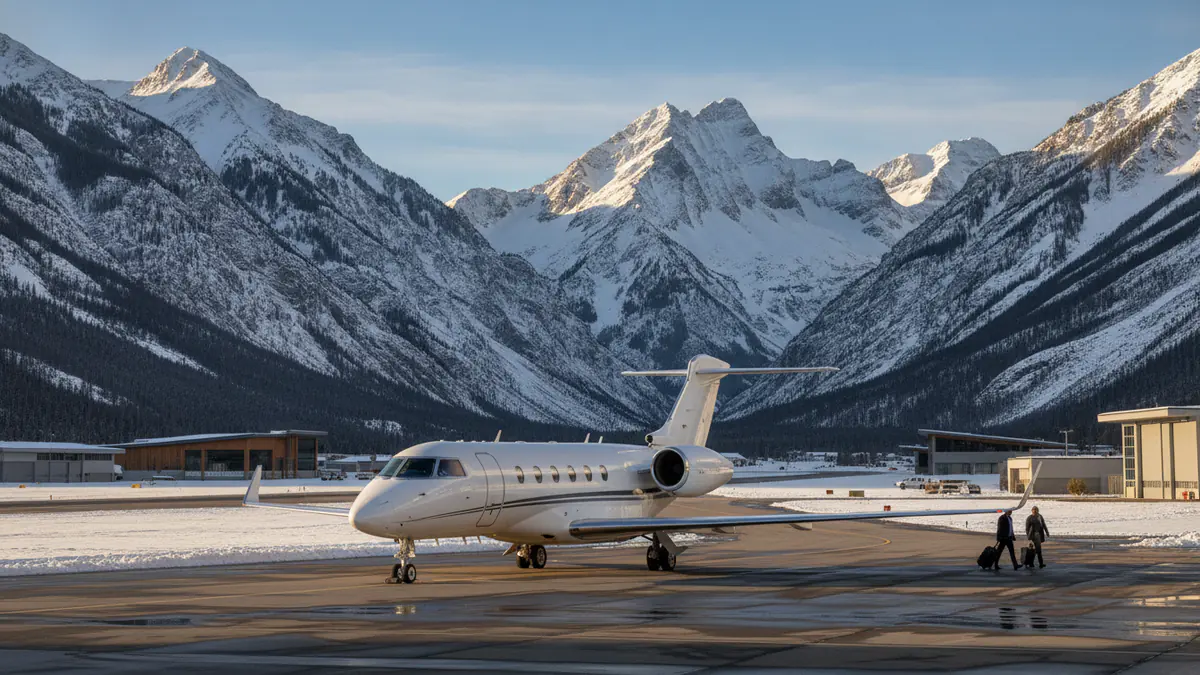
A private jet Aspen airport arrival is one of the most memorable landings in North American business aviation, and one of the most demanding. Aspen/Pitkin County Airport, known locally as Sardy Field, sits at around 7,820 feet above sea level in the narrow Roaring Fork Valley, a few miles from downtown Aspen, with high peaks rising on most sides (Wikipedia). When the weather is clear, you land a short drive from the lifts, the restaurants and your chalet. When it is not, the mountains set the rules.
The panels above this guide show the airport's codes (KASE and ASE), the driving route into town, the aircraft categories that can use it and the corridors we quote into Aspen. This guide explains what sits behind those numbers: the curfew, the wingspan limit, the effect of altitude on aircraft performance, the winter peaks, and when a nearby airport is the smarter choice. We are a charter broker. We do not own or operate aircraft; we source them from licensed operators that are experienced with mountain operations, and we plan the trip around the airport's constraints. You can read more about how that works on the JetPriceCheck homepage.
Why Aspen/Pitkin County Airport is different
Most airports in our network are defined by their runways and opening hours. Aspen is defined by its terrain. The airport has a single runway in a valley that narrows to the south, and pilots flying into ASE follow specific procedures set out by the airport, which publishes a high-altitude safety page for crews. Operators often require crews to have recent Aspen experience or specific training before they will accept a trip here.
For a passenger, that means three practical things:
- Not every aircraft can go. Size, weight and performance all matter, and some aircraft that fly easily into sea-level airports are simply not allowed or not suitable.
- Not every hour is available. Aspen has a strict overnight curfew, described below.
- Weather has more say. Low cloud, snow and wind in the valley can delay or divert flights more often than at a lowland airport, so a backup plan is part of every winter booking.
None of this should put you off. Thousands of private flights land at Aspen each season. It simply rewards careful planning, and that is where a broker earns its fee.
The Aspen curfew
Aspen/Pitkin County Airport publishes a curfew with no flight operations between 11 p.m. and 7 a.m., except for emergencies. That is unusual in the United States, where most airport night rules are voluntary or apply only to noisier aircraft. At Aspen, the hours are firm.
How it affects your trip:
- Late departures from the coasts. A flight from New York or Miami that leaves after work can easily arrive after 11 p.m. Mountain time. We plan the departure time backwards from the curfew, with a margin for headwinds and delays.
- Early starts from Aspen. The first departures leave from 7 a.m., which suits a morning meeting in Denver or Los Angeles but not an early-morning arrival on the East Coast.
- Weather delays. If a morning of low cloud pushes your departure into the afternoon, the evening curfew leaves less room to recover. We keep an eye on both ends of the day.
The 95-foot wingspan limit
Aspen's runway and taxiway layout does not meet every standard the Federal Aviation Administration applies to larger aircraft. According to the airport's own wingspan restriction briefing paper, the Pitkin County Code prohibits aircraft with a wingspan greater than 95 feet, a limit tied to the modified design standards the FAA approved for the airport.
In practice this removes some of the largest business jets and every airliner-sized VIP aircraft from the Aspen list. Many popular large-cabin jets still fit, but the limit is one of the first things we check when a client asks for a specific aircraft. If your preferred aircraft is too large, the choice is to use a slightly smaller jet into Aspen or to keep the larger aircraft and land at a nearby airport, then continue by car or on a smaller aircraft.
Altitude, aircraft performance and weight
At 7,820 feet, the air is thinner than at sea level, and on a warm summer afternoon it is thinner still. Thin air means an aircraft needs more runway to take off and climbs less steeply, and it produces less thrust from its engines. Add the surrounding terrain, and the result is that departures from Aspen are often weight-limited.
What that means for you:
- Passengers and luggage count more. A full aircraft with ski bags and winter luggage may need to carry less fuel out of Aspen, which can mean a fuel stop on longer trips.
- Summer afternoons are the tightest. Hot days reduce performance, so crews sometimes prefer morning departures in July and August.
- Nonstop range shrinks on the way out. An aircraft that flies nonstop to Aspen from the East Coast may need to stop on the return. We check the operator's performance calculations before quoting a nonstop flight.
Choosing an aircraft for Aspen
The aircraft panel above lists the categories that can use the airport. For Aspen, we look at the mission, the wingspan limit, the operator's mountain experience and the performance numbers together.
Light jets and turboprops
For short hops from Denver or other Colorado airports, a light jet or a capable turboprop is often the most efficient choice. Turboprops can make particular sense on the short Denver sector, where speed matters little and short-field performance helps. The trade-off is cabin space and luggage room, which matters in ski season when every passenger brings boots, skis and heavy coats.
Midsize and super midsize jets
This is the sweet spot for many Aspen trips. A super midsize jet offers a stand-up cabin, strong performance and room for winter luggage, with the range to fly nonstop from much of the United States on the way in. For flights from the West Coast, Texas or the Midwest, it is often the first category we propose.
Large-cabin jets
For coast-to-coast trips, families with a lot of luggage or passengers flying in from Europe, a large-cabin jet may be the right answer, as long as it meets the wingspan limit and the operator is approved for Aspen. Transatlantic guests often fly a long-range jet to a larger gateway and connect to Aspen on a smaller aircraft, which avoids both the wingspan limit and the performance penalty on departure.
Our aircraft guide explains each category in detail.
Aspen alternatives: Eagle County and Rifle
When Aspen does not fit the aircraft, the time or the weather, two airports come up most often:
- Eagle County Regional Airport in the Vail valley, west of Vail, handles larger aircraft and is a common alternate. From there, the drive to Aspen is long, typically well over an hour, and longer in winter weather.
- Rifle Garfield County Airport, further west, is lower and has a longer runway. It is useful for heavy aircraft and as a weather alternate, with a longer drive into the valley.
For many trips, the right plan is Aspen first, with a named alternate agreed in advance, and a car ready at either airport. We set that up at booking so a diversion is an inconvenience, not a crisis.
International guests and customs
Aspen draws a steady stream of guests from Europe, Latin America and Canada, and the London and Geneva corridors in the panel above reflect that. For flights arriving from abroad, the aircraft must first clear U.S. Customs and Border Protection at an airport where customs is available for its arrival time. Many transatlantic trips therefore land first at a larger U.S. gateway, clear customs there, and continue to Aspen as a domestic sector, sometimes on a smaller aircraft better suited to the valley.
Customs availability, hours and notice periods change, so we confirm the clearing airport for your exact schedule before quoting. Your operator files the passenger details in advance; you need valid passports and any visas or travel authorisations your nationality requires.
Getting from the airport into Aspen and Snowmass
One of the joys of flying into Sardy Field is how close it is to town. The map above shows the driving route to central Aspen, which is short in normal conditions. Snowmass Village is also nearby, a little further along the valley. Most clients arrange a private car or a hotel shuttle, and chalet owners often have a driver waiting at the aircraft.
Some tips:
- Tell us your final address. We pass it to the operator and the handler so your car is waiting when the door opens.
- Plan for winter roads. Snow can slow the short drive, and parking at private terminals is tight in peak weeks.
- Luggage and gear. Ski equipment is bulky. Tell us how many ski bags and boot bags you are bringing so the aircraft and the car both have room.
Winter peaks and parking
Aspen is busiest from the Christmas and New Year holidays through the February school holidays and into March. During these weeks, parking space for visiting aircraft is limited, and handlers may ask aircraft to drop passengers and leave, repositioning to another airport until the return flight. That affects price, because the aircraft flies extra empty sectors, and it affects timing, because the aircraft has to come back in before your departure.
Summer is quieter but still busy, with festivals, music and outdoor events drawing visitors from June to August. Summer brings its own considerations: afternoon thunderstorms over the mountains and the performance effect of warm air. Morning flights often work best.
If you know you will fly into Aspen over the holidays, book as early as you can. The best aircraft options and parking arrangements go first.
Private jet to Aspen: routes and prices
The corridors panel lists the routes we price into Aspen, from Denver, Los Angeles, Miami, New York, London and Geneva. Our Aspen departures hub lists the flights we price out of the valley, and the Aspen destination guide covers the resort itself, from where to stay to when to go.
On price, Aspen trips tend to cost more than a similar flight time to a lowland airport. Reasons include positioning and repositioning in peak weeks, crew experience requirements, de-icing in winter, and sometimes a fuel stop on the return. Every route page shows estimate ranges from our demonstration pricing model; they are estimates, not quotes. Our private jet cost guide explains how a charter price is built.
Empty legs into and out of Aspen
Because so many aircraft drop passengers at Aspen and fly out empty in peak season, empty legs appear on the empty-leg flights page from time to time. They can be good value, but the date, time and aircraft are set by another client's trip, and they can move or cancel. For a family holiday with fixed dates, a planned charter is usually the safer choice.
How we arrange a private jet into Aspen
- Tell us the trip. Dates, passengers, ski bags and luggage, and your final address in Aspen or Snowmass.
- We check the constraints. Wingspan, curfew, performance and operator approval for Aspen, plus a named alternate airport.
- We compare operators. We request quotes from licensed operators with suitable aircraft and crews experienced at ASE, and explain the differences.
- You confirm. You sign the charter agreement, and we issue the trip sheet with the handler, car and crew details.
- We watch the weather. In winter we track forecasts from the day before, and if a diversion looks likely we arrange ground transport at the alternate.
When you are ready, request a quote through JetPriceCheck for your Aspen dates.
Aspen private jet FAQ
Is there a curfew at Aspen airport?
Yes. The airport publishes a curfew with no flight operations between 11 p.m. and 7 a.m., except for emergencies. We plan departure times around it.
Can any private jet land at Aspen?
No. Aspen limits aircraft wingspan to 95 feet, and the altitude and terrain mean operators often require specific crew experience. Many light, midsize, super midsize and large-cabin jets qualify; the largest jets and airliners do not.
What happens if my flight cannot land in Aspen?
The crew diverts to an alternate airport, often Eagle County or Rifle, and you continue by car. We agree the alternate and arrange ground transport as part of the plan.
Why might a flight out of Aspen need a fuel stop?
Thin air at 7,820 feet reduces aircraft performance, so departures can be weight-limited, especially on warm days or with a full cabin. Carrying less fuel can mean a stop on longer trips.
When should I book for the holidays?
As early as possible. Aircraft, crews experienced at Aspen and parking space all get scarce from Christmas through March.