Airport
Cape Town International Airport for private jets
Cape Town International Airport (FACT, CPT) is a mixed commercial and business aviation serving Cape Town, South Africa.
Unverified Source: OurAirports (public domain, data of 2026-09-26): coordinates, IATA code, runways. Customs, hours and notes not yet verified.
- ICAO / IATA
- FACT / CPT
- Type
- Mixed commercial and business aviation
- Longest runway
- 10,502 ft
- Customs
- Not yet verified
- Hours
- Not yet verified
- Coordinates
- -33.9740, 18.6043
Getting to Cape Town
Driving route from the city centre. Times vary with traffic; your driver or the FBO can advise on the best pick-up time.
Aircraft that can use it
By runway length alone, turboprops, light jets, midsize jets, super midsize jets, heavy jets, ultra long range jets and vip airliners can typically use Cape Town. Operators confirm performance, slots and restrictions for each flight.
FBOs at Cape Town
No verified FBO records yet.
Empty legs from Cape Town
No live empty legs are connected for this search yet. Empty legs appear here only from real operator inventory; we never show made-up availability. A specialist can still check one-way opportunities for your dates.
Private jet routes from Cape Town
Private jet Cape Town: flying through Cape Town International
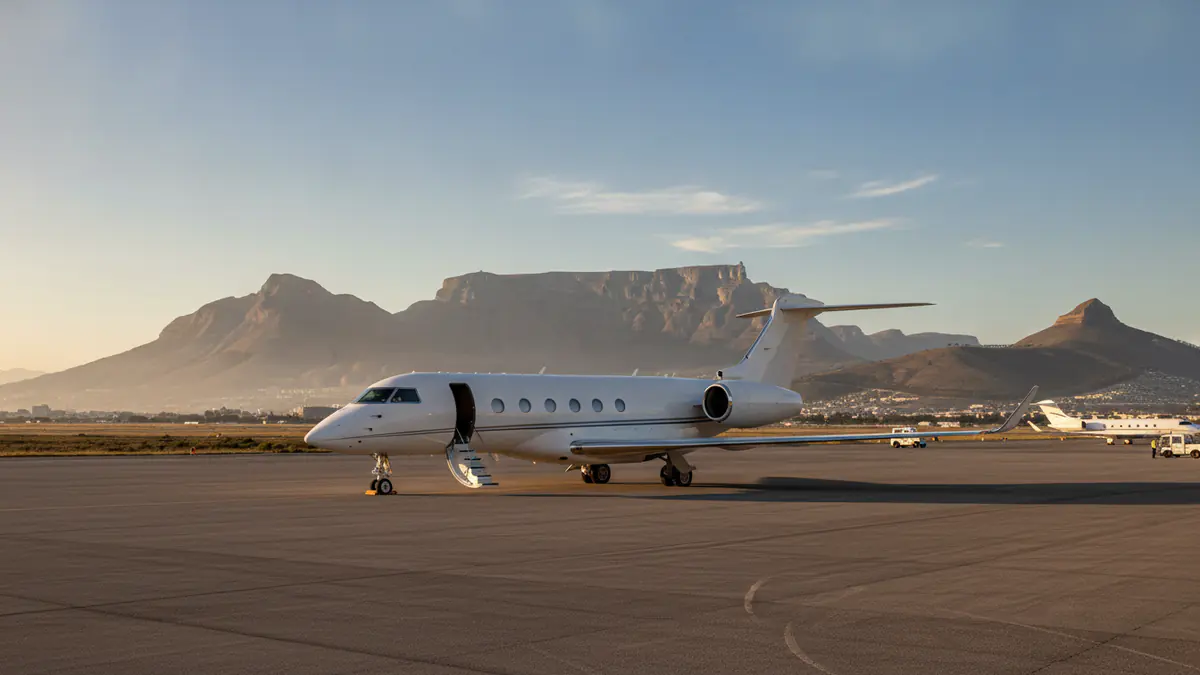
A private jet Cape Town trip almost always begins or ends at Cape Town International Airport, the main airport for the city and the Western Cape. It sits on the Cape Flats, roughly 20 km east of the city centre, with Table Mountain on the horizon and the N2 highway running straight into town. It is a busy airline airport rather than a business-only field, but it has a dedicated general aviation terminal, a long main runway and the customs and immigration services that international private flights need.
The panels above show the airport's codes (FACT and CPT), the aircraft that can use it and the transfer from the city centre. This guide adds the context: how private flights work at a mixed airline and business airport, what to expect when arriving from abroad, when the city is busiest, and how Cape Town connects to safari lodges and the rest of southern Africa. We are a charter broker, so we do not own or fly aircraft; we source them from operators and plan the trip around your schedule. You can read more about the service on the JetPriceCheck home page.
Why fly privately to and from Cape Town
Cape Town is a long way from most of the places its visitors start from. London, Frankfurt, Dubai and New York are all long-haul sectors, and airline schedules to the Cape are shaped around peak demand rather than individual itineraries. A private jet to Cape Town changes that in three ways:
- Timing on your terms. You leave when you are ready, not when the evening airline bank departs, and you arrive without a connection in Johannesburg, Dubai or Doha.
- One trip, several stops. A typical visit combines Cape Town with the Winelands, the Garden Route and a safari lodge. A private aircraft, or a mix of a long-range jet and a smaller aircraft, links those stops without backtracking.
- Privacy and discretion. The general aviation terminal keeps you away from the main terminal halls, which matters for high-profile guests, families and teams travelling with equipment.
Cape Town is also a base for South African business: financial services, technology, film production and the mining community that gathers in the city every year. For those travellers, a private flight to Johannesburg and back in one day is often the reason to fly privately at all.
Cape Town International at a glance
Cape Town International is owned and operated by Airports Company South Africa (ACSA), the state-owned company that also runs O. R. Tambo in Johannesburg and the country's other main airports. It is South Africa's second-busiest airport and a major gateway for international tourism.
Runway and aircraft
The Wikipedia entry for Cape Town International lists a main runway, 01/19, of about 3,200 metres (roughly 10,500 feet) with instrument approaches. That is long enough for the full range of business jets, from light jets to the largest long-range aircraft, although the operator always makes the final performance calculation for the weight, temperature and wind on the day. There is also a shorter secondary runway.
Because the airport sits close to sea level, it does not suffer from the "hot and high" performance penalty that affects Johannesburg's airports. On long-haul departures in cool conditions, that can help a long-range jet leave with a full fuel load.
The general aviation terminal
Private passengers use a separate general aviation terminal and apron rather than the airline terminals. Trip-support providers such as Universal Weather's airport listing describe handling for both aircraft and passengers, with customs and immigration arranged on site for international flights. In practice, your handling agent meets you, your bags are screened, formalities are completed, and you are driven or walked to the aircraft.
Hours and slots
Cape Town International handles airline flights through much of the day and night, and business aircraft share the runway with them. At busy times the airport may require slot or parking coordination, and parking space for business aircraft can become the constraint in peak season rather than the runway. The operator and handler arrange this, but it is another reason to book early for December and January.
Customs, immigration and entry to South Africa
International private flights clear customs and immigration at Cape Town International, which makes it a direct port of entry for a long-range jet from Europe, the Gulf or the Americas. The South African Revenue Service handles customs and the Department of Home Affairs handles immigration.
A few practical points:
- Passports and visas. Entry requirements vary by nationality. Check whether each passenger needs a visa, and make sure passports have enough validity and blank pages, since South Africa is strict on this.
- Travelling with children. South Africa has had specific documentation rules for minors travelling across its borders. Check the current requirements before you travel, especially if a child is travelling with only one parent.
- Onward to neighbouring countries. Flights to Namibia, Botswana, Zimbabwe or Mozambique leave South Africa and enter another country, so the aircraft clears outbound formalities before departure.
- Goods and wildlife products. Be aware of the rules on alcohol, tobacco and wildlife products, particularly on the return from a safari region.
The operator and handling agent file the necessary information in advance. We confirm the plan when we confirm the aircraft.
Getting between the airport and the city
The map above shows the driving route from the city centre. The N2 links the airport with the city bowl, the V&A Waterfront and the Atlantic Seaboard. On a clear road the drive into the centre is typically around 20 to 30 minutes; at peak commuting times it takes longer.
- To the Winelands. Stellenbosch, Franschhoek and Paarl lie east of the airport, so the airport is on the way rather than a detour. Many visitors go straight from the aircraft to a wine estate.
- To the Atlantic Seaboard. Camps Bay, Clifton and Bantry Bay are on the far side of the city; allow extra time.
- Helicopter transfers. For a very short connection to the Waterfront or a Winelands estate, helicopter transfers are sometimes possible. We can include one in the plan if the weather and permissions allow.
The south-easterly summer wind, known locally as the Cape Doctor, can be strong and gusty. It rarely stops flights, but it can make arrivals bumpy and affect helicopter plans.
Aircraft for a private jet to Cape Town
Distance is the deciding factor. Our aircraft guide explains each category; here is how they fit the Cape.
Long-range and ultra-long-range jets
From Europe or the Gulf, a long-range jet can usually reach Cape Town non-stop, although the exact answer depends on the aircraft, the passengers and the winds. From North America, most itineraries include a technical stop, often on the west coast of Africa or in the Atlantic. The operator plans the stop and the crew duty time.
Super midsize and midsize jets
For flights within South Africa, such as Cape Town to Johannesburg or Durban, a super midsize or midsize jet offers a comfortable cabin, room for baggage and a flight time of about two hours to Gauteng. These aircraft also suit Namibia and Botswana.
Light jets and turboprops
For the Garden Route, the Winelands and the private strips used by game lodges, smaller aircraft make more sense. Many lodge strips are short or unpaved and suit turboprops rather than jets. A common pattern is to arrive in Cape Town on a long-range jet and then continue on a smaller aircraft for the safari leg.
Beyond Cape Town: safari, the Garden Route and the region
A private flight from Cape Town opens up southern Africa's highlights:
- Kruger and the private reserves. Lodges in and around Kruger National Park, including the Sabi Sand area, are reached through regional airports and private lodge strips in the north-east of the country.
- The Garden Route. George and Plettenberg Bay serve the coast east of Cape Town, with its lagoons, forests and golf courses.
- Hermanus and the whale coast. Southern right whales are usually seen close to shore roughly from June to November; the coast is a short drive or flight from Cape Town.
- Namibia and Botswana. Windhoek, the Namib Desert lodges, the Okavango Delta and Chobe are all within reach of a midsize jet or a turboprop, depending on the airstrip.
Planning several legs at once often produces a better overall price than booking each sector separately, because it reduces empty positioning.
What a private jet to Cape Town costs
The price depends on the aircraft, the flight time, positioning, crew overnights, handling and airport charges. A long-range jet from Europe is a very different proposition from a turboprop to a lodge. Because many aircraft that fly to Cape Town are based elsewhere, positioning and the return empty sector can be a large part of the cost of a one-way trip.
Our private jet cost guide explains how estimates are built and why a firm figure only comes with a quote. Any numbers elsewhere on the site are estimates, not offers.
Empty legs to and from Cape Town do appear, especially around the start and end of the summer season when aircraft reposition. They suit flexible travellers; see our empty-leg flights page for current opportunities.
When Cape Town is busiest
Cape Town's seasons are the reverse of the northern hemisphere's, and private aviation demand follows the sunshine.
- December to February. Peak summer, the festive season and the busiest time for private arrivals. Aircraft parking, hotels and villas all fill up. Book as early as you can.
- February. The mining industry's Investing in African Mining Indaba conference is typically held in Cape Town in February and brings a wave of corporate travellers. The city's art fair season also falls around this time.
- March and April. Still warm, calmer winds on many days, and slightly less busy. The Cape Town Cycle Tour is typically held in March.
- May to August. The Cape's winter is cooler and wetter, with storms from the Atlantic. Demand for private flights is lower, which can mean better aircraft availability.
- September to November. Spring flowers on the west coast, whale season at Hermanus and the start of the busy period again.
How booking a Cape Town charter works
- Share your plans. Tell us your dates, departure city, passenger numbers, baggage and any onward legs to lodges or other countries.
- We shortlist aircraft. We check range, technical stops, runway suitability at each stop and crew duty rules with vetted operators.
- You choose. We present the options with the routing, estimated flight times and what the price includes.
- The operator confirms. Slots, parking, handling and customs arrangements are confirmed by the operator and handler.
- You travel. On the day, bring the right passports and documents, and allow for traffic on the N2.
Browse other routes and destinations in our route directory.
Frequently asked questions
Can private jets fly into Cape Town International?
Yes. Cape Town International has a general aviation terminal and apron for private aircraft, and its main runway is long enough for business jets of every size.
Is there customs for private jets at Cape Town airport?
Yes. International private flights clear customs and immigration at Cape Town International, with formalities handled through the general aviation terminal. Check passport, visa and minor-travel requirements before you fly.
Can I fly non-stop from Europe to Cape Town by private jet?
Often, yes, on a long-range jet, depending on the aircraft, the load and the winds. Flights from North America usually include a technical stop. The operator confirms the plan for each trip.
How far is Cape Town airport from the city centre?
Roughly 20 km east of the city centre along the N2. The drive usually takes 20 to 30 minutes outside peak times, and longer to the Atlantic Seaboard.
When is the busiest time for private flights to Cape Town?
December to February, during the southern summer and the festive season. Early February is also busy with conference traffic. Book aircraft and parking early for this period.
Can I fly from Cape Town to a safari lodge?
Yes. Many lodges have airstrips served by turboprops and small aircraft. A common plan is a larger jet to Cape Town and a smaller aircraft for the lodge leg.
Plan your Cape Town flight
A private flight to Cape Town works best when the long-haul sector, the airport, the season and any onward legs are planned together. Tell us where you are starting from, how many people are travelling and where you want to go next, and we will match the aircraft and routing to the trip. Use the quote form on this page, or return to the private jet charter home page to explore more.