Airport
Paris–Le Bourget Airport for private jets
Paris–Le Bourget Airport (LFPB, LBG) is a business aviation airport serving Paris, France.
Unverified Source: OurAirports (public domain, data of 2026-09-26): coordinates, IATA code, runways. Customs, hours and notes not yet verified.; AIP France (SIA) LFPB AD 2.3, AIRAC 03 SEP 2026: Douanes et police / Customs and immigration H24 (https://www.sia.aviation-civile.gouv.fr/media/dvd/eAIP_03_SEP_2026/FRANCE/AIRAC-2026-09-03/html/eAIP/FR-AD-2.LFPB-fr-FR.html)
- ICAO / IATA
- LFPB / LBG
- Type
- Business aviation airport
- Longest runway
- 9,843 ft
- Customs
- Yes
- Hours
- Not yet verified
- Coordinates
- 48.9623, 2.4365
Getting to Le Bourget
Driving route from the city centre. Times vary with traffic; your driver or the FBO can advise on the best pick-up time.
Aircraft that can use it
By runway length alone, turboprops, light jets, midsize jets, super midsize jets, heavy jets, ultra long range jets and vip airliners can typically use Le Bourget. Operators confirm performance, slots and restrictions for each flight.
FBOs at Le Bourget
No verified FBO records yet.
Empty legs from Le Bourget
No live empty legs are connected for this search yet. Empty legs appear here only from real operator inventory; we never show made-up availability. A specialist can still check one-way opportunities for your dates.
Private jet routes from Le Bourget
Private jet Le Bourget: why Paris business flights land here
If you are planning a private jet Le Bourget is almost certainly where your Paris trip will begin or end. Paris–Le Bourget Airport (ICAO LFPB, IATA LBG) sits about 11 km north of the city centre, in Seine-Saint-Denis, and it no longer handles scheduled airline traffic at all. That single fact shapes everything about it: the terminals are small private lounges rather than halls, the apron is full of business jets rather than airliners, and the airport's operator, Groupe ADP, runs it as a dedicated business aviation platform alongside its two commercial giants, Charles de Gaulle and Orly.
The data sections above this guide show the airport's identifiers, a live weather feed, a driving map from central Paris, the aircraft categories its runway can accept, and the routes we quote from it. This guide explains what those numbers mean in practice: how a departure from Le Bourget actually works, how it compares with the alternatives around Paris, what the night rules and customs set-up mean for your schedule, and which trips it suits. We are a charter broker, so our job is to match your trip to an aircraft and an operator; knowing the airport well is part of doing that properly.
A short history that still matters
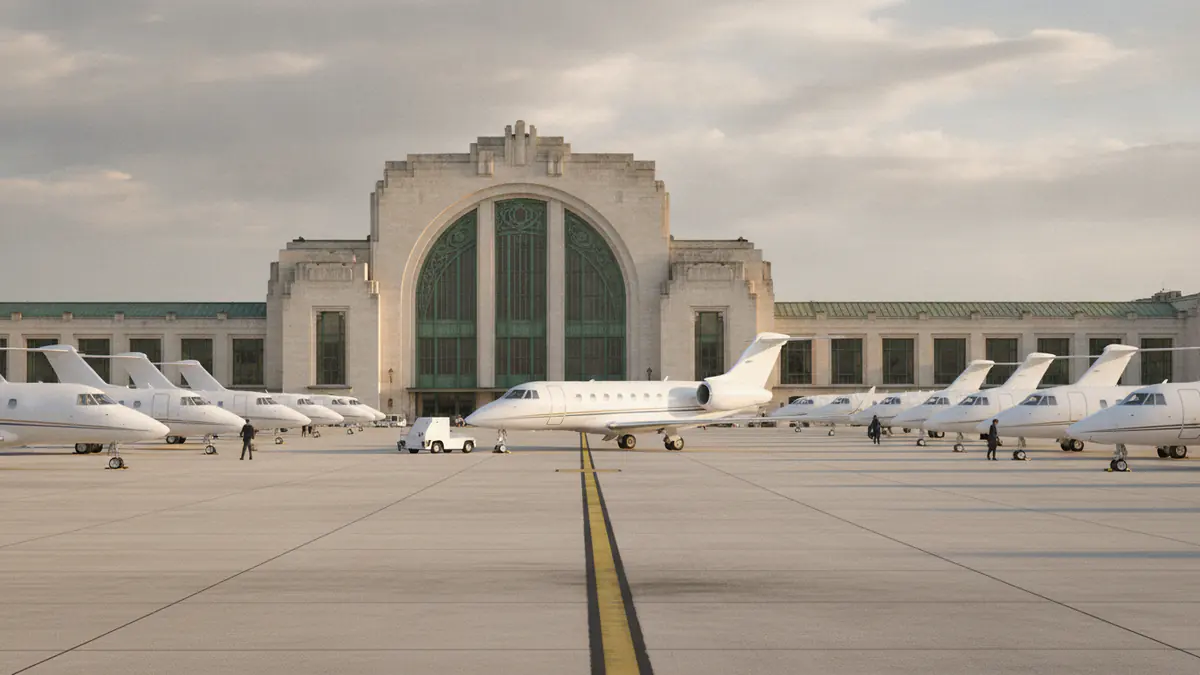
Le Bourget is one of the oldest airports in the world still in use. It was Paris's main airport between the wars, it is where Charles Lindbergh landed after the first solo non-stop Atlantic crossing in 1927, and it hosts the Paris Air Show every odd-numbered year in June. The old terminal building now houses the Musée de l'Air et de l'Espace.
The history matters. When airlines moved to Orly and then Charles de Gaulle, Le Bourget kept its long runways and ramp space but lost its airline schedule, and it became the natural home for corporate flight departments, charter operators and handlers. Today it is widely described as the busiest business aviation airport in Europe, and it is the only Paris airport intended for charter aircraft with fewer than 25 seats. For a traveller, that concentration means there is plenty of competition among handlers and a deep pool of aircraft based within a few minutes' taxi, which helps both availability and price.
What a departure from Le Bourget feels like
The appeal of a private jet at Le Bourget is how little of the airport you actually see. A typical departure runs like this:
- Your car drives to the handler's building. Private terminals at Le Bourget sit airside-adjacent, with parking or drop-off at the door. There is no terminal walk and no queue for a security lane shared with hundreds of others.
- Passport and security checks take place in the private terminal. For flights leaving the Schengen Area, border formalities are handled in the same building, and the process usually takes minutes rather than the long lines you would face at Charles de Gaulle.
- You walk or are driven to the aircraft. Luggage is loaded while you board. Most operators ask you to arrive around 20 to 30 minutes before the planned departure time, rather than the two hours or more that airline travel demands.
- The aircraft taxis a short distance and departs. Le Bourget does not have the airline banks that create long taxi queues at the big hubs, so the time from engine start to take-off is normally short.
Arrivals work the same way in reverse. A car can meet the aircraft or wait at the terminal door, and you are often on the road towards Paris within a quarter of an hour of the doors opening. That is the real time saving on short European hops, where the flight itself may only last an hour.
Customs, borders and paperwork
France is part of the Schengen Area, so flights between Le Bourget and other Schengen countries, such as Switzerland, Spain, Italy or Germany, usually involve no passport control on arrival, although you should always carry a valid passport or national ID card because operators and authorities can ask for it. Flights to or from non-Schengen countries, including the United Kingdom, the United States and the Gulf, require border checks.
Industry guides such as Universal Weather's Paris destination guide report that customs and immigration at Le Bourget are available around the clock with advance notice, and that clearance in the private terminals is usually a matter of minutes. We still ask for passenger passport details when you book, because operators have to file them in advance, and because customs availability at any airport can change. If you are flying in from outside the European Union with high-value goods, cash above the declaration threshold, pets or firearms for a hunting trip, tell us early: those items need paperwork before the flight, not on the apron.
Night rules and why timing matters
Le Bourget sits in a densely populated suburb, so noise rules are part of daily life. Night restrictions apply from late evening until 06:00 local time, and older, noisier aircraft are kept off the night schedule. Trade press such as Aviation Week has covered the curfew's effect on corporate flyers, and the detail of which aircraft can depart or arrive at night depends on the aircraft's noise certification.
In practice, this means three things for you:
- Very late departures are harder than very late arrivals. Night rules are stricter on take-offs than on landings for some aircraft, so a flight home to Paris late at night is often easier to arrange than a departure from Paris at the same hour.
- Modern jets have more flexibility. Newer light, midsize and long-range jets generally meet the noise standards more easily than older types. When you ask for a night departure, we check the specific aircraft, not just the category.
- Early starts are common. Business travellers regularly leave Le Bourget from 06:00 so they can be in a meeting in Geneva, Milan or London by mid-morning.
Unlike the most congested airports in Europe, Le Bourget does not allocate fixed time slots to business aviation flights, so short-notice changes to departure time are normally workable within the airport's opening rules. The exact night window and aircraft rules are published in the French Aeronautical Information Publication, and operators check them for every flight.
Le Bourget versus the other Paris options
Paris has several airports that can take a private aircraft, and choosing between them is part of planning a sensible trip.
Charles de Gaulle and Orly
Both commercial hubs can technically handle business jets, but they are built around airline schedules. Ground handling, parking and slot availability for private flights are more constrained, and the passenger experience is closer to an airline one. They occasionally make sense when an operator has a reason to use them, for example for a very large aircraft or a crew connection, but for most trips Le Bourget is the obvious choice.
Why Le Bourget usually wins
For most private travellers, the combination at Le Bourget is hard to beat: a short drive to the city, runways long enough for long-range jets, customs on site, many handlers competing for your business, and a large number of aircraft based nearby. According to our airport data, its longest runway is over 9,800 feet, which comfortably covers every jet category in our model; that figure comes from a public airport dataset, and the operator still confirms runway performance for each flight.
Getting between Le Bourget and central Paris
The map above shows the driving route from central Paris. The drive is short on paper, but Paris traffic sets the real timing. Off-peak, a chauffeur can reach the Opéra, the 8th arrondissement or La Défense quickly; in the morning rush or on a Friday evening, the A1 motorway and the Boulevard Périphérique can add a lot of time. We suggest planning pick-ups with a buffer and letting the handler or your driver advise on the day.
There are other options:
- Chauffeur-driven car. The most common choice. Your driver can meet you at the terminal door and, for arrivals, be waiting when the aircraft parks.
- Helicopter. Helicopter flights over central Paris are tightly restricted, so a helicopter transfer usually connects Le Bourget with a heliport on the edge of the city or with destinations outside Paris, such as châteaux, vineyards or country houses. Tell us early if you need one.
If you would like us to arrange your ground transfer alongside the flight, mention it in your request and we will include it in the quote.
Which routes and aircraft suit Le Bourget
Le Bourget is a genuinely global airport. Our route pages show how it connects with the rest of our network, and the corridors below are the ones we see most often.
Short European hops
Paris to the French Riviera, Switzerland, northern Italy and London are the backbone of Le Bourget's traffic. Flights to Nice and the Côte d'Azur and Paris to Geneva are typically light jet or midsize jet trips of about an hour to an hour and a half. The same is true of flights to Milan, popular with fashion, design and finance travellers. On these routes, the time saved on the ground is often bigger than the time spent in the air.
Leisure in the Mediterranean
In summer, Le Bourget becomes a gateway to the islands. Paris to Ibiza is a classic early-summer and August route, often flown by midsize jets with generous baggage space. Plan early for peak weekends, because the constraint is often at the island end rather than in Paris.
Long-haul departures
Le Bourget handles long-range jets that fly non-stop to North America, the Middle East and beyond. A transatlantic trip to New York usually needs a super midsize or large-cabin jet with the range to fly without a fuel stop, especially westbound against the prevailing winds. You can compare the categories on our aircraft guide.
For everything else leaving the city, including routes that use other airports, the Paris departures hub lists every corridor we quote, and the full route directory covers the whole network.
What a Le Bourget trip costs
Prices depend on the aircraft, distance, positioning, waiting time and season far more than on the airport. Le Bourget adds airport, handling and passenger fees, but those are a small share of most trips. Because so many aircraft are based at or near Le Bourget, positioning costs for a Paris departure are often lower than for a trip starting at a smaller airport, while one-way trips and peak weeks push prices up.
Our private jet cost guide explains how charter prices are built, and the estimates on our route pages are ranges built from published market rates, not quotes. You receive a firm quote from the operator only once the aircraft, times and passengers are confirmed.
Empty legs through Paris
Because Le Bourget has so many movements, it also sees a steady stream of one-way repositioning flights. If your dates and times are flexible, an empty-leg flight can cut the cost considerably. The catch is that an empty leg follows another client's schedule, so it can move or be cancelled; it suits flexible trips rather than fixed meetings.
Seasonality and events
Le Bourget is busy all year, but some periods need more planning:
- Paris Air Show years. Every other June, the airport hosts the Paris Air Show. The airfield remains open, but parking and movement become tighter during the show week, and many aircraft reposition to other airports. Book early and expect less flexibility.
- Fashion weeks. The spring and autumn fashion weeks bring heavy inbound traffic, especially from London, Milan and New York.
- Summer. June to August is the leisure peak, with strong demand towards the Riviera, Ibiza, Sardinia and Greece.
- Winter. From late December through March, flights towards the Alps, especially Geneva, Chambéry and Sion, pick up sharply on Saturdays.
Around big events, we suggest confirming your aircraft as early as possible and being flexible by a few hours on departure time if you can.
Who uses Le Bourget
Business travellers use it for same-day trips to Geneva, Zurich, London or Milan, where a private jet turns two days into one. Families head south in summer and to the mountains in winter, often with skis, heavy luggage or pets. Visitors from the Gulf, the United States and Asia value fast border checks and a short drive into the city. Tell us who is flying and why, and we can suggest an aircraft that fits rather than one that simply has enough seats.
How we arrange your Le Bourget flight
As a broker, we do not own or operate aircraft. You tell us the dates, passengers, luggage and any pets; we check suitable aircraft from licensed operators against Le Bourget's night rules, customs timing and the runway at the other end; you choose from a short list of priced options; and the operator confirms aircraft, crew and schedule once you accept.
To start, send a request with the form on this page or go back to the home page to explore routes and aircraft.
Private jet Le Bourget: frequently asked questions
Is Le Bourget only for private jets?
Yes, in practice. Le Bourget has no scheduled airline service. It serves business aviation, charter flights, government and military flights, and it hosts the Paris Air Show in odd-numbered years.
How early should I arrive at Le Bourget?
Most operators ask passengers to arrive around 20 to 30 minutes before departure. For international flights with border checks, or if you are carrying a lot of luggage, allow a little more. Your operator confirms the exact time.
Can I fly into Le Bourget late at night?
Often yes, but it depends on the aircraft. Night restrictions apply from late evening until 06:00, and rules on night departures are stricter than on arrivals for some aircraft. We check the specific aircraft's noise certification before confirming a late flight.
Is there customs at Le Bourget?
Yes. Border and customs formalities for non-Schengen flights take place in the private terminals, and industry guides report that clearance is available around the clock with advance notice. We confirm it for your flight time when we book.
How far is Le Bourget from central Paris?
Around 11 km north of the city centre. Driving time varies a lot with traffic, so we recommend planning your pick-up with a buffer.
Which aircraft can use Le Bourget?
Every jet category, from very light jets to large-cabin long-range jets. The runways are long enough for non-stop flights to North America and the Middle East. The operator confirms aircraft performance for each flight.