Airport
San Francisco International Airport for private jets
San Francisco International Airport (KSFO, SFO) is a commercial hub serving San Francisco, United States.
Unverified Source: OurAirports (public domain, data of 2026-09-26): coordinates, IATA code, runways. Customs, hours and notes not yet verified.; FAA Chart Supplement (effective 03 SEP 2026), SAN FRANCISCO INTL (KSFO): LRA (Landing Rights Airport; CBP permission to land required in advance) (https://aeronav.faa.gov/afd/03sep2026/sw_275_03SEP2026.pdf); FAA Chart Supplement (effective 03 SEP 2026), SAN FRANCISCO INTL (KSFO): LRA (Landing Rights Airport; CBP permission to land required in advance) (https://aeronav.faa.gov/afd/03sep2026/sw_275_03SEP2026.pdf)
- ICAO / IATA
- KSFO / SFO
- Type
- Commercial hub
- Longest runway
- 11,870 ft
- Customs
- On request
- Hours
- Not yet verified
- Coordinates
- 37.6198, -122.3748
Getting to SFO
Driving route from the city centre. Times vary with traffic; your driver or the FBO can advise on the best pick-up time.
Aircraft that can use it
By runway length alone, turboprops, light jets, midsize jets, super midsize jets, heavy jets, ultra long range jets and vip airliners can typically use SFO. Operators confirm performance, slots and restrictions for each flight.
FBOs at SFO
No verified FBO records yet.
Empty legs from SFO
No live empty legs are connected for this search yet. Empty legs appear here only from real operator inventory; we never show made-up availability. A specialist can still check one-way opportunities for your dates.
Private jet routes from SFO
Private jet SFO: how private flights work at San Francisco International
Booking a private jet SFO flight gets you into the Bay Area's biggest airport without the airline side of it: no terminal crowds, no security lines, no baggage hall. San Francisco International Airport (ICAO KSFO, IATA SFO) sits on the bay shore in San Mateo County, south of the city, and handles a large share of the region's airline and long-haul traffic. Private aircraft use it too, parking at a fixed-base operator (FBO) ramp on the airfield. Whether SFO is the right Bay Area airport for your trip is a separate question, and the answer often depends on the weather and your final address.
The facts panel and widgets above show SFO's codes, live weather, the driving route from downtown and the corridors that use the airport. This guide adds what the data can't: how the private side of SFO works, why fog matters more here than almost anywhere else in the country, and when Oakland, San José or a smaller field will get you there with less waiting.
We are a charter broker. We don't own or operate aircraft; we compare options from licensed operators, help you choose the right airport, and stay with the trip until you land. See how we work on the JetPriceCheck homepage.
The private side of SFO
Private aircraft at SFO don't use the passenger terminals. They taxi to an FBO, a business licensed by the airport to handle non-airline aircraft. The FBO is effectively a small private terminal: a lounge, a ramp, fuel, crew facilities and staff who meet the aircraft.
A typical departure
You arrive at the FBO rather than the departures curb. A staff member checks your name against the manifest, and your luggage goes directly to the aircraft. After the crew's briefing you walk out to the aircraft or are driven the short distance across the ramp, and the door closes when your group is aboard. No check-in desk, no airline security queue, no boarding groups.
A typical arrival
After landing, the aircraft taxis to the FBO. The crew opens the door, luggage comes off the hold, and your car is waiting at the lounge entrance or, where the airport's rules allow, close to the aircraft. For a group heading to a meeting in the Financial District or Silicon Valley, those saved minutes add up.
Why FBO fees are part of the price
The FBO charges the operator for handling, parking and services, and fees at a major hub are usually higher than at a small general aviation field. They are a line in the operator's quote rather than something you pay separately, but they are one reason the same trip can be priced differently at SFO and at Oakland or San José.
Fog, flow programs and why SFO timing can slip
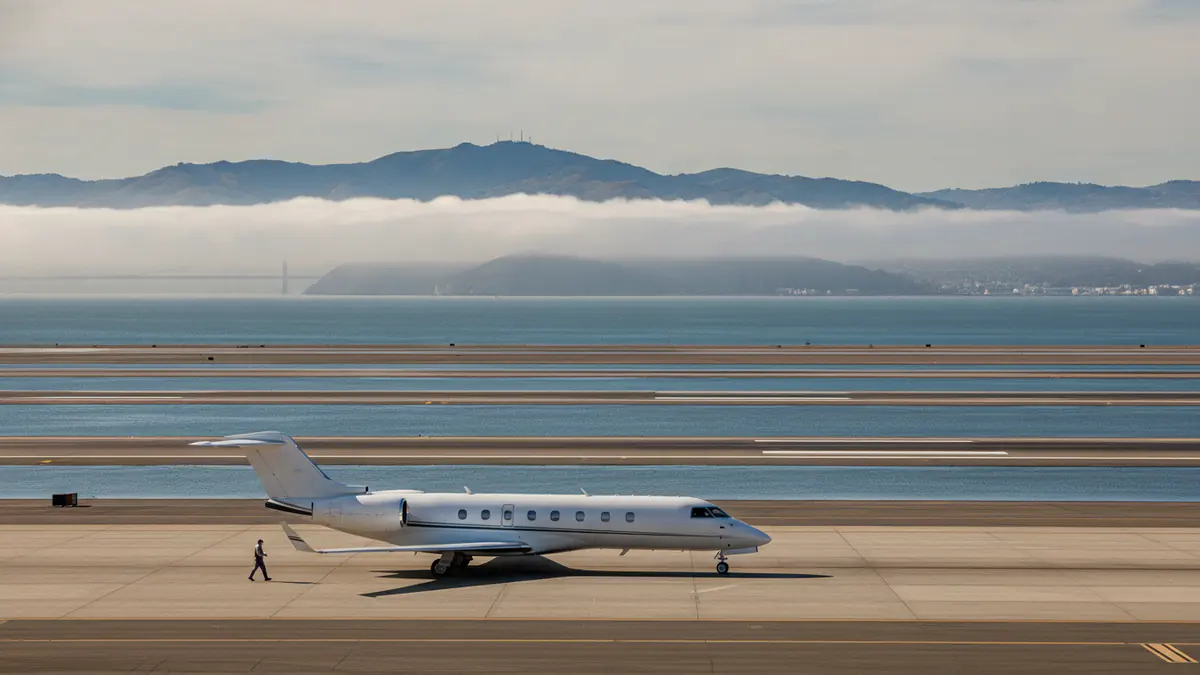
SFO's biggest operational quirk is the weather. Its main arrival runways are parallel and set very close together. In clear conditions, two aircraft can land side by side at the same time. When the summer marine layer, the low cloud that rolls in off the Pacific, sits over the bay, that stops, and arrivals have to be spaced as if there were one runway. Research by MIT Lincoln Laboratory on SFO's marine stratus looked at exactly this problem.
The practical effect for a private flight:
- Ground delay programs. When SFO's arrival capacity drops, the Federal Aviation Administration can hold flights at their departure airports. A private jet bound for SFO is in the same queue as the airlines, so a morning departure from Los Angeles or Seattle may wait on the ground.
- Mornings are the risk. The low cloud often lingers at SFO later in the morning than it does in the city itself, so early arrivals are the ones most likely to see delays, particularly in summer.
- The alternatives are close. Oakland and San José are near enough that an operator can plan for them from the start, or switch if SFO is under a program on the day.
We ask the operator to consider the forecast when planning a private jet SFO arrival, and to have a Plan B airport ready when timing matters. Check the official SFO website for current notices, including runway works that can affect capacity.
Planning around the marine layer
A few habits make a fog-season trip smoother. If the meeting is fixed and early, consider arriving the evening before, or land at Oakland or San José and let the car do the last stretch. If you are flexible, a late-morning or afternoon arrival usually meets clearer skies. For departures, fog matters less, because the constraint falls mainly on arrivals, but a busy afternoon push can still mean a wait at the runway. Tell us which part of the day is non-negotiable, and the operator can build the plan around it rather than hoping the cloud lifts in time.
SFO, Oakland or San José? Choosing a Bay Area airport
The Bay Area has several airports that take business jets, and the right one depends on where you are going.
| Airport | Distance from SFO (our data) | Usually suits |
|---|---|---|
| San Francisco International (SFO) | – | The Peninsula, the city, San Mateo, long-range international arrivals |
| Oakland International (OAK) | About 9 nm | The East Bay, Berkeley, the Tri-Valley, sometimes the city via the Bay Bridge |
| San José Mineta (SJC) | About 26 nm | Silicon Valley, Palo Alto, Cupertino, Santa Clara, Los Gatos |
Oakland and San José both carry airline flights, but far fewer than SFO, and both have their own general aviation areas. Local weather reports often note that their arrival reliability is typically better than SFO's when the marine layer is in. For a meeting in Menlo Park or Mountain View, San José can save a long drive up the 101; for Berkeley or Walnut Creek, Oakland is the natural choice.
Smaller Bay Area airports
Beyond the three big airports, business jets and turboprops also use several smaller fields. Hayward Executive is an East Bay option; Palo Alto and San Carlos take light aircraft close to Silicon Valley; Livermore and Concord serve the inland East Bay; and Napa County and Charles M. Schulz–Sonoma County serve wine country. Each has its own runway length, hours and noise rules, so the aircraft you can use depends on the field. We ask the operator to confirm suitability before recommending one.
Getting from SFO to San Francisco and Silicon Valley
SFO sits between the city and Silicon Valley, which is its great advantage. The city centre is north up the 101 or the 280; Palo Alto and Menlo Park are south. The map above shows the driving route from downtown San Francisco.
Chauffeured cars are the standard transfer from the FBO, arranged through the operator or FBO with your address and timing. Traffic on the 101 is the variable to plan around: weekday commuting peaks can make the run into the Financial District or down to Silicon Valley much slower than the midday drive. If you are landing at 5 p.m. with an evening engagement, say so when you ask for a quote; it may tip the choice to a different airport.
Who flies private through SFO
Tech and venture travellers. Founders, investors and executives flying in for board meetings and deal days often want the Peninsula, and SFO sits right on it.
Long-haul international arrivals. Aircraft arriving from Asia or Europe need an airport that handles long-range jets and customs, and SFO does both.
Leisure travellers heading north or east. Many Bay Area residents fly private to Lake Tahoe, the mountains and the Pacific Northwest. The San Francisco to Reno route is the classic Tahoe run.
West Coast business shuttles. The San Francisco to Seattle corridor and the Los Angeles to San Francisco route link three of the coast's business centres.
Routes from San Francisco
The routes section above lists the corridors that use SFO or the wider San Francisco market in our data. Most are short or medium trips where a light or midsize jet fits comfortably; see the aircraft guide to compare categories. The Reno flight is short enough that a turboprop or light jet is often the practical choice, and winter weather in the Sierra is a planning factor. Seattle is a comfortable midsize-jet mission. For longer trips, including transcontinental and international flights, an operator can offer super midsize and long-range aircraft.
Browse all departures on the San Francisco departures hub, or the full directory of charter routes.
Customs and international arrivals
International private arrivals into the United States clear U.S. Customs and Border Protection at an airport where the service is available. SFO is a major international gateway, and private flights from abroad can clear there with arrangements the operator makes in advance with CBP and the FBO. The CBP private flyers guidance explains the general process, including advance passenger information.
Every passenger needs a valid passport and the right entry documents for their nationality. Send names and passport details as early as you can, so the operator can file the manifest in good time. If you are arriving from abroad at one of the smaller Bay Area airports, confirm customs arrangements there before you plan around it.
Seasonality and busy periods
The Bay Area is a year-round business aviation market, but the pattern shifts with the seasons. Summer is fog season at SFO, with the most morning delays, and also the busiest time for leisure flights to Tahoe, the Pacific Northwest and the wine country. Winter brings ski traffic to Reno and the Sierra and occasional storms that affect both ends of the trip. Big technology conferences, investor events and major sporting fixtures in the region push up demand for aircraft and parking at short notice. We don't publish exact event dates; check organisers' calendars for your year.
When the calendar is busy, book early. Aircraft based in Northern California get committed, and positioning one from further afield adds cost.
What a private jet from SFO costs
The cost of a private jet from SFO depends mostly on the aircraft, the flight time and where the aircraft is based. Airport-specific costs include landing, handling and FBO fees, which scale with aircraft size, plus parking for longer stays. A turboprop to Reno and a long-range jet across the Pacific sit at opposite ends of the range.
Our private jet cost guide explains how estimates are built, and route pages show estimate ranges by aircraft category. They come from our demonstration pricing model and are not quotes; a firm price comes from a licensed operator for a specific aircraft and date.
Empty legs in the Bay Area
Repositioning flights into and out of the Bay Area come up regularly, especially on the Los Angeles, Las Vegas and Pacific Northwest routes. These one-way empty legs are cheaper, but their timings are fixed by the original booking and can change. Our empty-leg flights page explains how they work.
How we arrange your private jet at SFO
Tell us who is travelling, when, and the exact address at each end. We check aircraft availability from licensed operators, ask each to confirm SFO feasibility for your timing, and, where it helps, show you an Oakland or San José alternative with the drive time spelled out. You choose, the operator flies, and we coordinate the details with the crew and the FBO until you land. To get started, ask JetPriceCheck for options.
SFO private jet FAQs
Can private jets fly into SFO?
Yes. Private aircraft use SFO through the FBO on the airfield. Timings can be affected by airline traffic and by fog-related flow programs, especially on summer mornings.
Is there a private terminal at SFO?
Private jet passengers use the FBO, which works as a small private terminal with its own lounge and ramp, separate from the airline terminals.
Is Oakland or SFO better for a private jet?
It depends on where you are going and the weather. SFO suits the Peninsula and long-range arrivals; Oakland suits the East Bay and is often less affected by fog delays.
Why are there so many delays at SFO?
SFO's closely spaced parallel runways can't be used side by side for arrivals when low cloud sets in, which cuts capacity and triggers ground delay programs.
How long is a private flight from San Francisco to Reno?
It is a short hop over the Sierra. The route page shows flight time estimates by aircraft category from our data.