Airport
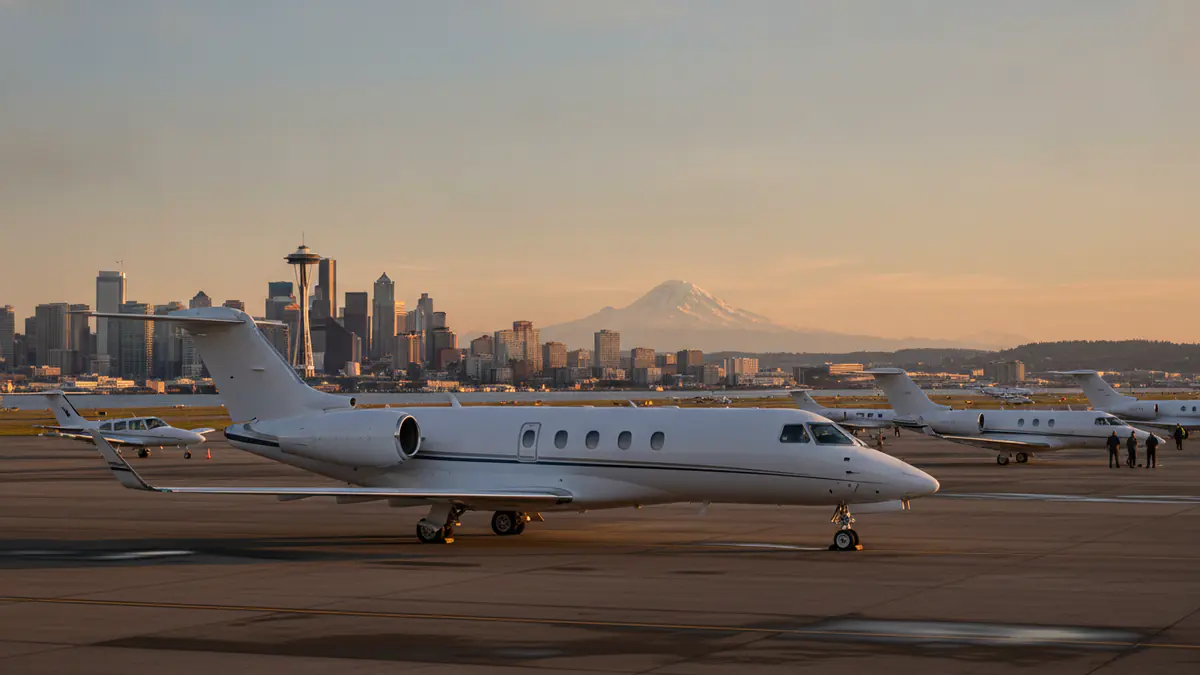
King County International Airport (Boeing Field) for private jets
King County International Airport (Boeing Field) (KBFI, BFI) is a mixed commercial and business aviation serving Seattle, United States.
Unverified Source: OurAirports (public domain, data of 2026-09-26): coordinates, IATA code, runways. Customs, hours and notes not yet verified.; FAA Chart Supplement (effective 03 SEP 2026), BOEING FLD/KING CO INTL (KBFI): AOE (Airport of Entry) (https://aeronav.faa.gov/afd/03sep2026/nw_263_03SEP2026.pdf)
- ICAO / IATA
- KBFI / BFI
- Type
- Mixed commercial and business aviation
- Longest runway
- 10,007 ft
- Customs
- Yes
- Hours
- Not yet verified
- Coordinates
- 47.5270, -122.2999
Getting to Boeing Field
Driving route from the city centre. Times vary with traffic; your driver or the FBO can advise on the best pick-up time.
Aircraft that can use it
By runway length alone, turboprops, light jets, midsize jets, super midsize jets, heavy jets, ultra long range jets and vip airliners can typically use Boeing Field. Operators confirm performance, slots and restrictions for each flight.
FBOs at Boeing Field
No verified FBO records yet.
Empty legs from Boeing Field
No live empty legs are connected for this search yet. Empty legs appear here only from real operator inventory; we never show made-up availability. A specialist can still check one-way opportunities for your dates.
Private jet routes from Boeing Field
Private jet Boeing Field: Seattle's close-in airport for business aviation
A private jet Boeing Field arrival puts you closer to downtown Seattle than any other airport with a long runway. King County International Airport, known to almost everyone as Boeing Field (ICAO KBFI, IATA BFI), lies in the Duwamish valley about four miles south of downtown, according to King County, which owns and runs it. The airport is a working mix of corporate jets, cargo flights, small commuter airlines, helicopters, military aircraft and aircraft-maker test and delivery flights, and for private passengers it offers something rare in a major city: a runway long enough for the largest business jets, a few minutes' drive from the office towers.
The facts panel and widgets above give the codes, coordinates, runway figure, customs status, live weather and the driving route from central Seattle. This guide covers what those facts mean for a charter: how private flights work on a busy mixed-use field, why the runway matters, customs on international trips, Boeing Field versus Sea-Tac, and how we plan a flight through BFI.
JetPriceCheck is a charter broker. We do not own or operate aircraft. We ask licensed operators for suitable aircraft, compare options and stay with the booking until you land. The JetPriceCheck homepage explains how it works.
Why private flights to Seattle use Boeing Field
Seattle's airline airport, Seattle–Tacoma International, lies further south, between the two cities that give it its name, and it runs a dense airline schedule. Private aircraft can use it, but for most business aviation trips Boeing Field is the practical choice.
- Proximity. Four miles to downtown means a short drive to the business district, the waterfront, South Lake Union and the stadiums, traffic permitting.
- Private-scale handling. Business aviation passengers use fixed-base operators (FBOs) with their own lounges, car access and aircraft parking, not airline terminals. If the term is new, our explainer on what an FBO is covers what they provide.
- A runway for any business jet. Public airport data (OurAirports) lists the main runway at 10,007 ft, and the county notes a shorter parallel runway used by smaller general aviation traffic.
We do not name individual handlers here because we have not verified the current list. The operator confirms its handler when your flight is booked, and we pass the address to your driver.
Boeing Field's history in one paragraph
The field has been tied to aviation manufacturing since the early twentieth century, and it still hosts aircraft-maker activity alongside everything else, as Wikipedia explains. That heritage is why the airport has infrastructure out of proportion to its size: long runways, a control tower handling varied traffic and a strong base of aviation services. It is also why you may see brand-new airliners on test flights while your business jet taxis out.
Who flies private through Boeing Field
The typical private jet Boeing Field passenger falls into one of a few groups:
- Technology and corporate travellers visiting headquarters and offices around Seattle and the Eastside.
- Sports and entertainment travellers, since the stadium district is close to the field.
- Leisure travellers heading to the San Juan Islands, mountain resorts, California and Hawaii.
- International travellers to and from Canada and Asia, using customs on the field.
What a private jet Boeing Field departure looks like
Because the airport is busy with many kinds of traffic, the private side is kept separate from cargo and manufacturer areas. On the day, a departure usually runs like this:
- Arrival at the FBO. Your car drives to the handler's building, not to a terminal. We send the exact address and gate details to your driver the day before.
- Check-in. The handler checks identity against the passenger list the operator filed. For international flights, passports are checked against the manifest.
- Baggage. Bags go directly from the car to the aircraft hold. There is no bag drop or carousel, and oversized items such as skis or golf bags are fine if you told us in advance.
- Boarding. You walk or are driven to the aircraft. The crew briefs you on the flight time, the weather and the arrival arrangements.
- Taxi and departure. Boeing Field's mixed traffic means an occasional short wait for a cargo jet or a test flight, but queues are nothing like an airline hub's.
Arrivals run the same way in reverse: the aircraft parks at the FBO, your car waits beside it or at the door, and bags are transferred for you. On international arrivals, customs inspection comes first.
Flights to and from Canada
Vancouver and Victoria are short hops from Seattle, and they are among the most common international private trips from BFI. Because the flight crosses a border, both countries' entry rules apply: the operator files advance passenger information for each direction, passengers carry passports, and customs is cleared at the first airport of arrival. The flight itself is short, so allow for the paperwork in the overall timing. For a same-day return, we confirm customs availability at both ends before committing to the schedule.
Runway and aircraft at BFI
With a main runway above 10,000 ft, Boeing Field accommodates every business jet category by runway length, from turboprops to ultra-long-range jets. The aircraft screening section above reflects that. The runway's length matters most for heavy jets carrying fuel for long flights, such as trips to the East Coast, Hawaii or Asia, where a shorter runway might limit the load.
The operator still checks performance for each flight, taking account of weight, temperature and the runway in use. Our aircraft guide explains the categories, passenger numbers and ranges. For Boeing Field trips the typical choices are:
- Turboprops and light jets for four to seven passengers on regional trips to Portland, Spokane, Vancouver, the islands and Sun Valley.
- Midsize and super midsize jets for California, the Mountain West and Texas, and for larger groups.
- Heavy and ultra-long-range jets for coast-to-coast trips, Hawaii and Asia.
Over-water flights to Hawaii and Asia
Flights across the Pacific need extra fuel reserves because there are few or no diversion airports along the way. Even where an aircraft's published range looks sufficient, operators often use a larger aircraft for an ocean crossing, and each trip is checked by the operator for winds, reserves and alternates before it is confirmed.
Boeing Field or Sea-Tac: which Seattle airport suits your trip
| Question | Boeing Field (BFI) | Seattle–Tacoma (SEA) |
|---|---|---|
| Main traffic | Business aviation, cargo, commuter airlines, manufacturer flights | Airline hub |
| Distance to downtown | About four miles (King County) | Further south |
| Ground delays | Usually short | Can be long at airline peaks |
| Best for | Downtown, stadiums, South Lake Union, most private trips | Airline connections, very large aircraft groups |
For most private trips, Boeing Field wins on time. Sea-Tac comes into play for connections with airline flights or for occasional VIP airliner operations. Operators may also suggest other regional airports for addresses on the Eastside or further north. The choice is rarely about the aircraft, since both runways are long; it is about where you are going once you land, what time of day you travel and whether you need to meet an airline flight. We compare the door-to-door time for each option before recommending one.
Customs at Boeing Field
The FAA Chart Supplement current at the time of writing lists Boeing Field as an Airport of Entry. That means U.S. Customs and Border Protection provides inspection there for international arrivals, which is useful for flights from Canada and Mexico, returns from the Caribbean or Europe, and trans-Pacific sectors from Asia.
For passengers:
- Advance passenger information. The operator files the manifest through eAPIS before departure, so names and passport details must be final.
- Entry documents. Every passenger needs a valid passport and the right visa or travel authorisation for the United States.
- Timing. Customs hours and staffing should be confirmed for the specific arrival time, especially late at night.
For outbound trips, our guide to private jet security and passports covers what passengers usually need.
Getting between Boeing Field and the city
The airport sits beside Interstate 5 and the Duwamish, south of the SoDo district. The map above shows the driving route from central Seattle.
- Downtown, the waterfront and the stadiums are a short drive outside rush hour.
- South Lake Union and Capitol Hill are a little further, through the downtown grid.
- Bellevue and the Eastside involve crossing Lake Washington, and bridge traffic can add a lot of time at peak hours.
Most passengers are met by a chauffeured car at the FBO. If you want the car organised with the flight, our private jet with chauffeur service arranges the pick-up and tracks your arrival.
Routes from Boeing Field
Two corridors in our data use Boeing Field as the Seattle airport: Los Angeles–Seattle and San Francisco–Seattle. Both are West Coast business routes where a midsize or super midsize jet suits most groups and a light jet can work for smaller parties. The airport's short drive to downtown is a big part of their appeal.
Other common private trips from BFI include:
- Regional hops to Portland, Spokane, Vancouver and the San Juan Islands.
- Mountain resorts such as Sun Valley, Jackson Hole and Aspen in the winter season.
- Business centres in Texas, the Midwest and the East Coast.
- Hawaii and Alaska, planned with the over-water considerations above.
The Seattle departures hub groups the city's routes, and the directory of charter routes lists every route we cover.
Seasons and weather at Boeing Field
The Pacific Northwest's weather is famous for rain and low cloud rather than extremes. Long spells of overcast and drizzle from autumn to spring are routine for professional crews, but low cloud and fog can slow arrival rates at times. Occasional snow and ice in winter cause disruption, and wildfire smoke in some summers reduces visibility.
Summer is the busiest leisure season, with trips to the islands, Alaska and mountain lakes, while winter brings ski traffic and business travel. Major sports and technology events fill aircraft and ground transport, so book early for those dates.
What a private jet from Boeing Field costs
Charter prices depend mainly on the aircraft, the flight time and where the aircraft is based. Boeing Field adds landing, parking and handling fees that vary by aircraft size and length of stay. Seattle has a solid base of charter aircraft, which helps keep positioning costs in check for regional and West Coast trips.
Our private jet cost guide explains how estimates are built, and each route page shows estimated ranges by aircraft category. Those are estimates from our pricing model, not quotes. A firm price comes from a licensed operator for a specific aircraft and date.
Empty legs from Boeing Field
Repositioning flights between Seattle and California are common, and some are offered as one-way empty legs at lower prices. They depend on another client's booking and can change. Our empty-leg flights page explains how they work.
How we arrange your private jet Boeing Field flight
We start with passengers, luggage, dates and the addresses at each end. We ask licensed operators for aircraft that suit the route, check the Boeing Field points that matter (customs timing on international trips, fuel planning on over-water sectors, ground transfer timing across the lake) and present the options with the trade-offs laid out. You choose; the operator flies; we coordinate until you land.
To start, send your trip to JetPriceCheck.
Private jet Boeing Field FAQs
Can private jets land at Boeing Field?
Yes. Boeing Field handles business jets of every size, with a main runway of about 10,000 ft. Private passengers use FBOs rather than an airline terminal.
How far is Boeing Field from downtown Seattle?
About four miles south of downtown, according to King County. Drive times depend on traffic on Interstate 5.
Is Boeing Field or Sea-Tac better for a private jet?
For most private trips, Boeing Field is closer to downtown and quicker on the ground. Sea-Tac suits airline connections and very large aircraft groups.
Does Boeing Field have customs?
Yes. The FAA Chart Supplement lists Boeing Field as an Airport of Entry, so international arrivals clear U.S. Customs and Border Protection on the field. Confirm hours for your arrival time.
Can I fly nonstop from Seattle to Hawaii on a private jet?
Many larger business jets can. Over-water flights need extra fuel reserves, so operators often choose a larger aircraft for the crossing and check each trip individually.