Turboprop
Pilatus PC-12 charter
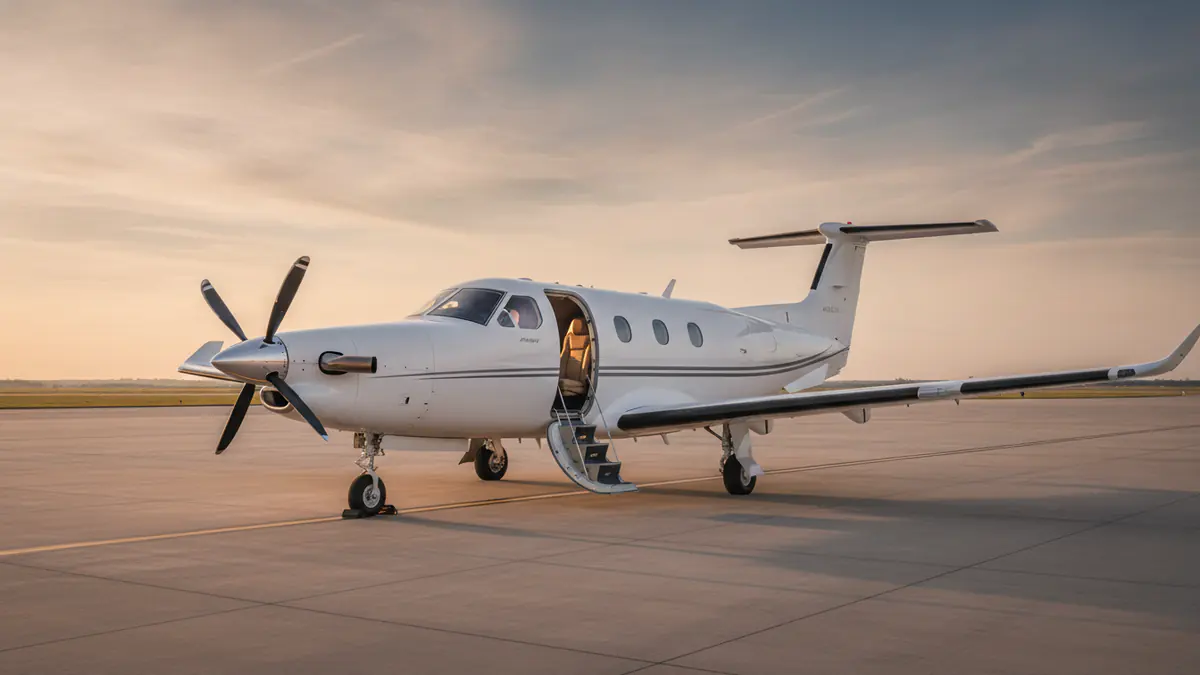
The Pilatus PC-12 is a turboprop built by Pilatus Aircraft with a published range of about 1,765 nm, typically carrying 6–8 passengers.
Unverified Specifications source: Pilatus PC-12 PRO overview, maximum range (pilatus-aircraft.com) (https://www.pilatus-aircraft.com/en/fly/pc-12); Pilatus PC-12 PRO technical data (pilatus-aircraft.com) (https://www.pilatus-aircraft.com/en/pc-12/technical-data)
- Range
- 1,765 nm
- published, not practical
- Cruise
- 290 kt
- Passengers
- 6–8
- max 9 certified
- Cabin (H × W × L)
- 4.8 × 5 × 16.9 ft
- Baggage
- 34.3 cu ft
- In production
- Yes
Where the Pilatus PC-12 can fly nonstop
Screened against our route set with a practical-range margin.
Of 104 city pairs we cover, the Pilatus PC-12 can typically fly 71 nonstop.
| Route | Distance | Range |
|---|---|---|
| New York – Dubai | 5,951 nm | Fuel stop likely |
| London – Los Angeles | 4,718 nm | Fuel stop likely |
| Geneva – Aspen | 4,543 nm | Fuel stop likely |
| New York – São Paulo | 4,162 nm | Fuel stop likely |
| London – Aspen | 4,140 nm | Fuel stop likely |
| Hong Kong – Sydney | 3,993 nm | Fuel stop likely |
| London – Miami | 3,823 nm | Fuel stop likely |
| Nice – New York | 3,464 nm | Fuel stop likely |
| Geneva – New York | 3,352 nm | Fuel stop likely |
| London – Washington, D.C. | 3,179 nm | Fuel stop likely |
Pilatus PC-12 charter cost
Charter pricing for turboprops in our model runs US$2,000–US$3,500 per flight hour Estimate. Individual aircraft vary with age, interior, operator and base. This is the cost to charter, not to buy.
Singapore to Hong Kong: about 5 h 30 min, US$17,500–US$31,000 one way.
New York to Cancún: about 5 h 25 min, US$17,500–US$30,500 one way.
Los Angeles to Dallas: about 4 h 25 min, US$14,000–US$25,000 one way.
Other turboprops
| Aircraft | Range | Passengers | Baggage |
|---|---|---|---|
| Pilatus PC-12 | 1,765 nm | 6–8 | 34.3 cu ft |
| Beechcraft King Air 350i | 1,806 nm | 6–8 | — |
Pilatus PC-12 at a glance
The Pilatus PC-12 is the aircraft many travellers are offered when they ask for something smaller and cheaper than a jet, and it is worth understanding before you dismiss it as "just a propeller plane". It is a single-engine turboprop built in Switzerland, with a cabin about as wide as a light jet's, a big rear cargo door and the ability to use short and even unpaved runways. On trips of up to about two hours, it often costs less than the smallest jets and reaches airports they cannot.
The facts strip above shows the figures in our dataset for the PC-12, taken from Pilatus's figures for the current PC-12 PRO: range, cruise speed, passengers, cabin size and baggage. They are published manufacturer or public figures, not independently verified. The tables list the trips it can typically fly nonstop and the other turboprop we track. This guide explains what the numbers mean in practice: who the aircraft suits, where it is the smart choice and where a jet would serve you better.
We are a charter broker. We do not own or operate the PC-12 or any other aircraft. We ask licensed operators for aircraft that fit your trip, compare the options with you, and stay with the booking until you land. You can read more about how that works on the JetPriceCheck homepage.
What the PC-12 is, and why operators like it
Pilatus Aircraft, based in Stans near Lucerne, designed the PC-12 in the late 1980s. It first flew around 1991 and entered service a few years later, according to the Pilatus PC-12 entry on Wikipedia. The PC-12 NGX arrived around 2019 with a newer engine, an electronically controlled propeller and a refreshed cabin; the current version is the PC-12 PRO, described on Pilatus's own PC-12 page. More than 2,000 have been delivered across all versions, which makes it one of the most common business turboprops in the world.
It is flown in very different roles: corporate shuttles, fractional and membership programmes, air ambulance work (the Royal Flying Doctor Service in Australia is a well-known operator), cargo and passenger charter. That versatility explains why the aircraft appears in charter fleets on several continents, and it has three consequences for you.
- Availability. A large, spread-out fleet raises the chance of finding one near your departure airport, which keeps positioning costs down.
- Airport access. The PC-12 is approved for short, rough and unpaved strips, so it can get closer to ranches, islands and mountain towns than most jets.
- Running costs. One engine burns less fuel than two, and the lower operating cost flows through to the hourly rate.
One engine: what that means for charter
The PC-12 has a single Pratt & Whitney Canada PT6 turboprop engine, a family with a long service record in business and utility aviation. Whether a single-engine aircraft may carry paying passengers at night or in cloud depends on the regulator. In the United States, charter operators flying under 14 CFR Part 135 can operate single-engine turbine aircraft for passengers under instrument flight rules when they meet the equipment and approval requirements. In Europe, the European Union Aviation Safety Agency (EASA) has allowed commercial single-engine turbine operations in instrument conditions, known as SET-IMC, since around 2017, again with specific operator approval.
In plain terms: not every PC-12 operator can fly every mission. When we ask for quotes, we confirm that the operator holds the right approvals for your route, timing and weather conditions. If you would simply feel more comfortable with two engines, say so and we will look at the twin-engine King Air 350i instead.
PC-12 range and speed: the practical picture
The dataset shows a published range of about 1,765 nautical miles and a cruise speed of about 290 knots. Published range assumes a light load, long-range cruise settings and still air. Real charter trips add headwinds, a full cabin, alternate airports and reserve fuel, so our screening applies a practical-range margin before it calls any trip nonstop.
Speed is where the trade-off shows. At around 290 knots, the PC-12 is roughly a third slower than a light jet. On a 45-minute hop that difference is a few minutes; on a three-hour sector it can be the best part of an hour. That is why the PC-12's natural charter zone is the flight of up to about two hours, where lower cost and better airport access outweigh the slower cruise.
Our fact pack screens 71 of the corridors we cover as nonstop for the PC-12. These are screening estimates, not operating promises. They include:
- United States short hops: New York to Washington, D.C., Boston, Philadelphia and Nantucket; Los Angeles to Las Vegas, San Diego, San Francisco, Phoenix and Aspen; San Francisco to Reno; Denver to Aspen; Dallas to Austin and Houston.
- Florida and the islands: Miami to Nassau, Orlando and Atlanta; New York and Miami to Cancún.
- Europe: London to Paris, Geneva, Nice and Milan; Paris to Nice and Geneva; Munich, Zurich and Milan links; Barcelona and Madrid to Ibiza; Geneva to Olbia.
- Middle East and Asia-Pacific: Dubai to Riyadh, Doha and Jeddah; Riyadh to Jeddah; Singapore to Bali; Melbourne to Sydney.
Some of those pairs sit near the edge of what anyone would want to do in a turboprop. New York to Cancún or Singapore to Hong Kong may pass the range screen, but at turboprop speed they are long flights, and a jet will often make more sense. The list also shows what is missing: New York to Aspen, Miami to Aspen and Miami to Cabo San Lucas pass the screen for light jets in our data but not for the PC-12. Our private jet range guide explains how the screening works.
Pressurisation and altitude
The PC-12 is pressurised and cruises well above the low-level weather that bumps unpressurised piston aircraft around, although it flies lower than jets. On most short trips passengers notice little difference. On a hot summer afternoon over mountains or the desert, a jet's higher cruise can mean a smoother ride, so it is worth asking about if anyone in the group is a nervous flyer.
Inside the PC-12 cabin
This is where the PC-12 surprises people. The cabin in our dataset measures about 4.8 feet high, 5 feet wide and 16.9 feet long. That is not a stand-up cabin, but it is about as wide as a light jet's, and the flat floor makes it feel open.
Seating. Executive layouts usually have six or eight seats, often in a club arrangement with forward- and rear-facing seats. Our facts strip shows six to eight passengers as typical, with nine as the published maximum. For comfort on trips over an hour, six adults is a sensible plan.
Lavatory. Many executive PC-12s have a small toilet at the front or rear of the cabin, but some configurations do not, and it is often a compact seat with a curtain or partition rather than a separate room. If it matters to your group, tell us and we will confirm the layout of the specific aircraft offered.
Refreshments. Expect a small refreshment cabinet with cold drinks and snacks. On a 90-minute flight that is usually all anyone needs.
Noise. Turboprops are louder in the cabin than modern light jets, although the NGX added features to reduce noise and vibration. Many operators provide headsets.
Baggage and the cargo door
The dataset lists about 34 cubic feet of baggage space, which sounds small. The real advantage is the large rear cargo door, one of the PC-12's signatures. Because the baggage area is inside the pressurised cabin and can be extended by removing or folding seats, bulky items fit more easily than in many light jets: skis, golf bags, bikes, surf boards, dog crates or equipment cases. With fewer passengers, you get far more room. Tell us what you are bringing and we will check the load with the operator before you commit.
Who a PC-12 charter suits
The aircraft is a strong fit for:
- Short regional trips. New York to the Hamptons, Nantucket or Martha's Vineyard, Los Angeles to Palm Springs or Las Vegas, London to Paris, or island hops in the Bahamas.
- Mountain and ski travel. Denver to Aspen or Telluride, or regional strips in the Alps, where short runways and steep approaches matter.
- Remote or rough airfields. Ranches, hunting lodges and island strips with short or unpaved runways that jets cannot use.
- Groups with bulky kit. Sports teams, film crews and families with skis, bikes or pets.
- Budget-conscious flyers. Travellers who want private access and flexibility but not the cost of a jet.
It is a weaker fit for:
- Flights over about two and a half hours. The speed gap to a jet grows with distance.
- Passengers who want a separate, enclosed lavatory. Many light and midsize jets have one as standard.
- Travellers who want two engines. The King Air 350i or a light jet is the answer.
Pilatus PC-12 cost: reading the estimates
The cost section above shows the hourly range our pricing model uses for turboprops, based on published market rates, USD 2,000–3,500 per flight hour, plus sample one-way estimates for trips the aircraft can fly nonstop. These are estimates, not quotes and not offers. A real price comes only from a licensed operator for a specific aircraft on a specific date, and our private jet cost guide explains how the ranges are built.
Many people searching for the cost of a Pilatus PC-12 are asking about the purchase price. This page covers charter only: you pay for flight time and the associated fees, not the aircraft. What moves a PC-12 charter quote most:
- Positioning. If the nearest suitable aircraft is an hour away, that hour, and often the return, is in the price.
- Slower cruise. A lower hourly rate is partly offset by more hours on longer trips. On a 300-mile hop the PC-12 usually wins on total cost; on a 1,000-mile trip a light jet can come close.
- Trip shape. A same-day return usually costs well under twice a one-way.
- Overnights. Crew hotel and parking are added if the aircraft waits with you.
- Airport and handling fees. These vary by airport and season.
- Demand. Holiday weekends and event weeks tighten supply.
Empty legs
Popular turboprops generate empty legs when they fly home after a one-way trip, especially on seasonal routes to islands and ski towns. They can be priced below the normal charter rate, but the timing is set by the original booking and can change. Our empty leg flights page explains how to use them sensibly.
PC-12 or the alternatives?
The comparison table above lists the other turboprop in our dataset. Most clients weighing a PC-12 are really choosing between it, the King Air 350i and the smallest jets. Here is how we frame that decision:
| Question | Pilatus PC-12 | King Air 350i | Light jet |
|---|---|---|---|
| Engines | One turboprop | Two turboprops | Two jets |
| Cabin width | Wider than the King Air in our data | Narrower, longer | Varies, often similar |
| Bulky baggage | Large rear cargo door | Good, aft cabin hold | Often tight |
| Cruise speed | Slowest | A little faster | Much faster |
| Short and unpaved strips | Strong | Good | Limited |
| Relative estimate range | Lowest | Low | Higher |
If the trip is under two hours, the group is up to six with bulky bags, and the destination has a short runway, the PC-12 is often the right-sized choice. If you want two engines or seats for more passengers, look at the Beechcraft King Air 350i. If speed matters most, a light jet such as the Pilatus PC-24, from the same manufacturer and designed to use similar short strips, or the Phenom 300E is the next step. Our turboprop charter guide compares the category, and the wider aircraft guide covers every size.
How we arrange a PC-12 charter
- You share the brief. Dates, airports, passenger count and a description of the luggage and any equipment.
- We ask licensed operators. We look for PC-12s and close alternatives near your departure point and confirm the operator's approvals for your route and timing.
- You compare options. We show the aircraft, its year and layout where available, what is included, and any positioning or overnight costs.
- You confirm on the operator's terms. The operator is responsible for the flight; we coordinate the details.
- We stay with the trip. Weather, runway conditions and changing plans are handled with the operator on your behalf.
If you know the route, browse the directory of private jet routes for route estimates, flight times and airport notes, or send your trip to JetPriceCheck and we will do the searching.
Pilatus PC-12 FAQ
Is the Pilatus PC-12 a private jet?
No. The PC-12 is a turboprop: a turbine engine drives a propeller. It is often chartered in place of a light jet on short trips, and it is pressurised with an executive cabin, but it is slower than a jet.
How many passengers can a Pilatus PC-12 carry?
Our dataset shows six to eight passengers as typical, with nine as the published maximum. For comfort on flights over an hour, plan on six adults and check that the luggage fits.
How far can a PC-12 fly?
Pilatus publishes a range of about 1,765 nautical miles under ideal conditions. For charter, plan on sectors of up to about two hours; longer trips are possible but a jet is often more comfortable. Our screening flags 71 corridors in our route set as nonstop for this aircraft.
Does the PC-12 have a bathroom?
Many executive PC-12s have a small toilet, but not all, and it is usually compact rather than a separate room. Ask us to confirm the layout of the aircraft offered.
How much does it cost to charter a Pilatus PC-12?
Our pricing model, based on published market rates, uses USD 2,000–3,500 per flight hour for turboprops, but the final price depends on positioning, trip shape, fees and dates. Only an operator's quote is a firm price.
Can the PC-12 land on short or grass runways?
Yes, it is approved for short and unpaved strips, which is one of its main advantages. Every airport is still checked for the specific date, load and conditions, so we always confirm suitability with the operator.