Guide
FBO Airport Meaning: What Is an FBO in Aviation?
What a fixed-base operator is, what happens there on a private flight, and how FBOs differ from airline terminals.
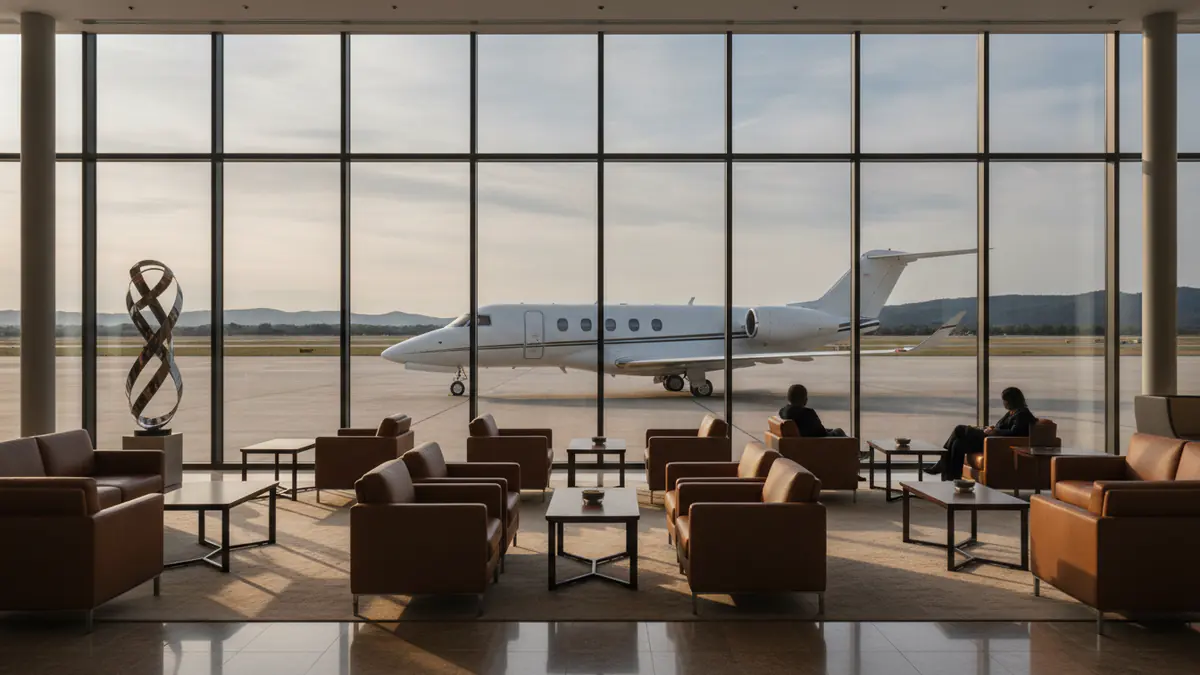
FBO airport meaning in one sentence
The FBO airport meaning is simple: an FBO, or fixed-base operator, is the business at an airport that looks after private aircraft and their passengers, from fuel and parking to the private terminal where you check in, relax and walk out to your jet. If you have ever wondered what "FBO" on a charter itinerary means, it is the address you drive to instead of the airline terminal.
This guide explains what FBO stands for in aviation, what an FBO actually does, what happens there on the day of a private flight, and how the experience differs from flying with an airline. It also covers the practical questions travellers ask us most: how early to arrive, whether there is security screening, where customs happens on international trips and how your driver finds you.
We are a charter broker. We do not own aircraft and we do not run FBOs; we arrange flights with licensed operators, and the FBO you use is normally chosen by the operator. Once your trip is confirmed, we give you the FBO's name, address and contact details in your trip sheet. You can see how the whole process works on the JetPriceCheck homepage.
What does FBO stand for in aviation?
FBO stands for fixed-base operator. The term dates from the early days of civil aviation. After the First World War, many pilots flew from town to town giving rides and displays, with no permanent home. Businesses that set up permanently at one airfield, offering fuel, repairs, flight training and aircraft rental, came to be called fixed-base operators to set them apart, according to the Wikipedia article on fixed-base operators.
A century later, the name has stuck, even though the business has changed. Today, when someone asks "what does FBO mean in aviation?", the practical answer is: the private aviation service centre at an airport.
FBO meaning outside the United States
The term FBO is most common in North America. In Europe, the Middle East and Asia you will also hear:
- GAT (general aviation terminal): a terminal building for private and business flights, sometimes run by the airport itself.
- Handling agent: the company that provides ground services to the aircraft and passengers, whether or not it has its own building.
- Business aviation terminal or VIP terminal: often used at big international airports where private flights share the airfield with airlines.
The words differ, but the idea is the same: a separate door, a separate lounge and a short walk or drive to the aircraft.
What does an FBO do?
An FBO serves two customers at once: the aircraft and crew, and the passengers. Behind the lounge you see, much of the work happens on the ramp.
Services for the aircraft
- Fuel. Selling jet fuel is the core of most FBOs' business.
- Ramp and parking. Marshalling the aircraft in, chocking it, and finding it a parking spot on the apron or in a hangar.
- Hangar space. Overnight or long-term storage out of the weather, which matters for de-icing in winter and heat in summer.
- Ground power, towing and lavatory service. The practical services that keep an aircraft ready between flights.
- Maintenance. Some FBOs have repair stations on site or can call in engineers.
Services for passengers and crew
- Lounge. A private waiting area, usually with seating, refreshments, Wi-Fi and restrooms, and at larger FBOs meeting rooms.
- Check-in. Staff confirm who is flying and pass the passenger list to the crew.
- Baggage. Your bags are taken from your car to the aircraft.
- Catering coordination. Meals are usually ordered by the operator and delivered to the FBO for loading.
- Ground transport. Cars can often drive to the ramp, subject to airport rules, and FBOs arrange taxis or rental cars.
- Crew facilities. Rest rooms, flight planning areas and weather briefing tools for the pilots.
In the United States, airports that receive federal grants usually set minimum standards that businesses must meet to operate as an FBO, and the Federal Aviation Administration publishes guidance on how airports write those standards in Advisory Circular 150/5190-7. The industry's main US trade body is the National Air Transportation Association, which represents FBOs among other aviation service businesses.
FBO airports: where you find them
Almost every airport that handles private flights has at least one FBO or handling agent. They fall into three broad groups.
Business aviation airports. Some airports are dedicated largely or entirely to private and business flights. Teterboro near New York, Van Nuys in Los Angeles, Paris–Le Bourget and London Farnborough are well-known examples. These FBO airports often have several competing FBOs side by side, and the whole airport is built around private flying. Our guides to Teterboro, Van Nuys, Paris–Le Bourget and London Farnborough cover each one.
Large commercial hubs. Major airline airports usually have an FBO or business aviation terminal on the far side of the field, away from the airline terminals. Some big hubs also offer a separate private suite service for airline passengers who want to skip the public terminal. That is a different product from an FBO, but it shows how far the private-terminal idea has spread.
Small regional airfields. At a small airport, the FBO may be a modest building that also sells fuel to local pilots and runs a flight school. The welcome is often just as personal; the facilities are simpler.
When we plan a trip, the choice of airport is often more important than the choice of FBO. A business aviation airport close to your address can save more time than any lounge. You can browse the airports we cover in our airport guides.
What happens at an FBO on the day you fly
Here is how a typical departure works for a private jet charter passenger.
Arriving at the FBO
You, or your driver, go to the FBO address in your trip sheet, not to the airline terminal. This is the most common mix-up we see: at a big airport the FBO can be a long drive from the passenger terminals, with its own entrance road. At many FBOs your car can park right outside, and at some, subject to the airport's rules, the car can drive onto the ramp to the aircraft.
How early should you arrive?
Most operators ask passengers to arrive 15 to 30 minutes before a domestic departure, and a little earlier for international flights, where documents are checked. That compares with the one to three hours many travellers allow for an airline flight. The crew will be there well before you, preparing the aircraft and filing the flight plan.
Check-in, ID and bags
FBO staff greet you, confirm your name against the passenger list, and check identity documents as the operator requires. Your bags are loaded for you. If you are carrying anything unusual, such as sports equipment, firearms for a hunting trip or a pet, the operator will have told you the rules in advance, and the FBO team will know you are coming.
Boarding
When the aircraft is ready, the crew or FBO staff walk you out to the aircraft. The captain usually gives a short briefing, the door closes, and the aircraft taxis. From kerb to take-off can be a matter of minutes.
Arriving at your destination
On arrival, the aircraft taxis to the FBO ramp at the destination airport. Your car can often meet you at or near the aircraft, and your bags are transferred straight from the hold. There is no baggage belt and no walk through a public terminal.
FBO vs airline terminal: the key differences
| FBO (private terminal) | Airline terminal | |
|---|---|---|
| Arrival before departure | Typically 15–30 minutes | Often 1–3 hours |
| Security | Operator's procedures; TSA programmes for larger charter aircraft | Public security checkpoint |
| Crowds | A few passengers at a time | Hundreds or thousands |
| Walk to the aircraft | Usually a short walk across the ramp | Gates, piers, sometimes buses |
| Baggage | Carried to and from the aircraft for you | Check-in desk and baggage belt |
| Car access | Often at the door, sometimes on the ramp | Kerbside drop-off, public car parks |
These differences are the main reason many travellers choose private flights for short trips, where time saved on the ground is a large share of the whole journey.
Security at the FBO
A question from the People Also Ask box comes up in almost every conversation: do you still go through TSA on a private jet? For most charter flights on smaller aircraft, there is no public TSA checkpoint of the kind you pass through at an airline terminal. Security is handled through the operator's procedures: confirming the identity of every passenger, controlling access to the ramp and the aircraft, and checking baggage as the operator's security programme requires.
Larger charter aircraft are covered by TSA security programmes that the operator must follow, and those can include screening of passengers and bags. The rules depend on the size of the aircraft and the type of operation, and other countries apply their own security regimes. In practice, the experience is still quicker and more private than an airline checkpoint, but you should carry valid ID and expect questions about your bags.
Customs and immigration at FBOs
For international trips, customs and immigration depend on the airport. At some FBO airports, officers work in or visit the FBO, so passengers clear formalities without entering the public terminal. At others, passengers are taken to a dedicated facility elsewhere on the airport. Some smaller airports cannot handle international arrivals at all, and the aircraft must land first at a designated airport of entry.
This is one of the reasons we check the arrival airport carefully on international trips. It affects not just the time on the ground but whether a particular airport is possible for your first landing in a new country. Our guide to private jet security and passports explains the documents to carry.
FBO fees: who pays and what for
FBOs charge for their services, and on a charter flight those charges are part of what the operator passes on to you, either built into the quote or listed as extras. The most common are:
- Handling or facility fees, which some FBOs reduce or waive when the aircraft buys fuel.
- Parking and hangar fees, often charged per night and rising with aircraft size.
- Airport landing and passenger fees, collected by the airport, sometimes through the FBO.
- De-icing, catering and ground transport, charged when used.
These costs are one reason why two quotes for the same route can differ. Our private jet cost guide lists the other factors, and if you want to see how the price of an aircraft class changes with its size, our guide to private jet sizes sets out the estimate ranges by category.
Choosing an FBO: does the passenger get a say?
On a charter flight, the operator usually chooses the FBO. It may have a fuel contract with one of them, a hangar agreement, or simply a preference based on service. As a passenger you can ask for a particular FBO, for example because it is on the side of the airport closer to your destination or because it has a meeting room you want to use, and we pass the request on. Whether it can be granted depends on the operator.
If you own a share in an aircraft or hold a membership programme, the programme often has preferred FBOs across its network. Our guide to fractional jet ownership explains how those arrangements work.
FBOs and empty legs
FBOs are also where the ends of empty-leg flights begin and finish. An empty leg is an aircraft flying without passengers to reposition for its next booking. If you book one, you meet the aircraft at the FBO the operator is using for that positioning flight, which may be at a different airport from the one you would have chosen. It is worth checking the FBO address and the drive time before you commit.
Frequently asked questions
What does FBO stand for in aviation?
FBO stands for fixed-base operator. It is the business at an airport that provides fuel, parking, hangars and ground handling for private aircraft, and a lounge and private terminal for their passengers and crew.
What is the FBO airport meaning for passengers?
For a passenger, the FBO is the private terminal you use instead of the airline terminal. You check in there, wait in its lounge if needed, and walk or are driven to the aircraft across the ramp. Your trip sheet gives its name and address.
Do you still go through TSA on a private jet?
For most charter flights on smaller aircraft, there is no public TSA checkpoint. The operator checks passenger identity and baggage under its own procedures. Larger charter aircraft fall under TSA security programmes that can include screening, so the answer depends on the aircraft and the flight.
How early should I arrive at the FBO?
Most operators ask for 15 to 30 minutes before a domestic departure and a little more for international flights, where documents are checked. Your trip sheet will give the operator's exact request.
Can my car drive to the aircraft at an FBO?
Sometimes. Many FBOs allow cars to drive onto the ramp to the aircraft, subject to airport security rules and an escort. At others, the car stops at the building and you walk a short distance. We confirm the arrangement when we plan your ground transport.
Is an FBO the same as a private terminal at a big airport?
Not always. An FBO serves private aircraft and their passengers. Some large airline hubs also sell a separate private suite service for airline passengers who want to avoid the public terminal. If you are flying on a chartered aircraft, you will use an FBO or business aviation terminal. To plan a flight, send us your trip details and we will confirm the airport and FBO with your options.