Light Jet
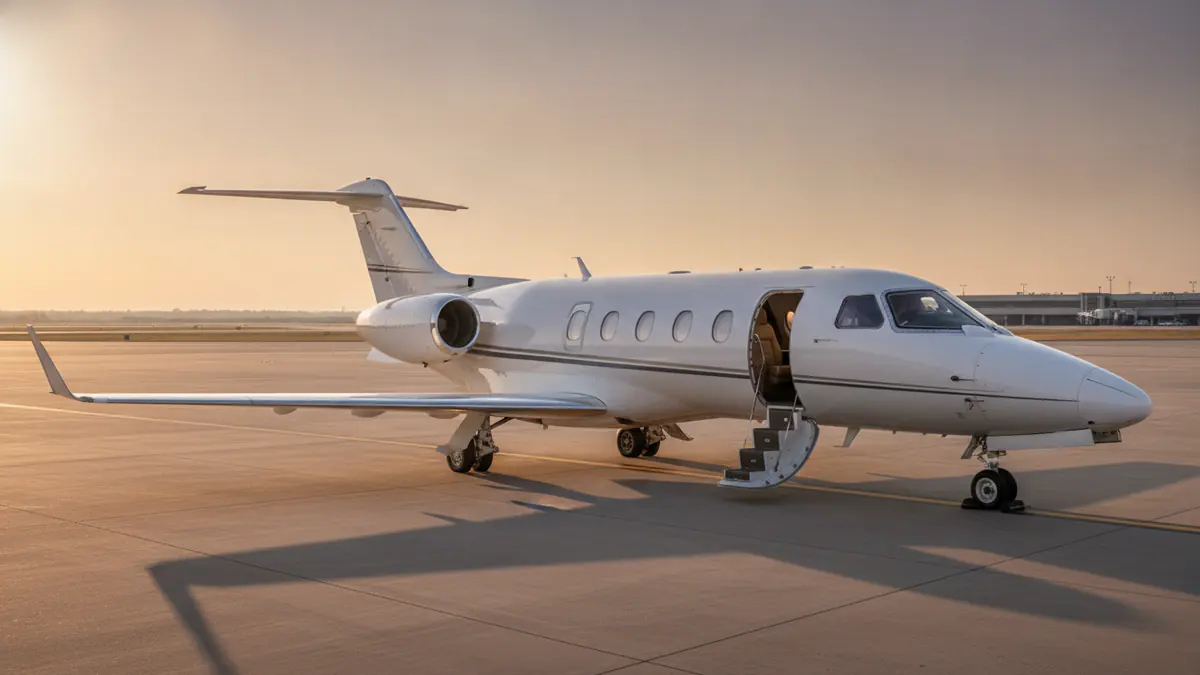
Bombardier Learjet 75 charter
The Bombardier Learjet 75 is a light jet built by Bombardier with a published range of about 2,040 nm, typically carrying 6–7 passengers.
Unverified Specifications source: Cleared: not stated by the source checked (Wikipedia: Learjet 70/75, specifications and design (cabin 1.50 m x 1.55 m x 6.0); left empty rather than keeping a demo value (https://en.wikipedia.org/wiki/Learjet_70/75); Wikipedia: Learjet 70/75, specifications and design (cabin 1.50 m x 1.55 m x 6.05 m; production ended 2022) (https://en.wikipedia.org/wiki/Learjet_70/75); Cleared: not stated by the source checked (Wikipedia: Learjet 70/75, specifications and design (cabin 1.50 m x 1.55 m x 6.0); left empty rather than keeping a demo value (https://en.wikipedia.org/wiki/Learjet_70/75); Wikipedia: Learjet 70/75, specifications and design (cabin 1.50 m x 1.55 m x 6.05 m; production ended 2022) (https://en.wikipedia.org/wiki/Learjet_70/75)
- Range
- 2,040 nm
- published, not practical
- Cruise
- 465 kt
- Passengers
- 6–7
- max 9 certified
- Cabin (H × W × L)
- 4.9 × 5.1 × 19.8 ft
- Baggage
- Not yet verified
- In production
- No
Where the Bombardier Learjet 75 can fly nonstop
Screened against our route set with a practical-range margin.
Of 104 city pairs we cover, the Bombardier Learjet 75 can typically fly 76 nonstop.
| Route | Distance | Range |
|---|---|---|
| New York – Dubai | 5,951 nm | Fuel stop likely |
| London – Los Angeles | 4,718 nm | Fuel stop likely |
| Geneva – Aspen | 4,543 nm | Fuel stop likely |
| New York – São Paulo | 4,162 nm | Fuel stop likely |
| London – Aspen | 4,140 nm | Fuel stop likely |
| Hong Kong – Sydney | 3,993 nm | Fuel stop likely |
| London – Miami | 3,823 nm | Fuel stop likely |
| Nice – New York | 3,464 nm | Fuel stop likely |
| Geneva – New York | 3,352 nm | Fuel stop likely |
| London – Washington, D.C. | 3,179 nm | Fuel stop likely |
Bombardier Learjet 75 charter cost
Charter pricing for light jets in our model runs US$3,500–US$5,000 per flight hour Estimate. Individual aircraft vary with age, interior, operator and base. This is the cost to charter, not to buy.
Dubai to Istanbul: about 4 h 15 min, US$23,500–US$33,500 one way.
Dubai to Malé: about 4 h 10 min, US$23,500–US$33,500 one way.
Miami to Cabo San Lucas: about 4 h 10 min, US$23,000–US$33,000 one way.
Other light jets
| Aircraft | Range | Passengers | Baggage |
|---|---|---|---|
| HondaJet Elite II | 1,547 nm | 4–5 | — |
| Pilatus PC-24 | 2,000 nm | 6–8 | 90 cu ft |
| Embraer Phenom 300E | 2,010 nm | 6–7 | 84 cu ft |
| Bombardier Learjet 75 | 2,040 nm | 6–7 | — |
The Learjet 75 at a glance
The Learjet 75 is the last of a famous line: a fast, sleek light jet from Bombardier that carries six or seven passengers at close to midsize-jet speed. If you are weighing a charter on one, the short version is this. It climbs quickly, cruises high above most traffic, and covers the typical one-to-three-hour business trip faster than almost anything else in its class. What it gives up is cabin height and baggage room, and because production has ended, every aircraft you are offered is at least a few years old.
This page sits under the facts strip, the nonstop route table, the cost estimates and the peer comparison above. Those figures come from our dataset, drawn from published manufacturer and reference figures: they are published manufacturer or public figures, not independently verified. The sections below explain what they mean for a real trip, where the aircraft fits well, and where a different jet would serve you better.
A quick word on who we are. JetPriceCheck is a charter broker. We do not own or operate the Learjet 75 or any other aircraft. We ask licensed operators for aircraft that suit your trip, compare what comes back, and stay on the booking until you land. You can read more about the service on the JetPriceCheck homepage.
What is a Learjet? A short history of the name
Few aircraft names have crossed into everyday language the way "Learjet" has. The company was founded by the American inventor Bill Lear, and its first jet flew in 1963, according to the Learjet entry on Wikipedia. For decades, "Lear jet" was shorthand for any small private jet, which is why so many people still search for the word without a model number.
Bombardier bought Learjet in 1990 and kept developing the line. The Learjet 75 is a modernised descendant of the Learjet 45, described in the Learjet 45 article, which also covers the closely related Learjet 70. The 75 arrived around 2013 with a new glass cockpit (Garmin G5000), winglets, updated Honeywell engines and a refreshed cabin. A later "Liberty" version offered a six-seat club layout aimed at owners moving up from smaller jets.
In 2021, Bombardier announced that it would end Learjet production, and the final aircraft were delivered in 2022. That has three practical consequences for anyone looking at a Learjet charter today:
- Every airframe is used. The youngest Learjet 75 aircraft are a few years old, and the oldest date from the mid-2010s. Interiors vary with how each owner has refurbished them.
- Support continues. Bombardier still supports the fleet through its service network, according to Bombardier. Ending production is not the same as ending support.
- Availability is regional. Most Learjet 75 aircraft fly in North America, with smaller numbers elsewhere. In some regions the aircraft you are offered will more likely be a Phenom 300E or a PC-24.
Of the Learjet models still seen on charter lists, the 75 is the newest.
Learjet 75 speed and range in practice
Speed is what the Learjet name has always sold. Our facts strip shows a cruise of about 465 knots true airspeed, the highest of the four light jets in our dataset. The design is known for a steep climb and a high certified ceiling, around 51,000 feet, which lets crews climb above much of the weather and airline traffic on busy corridors.
The Learjet 75 range in our dataset is about 2,040 nautical miles, again at the top of our light-jet group. Treat that as a best case. Published range assumes a set passenger load, standard reserves and still air. Real trips add headwinds, cold-weather performance limits, an alternate airport and each operator's own fuel policy. That is why our screening applies a practical-range margin before calling any route "nonstop", and why the private jet range guide is worth a read if you plan to stretch the aircraft.
Where the Learjet 75 flies nonstop
Our fact pack screens 76 of the corridors we cover as nonstop for the Learjet 75. They are screening estimates, not operating promises; the table above links through to each route. Grouped by region:
- North American short hops: New York to Washington, D.C., Boston, Philadelphia, Nantucket, Chicago, Toronto, Palm Beach and Miami; Los Angeles to San Francisco, San Diego, Las Vegas, Phoenix, Seattle, Vancouver and Dallas; Dallas to Houston and Austin; Miami to Orlando and Atlanta.
- Longer North American sectors: New York to Aspen, Miami to Aspen and Los Angeles to Aspen, Denver to Los Angeles, Dallas to Las Vegas, and Los Angeles or Miami to Cabo San Lucas.
- Caribbean and Mexico: Miami and New York to Nassau and Cancún.
- Europe: London to Paris, Geneva, Nice, Milan, Madrid and Ibiza; Paris to Nice, Geneva and Milan; Munich, Zurich and Vienna links; Madrid to Marrakech; Geneva to Olbia.
- Middle East and Asia-Pacific: Dubai to Riyadh, Jeddah, Doha, Mumbai, Istanbul and Malé; Singapore to Hong Kong and Bali; Melbourne to Sydney.
Two entries stand out. Dubai to Istanbul and Dubai to Malé appear for the Learjet 75 but not for the Phenom 300E or the Pilatus PC-24 in our screening, because the 75 has the longest range of the group. Those are edge cases, though: with a full cabin, winter winds or a strict reserve policy, an operator may still plan a fuel stop. What the list does not include is the coast-to-coast trip from New York to Los Angeles. For that, you need a midsize jet or larger.
Learjet 75 cabin: what to expect inside
The cabin is where the Learjet 75 reminds you it is a light jet. Our dataset lists a height of about 4.9 feet, a width of about 5.1 feet and a length of about 19.8 feet. Most adults stoop to walk down the aisle but sit comfortably, and the seats are wide, deep and well padded.
Seats and layout. The typical charter layout is a four-seat club section with two or three further seats, giving six to seven passengers in comfort. Our dataset shows a higher published maximum of nine, but that uses every seat including the side-facing ones; on a flight longer than an hour, plan on six adults.
Lavatory. Expect an enclosed lavatory at the rear of the cabin. Exact fittings vary by airframe, so we confirm the layout of the specific aircraft offered.
Refreshments. A small galley or refreshment centre carries cold drinks, snacks and catering loaded to order. It is not a kitchen for hot meals.
Connectivity and noise. Wi-Fi is fitted on some airframes and not others, and the systems differ. If you need to work online or take calls, tell us and we will ask the operator what is fitted.
Baggage: the Learjet 75's weak point
Our sources give no baggage volume for the Learjet 75, so we list none; the Phenom 300E publishes about 84 cubic feet and the Pilatus PC-24 about 90. Operators describe the hold as modest for the class. In practice, four or five travellers with one medium case each fit well. Six passengers with ski bags, golf clubs or large hard-shell cases often do not. If you are travelling with sports equipment, bags rather than seats usually decide the aircraft. Send us a short description of what you are packing and we will check it with the operator before you commit.
Who a Learjet 75 charter suits
The Learjet 75 is a strong fit for:
- Time-sensitive business travel. Two to five executives on a same-day return, where cruise speed and a quick climb shave minutes off each leg.
- The longer end of light-jet trips. Sectors of three hours or a little more, such as New York to Aspen, where its range margin matters.
- Routes with busy airspace. Climbing above traffic can help on crowded corridors, although air traffic control still decides the final routing.
It is a weaker fit for:
- Groups with a lot of luggage. The smaller hold is the most common reason to choose a Phenom 300E or PC-24 instead.
- Very short, rough or unpaved strips. The Learjet is a fast jet designed for paved runways. The Pilatus PC-24 is built for shorter and rougher fields.
- Travellers who want the newest cabin. With production ended, the youngest aircraft are several years old.
- Groups of seven or more adults. A midsize jet is more comfortable and sometimes costs less than squeezing into a light jet.
Crew and safety standards
The Learjet 75 is certified for two pilots, according to published type information. That differs from some rivals, such as the Phenom 300E and PC-24, which are certified for single-pilot operation. For charter, crewing is set by the operator and its regulator, and many commercial operators fly two pilots on every type. In the United States, on-demand charter flights are run under an operator certificate described by the FAA's Part 135 certification pages. We check that the operator holds the right certificate for your flight before we present an option.
Learjet 75 charter cost: reading the estimates
The cost section above uses our pricing model for light jets, which is built on published market rates: USD 3,500–5,000 per flight hour, with sample one-way estimates for trips the aircraft can fly nonstop. These are estimates, not quotes and not offers. A real price only comes from a licensed operator for a specific aircraft on a specific date.
To make the model concrete: a trip with about 1.5 hours of flying would land somewhere between USD 5,500 and 7,500 in flight time alone at those rates, before anything else is added. The final bill for a Learjet 75 charter usually moves on these factors:
- Positioning. If the nearest free aircraft is two hours away, those hours are part of the price. Because the Learjet fleet is concentrated in North America, positioning can cost more elsewhere.
- Trip shape. A same-day return usually costs well under twice a one-way, because the aircraft waits for you rather than flying home empty.
- Overnight stays. Crew hotels and aircraft parking are added if the aircraft stays with you.
- Airport and handling fees. These vary widely between airports and seasons.
- Dates and demand. Holiday weekends and event weeks tighten supply on every light jet.
- Airframe age and interior. A recently refurbished Learjet 75 can price differently from an older one in original condition.
Our private jet cost guide explains how the ranges are built and what a quote should include.
Learjet 75 empty legs
Light jets often fly home empty after a one-way trip, and those positioning flights can be offered below a normal charter price. The catch is flexibility: the aircraft, date and time are set by the original booking and can change or be cancelled at short notice. For travellers with loose plans, they are worth watching on our empty leg flights page.
Learjet 75 vs Phenom 300E, PC-24 and HondaJet
The peer table above compares the four light jets in our dataset. Here is how we frame the choice for most clients:
| What matters most | Learjet 75 | Phenom 300E | Pilatus PC-24 | HondaJet Elite II |
|---|---|---|---|---|
| Cruise speed (dataset) | Highest | Very close | Lower | Lowest |
| Range (dataset) | Longest | Close | Close | Shortest |
| Baggage (published) | No figure | About 84 cu ft | About 90 cu ft | No figure |
| Cabin length (published) | Second longest | Shorter | Longest | No figure |
| Short or rough runways | Paved only | Good | Strongest | Good |
| Still in production | No | Yes | Yes | Yes |
- Against the Embraer Phenom 300E: the two are close on speed and range. The Phenom publishes a baggage figure the Learjet lacks, usually wins on cabin freshness, and it is the more common aircraft in many markets. The Learjet 75 wins on climb and ceiling.
- Against the Pilatus PC-24: the PC-24 has a longer cabin, a published 90 cubic feet of baggage and access to shorter runways. The Learjet 75 is faster and has a little more range.
- Against the HondaJet Elite II: the HondaJet is smaller, carries four or five passengers comfortably and suits shorter trips. The Learjet 75 is the pick when the trip is longer or the group is larger.
If the group, the luggage or the sector keeps growing, look beyond the class. Our light jet charter guide explains the category, and the full aircraft guide covers everything from turboprops to ultra-long-range jets.
How we arrange a Learjet 75 charter
- You share the trip. Dates, times, preferred airports, passenger numbers and a description of the luggage.
- We ask licensed operators. We look for a Learjet 75 near your departure airport, plus close alternatives in case the price or positioning favours another type.
- You compare options side by side. We show the aircraft, its year and interior where available, what the price includes, and any positioning or overnight costs.
- You book on the operator's terms. The operator is responsible for the flight; we coordinate the details with them.
- We stay with the trip. If the weather, slots or your plans change, we handle it with the operator.
If you already know your route, browse the directory of private jet routes for flight times, airport notes and estimates, or ask JetPriceCheck for a quote and we will do the searching.
Learjet 75 FAQ
How many passengers does a Learjet 75 seat?
Six to seven passengers is a comfortable load. Our dataset lists a published maximum of nine, but that uses every seat. For flights over an hour, plan on six adults and check that the bags fit too.
How far can a Learjet 75 fly?
Our dataset shows a range of about 2,040 nautical miles, the longest of the light jets we track. On real charter trips, allow for winds, reserves and a full cabin; our screening flags 76 corridors as nonstop, including New York to Aspen and Dubai to Istanbul.
How fast is a Learjet 75?
It cruises at about 465 knots true airspeed in our dataset, and it is known for a quick climb to a high cruising altitude. On a typical one-to-two-hour trip, that makes it one of the quickest options in its class.
Is the Learjet still in production?
No. Bombardier announced the end of Learjet production in 2021 and delivered the final aircraft in 2022. The existing fleet continues to fly and is still supported, so Learjet 75 charters remain widely available, especially in North America.
How much does it cost to charter a light jet like the Learjet 75?
Our pricing model, based on published market rates, uses USD 3,500–5,000 per flight hour for light jets. Positioning, trip shape, overnight stays, fees and dates all change the final number, and only an operator's quote is a firm price.
Can you stand up in a Learjet 75?
Most adults cannot stand fully upright: the cabin is just under five feet tall. Seated headroom is good, and the cabin is designed for short and medium trips.