Category comparison
Light Jets vs Midsize Jets
Midsize Jets carry more passengers and fly further than light jets, and cost more per hour. Where the extra range and cabin pay off depends on the trip.
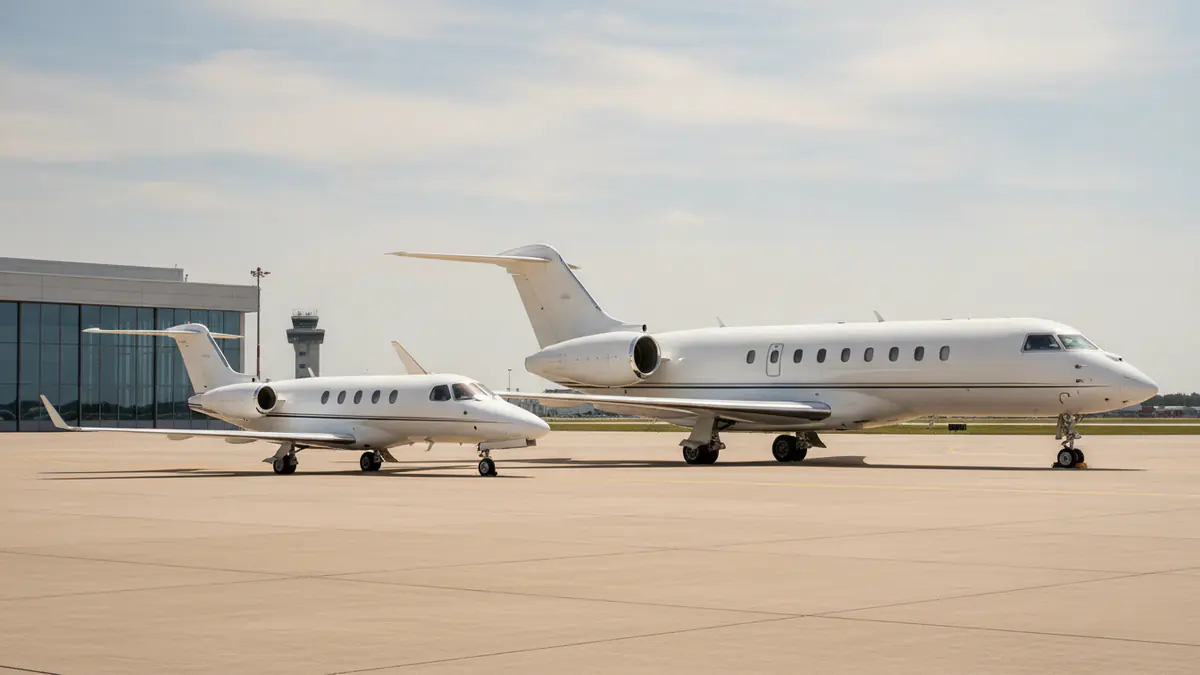
Side by side
| Light Jets | Midsize Jets | |
|---|---|---|
| Typical passengers | 4–7 | 6–9 |
| Typical cruise | 420 kt | 440 kt |
| Longest range in dataset | 2,040 nm | 2,700 nm |
| Per flight hour Estimate | US$3,500–US$5,000 | US$4,500–US$7,000 |
| Models in dataset | HondaJet Elite II, Pilatus PC-24, Embraer Phenom 300E, Bombardier Learjet 75 | Cessna Citation XLS+, Cessna Citation Latitude |
Where the difference shows
The shortest route in our set where only one of them is typically nonstop is New York to Las Vegas.
| Route | Distance | Light Jets | Midsize Jets |
|---|---|---|---|
| New York to Las Vegas | 1,935 nm | Nonstop in good conditions | Nonstop |
| Miami to Los Angeles | 2,035 nm | Fuel stop likely | Nonstop |
| New York to Los Angeles | 2,129 nm | Fuel stop likely | Nonstop |
| Rome to Dubai | 2,334 nm | Fuel stop likely | Nonstop in good conditions |
| Dubai to Milan | 2,523 nm | Fuel stop likely | Nonstop in good conditions |
Screened with the longest-range model of each category in our dataset. Flight time on a 1935 nm trip: about 5 h 5 min in a midsize jet.
Light jets vs midsize jets: the short answer
Light jets vs midsize jets is the first size decision most charter clients face, and it is usually simpler than it looks. A light jet is the efficient choice for up to about six passengers on trips of up to two or three hours. A midsize jet makes sense when the group grows, the flight gets longer, or someone in the party needs to stand up and walk around. Speed is almost never the deciding factor: on typical trips the two categories arrive within minutes of each other.
The side-by-side table above lists the key figures from our data: typical passengers, cruise speed, estimated hourly cost and example models. The routes table shows where the difference in range actually changes whether a flight is nonstop. This guide explains what those numbers mean in practice, where each category is the better fit, and how to think about cost per seat rather than cost per hour.
We are a charter broker. We do not own or operate aircraft, so we have no fleet to fill and no reason to push one size over the other. We compare options from licensed operators and recommend the aircraft that fits your trip. You can read more about how we work on the JetPriceCheck homepage.
What separates the two categories
The labels "light" and "midsize" are industry shorthand rather than formal certification classes, and different sources draw the boundaries slightly differently. The general picture of business jet categories is consistent, though: a light jet is designed around short and medium trips with a small group, and a midsize jet trades a little efficiency for a noticeably larger cabin and more range.
Cabin height and comfort
This is the difference most passengers notice first. Light-jet cabins are generally not tall enough to stand upright; you move through the cabin with a stoop. Midsize jets are typically described as stand-up or near stand-up, and many have a flat floor rather than a dropped aisle. On a 45-minute hop, that difference barely matters. On a three-hour flight, being able to stand, stretch and move around without crouching changes how you feel on arrival.
Our example models illustrate the point. The Embraer Phenom 300 family is one of the best-selling light jets and is known for a comfortable cabin by light-jet standards, but it is still a cabin you sit in. The Cessna Citation Latitude was designed around a taller, flat-floor cabin that you can walk through upright.
Passengers
Our data puts typical light-jet loads at four to seven passengers and midsize jets at six to nine. The overlap is deliberate: six passengers can fly in either. The question then becomes how much luggage they carry and how long the flight is. Six people with weekend bags on a one-hour flight fit comfortably in a light jet. Six people with golf bags on a three-hour flight are much happier in a midsize jet.
Remember that the certified maximum seat count is rarely the comfortable number. A light jet filled to every seat, including any side-facing or lavatory seat, is workable for short sectors but not something to plan a longer trip around.
Baggage
Baggage volume grows with cabin size. Light jets have a nose or aft compartment that takes soft bags and a few suitcases; bulky items such as golf bags, skis or large hard cases can fill it quickly. Midsize jets usually offer a larger aft hold, often reachable in flight, and more cabin stowage. If your trip involves sports equipment, several large suitcases or anything unusual, a midsize jet removes a lot of uncertainty. Always send the operator a baggage list, whichever category you choose.
Washroom
Lavatory arrangements vary widely among light jets. Some have a small enclosed washroom; others have a more basic arrangement that is fine for emergencies but not ideal for a longer flight. Midsize jets generally have a proper enclosed lavatory. For a group including children or older travellers on a flight of more than an hour or so, it is worth checking the floor plan of the specific aircraft before booking.
Speed
Our data lists a default cruise of about 420 knots for light jets and about 440 knots for midsize jets. That difference sounds meaningful, but on a trip of 500 nm it saves roughly four minutes, and on 1,000 nm roughly seven. Some modern light jets cruise faster than older midsize jets, so the specific aircraft matters more than the category. If you are choosing between the two to save time, you will be disappointed; choose on cabin, range and baggage instead.
Range: where the difference is real
Range is the one area where the categories genuinely diverge. Our private jet range tool shows how far each aircraft can travel from a given airport, and the routes table above lists trips in our set where only one of the two categories is typically nonstop.
Using our example models, we treat 85% of published range as practical once passengers, winds and reserves are considered. On our data that gives the Phenom 300E a practical figure of around 1,700 nm and the Citation Latitude around 2,300 nm. In practice, that means:
- Up to about 1,500 nm, both categories generally fly nonstop, and the light jet is usually the more economical option.
- Between roughly 1,600 and 2,200 nm, the midsize jet is often nonstop where the light jet needs a fuel stop or a reduced load. This band covers many longer domestic trips in the United States and some of the longer sectors within Europe.
- Beyond that, both typically need a stop, and a super midsize or heavy jet becomes the natural comparison.
Winds matter here. A light jet flying close to its practical range on a strong headwind day may have to take fewer passengers or less baggage, or stop to refuel. A fuel stop adds perhaps 30 to 60 minutes to the journey, and it can wipe out the cost advantage of the smaller aircraft once you add landing and handling fees at the stop.
Runways and airport access
Light jets can use shorter runways than midsize jets. Our own screening uses rough minimums of about 3,500 ft for light jets and 4,500 ft for midsize jets to flag airports that need checking; these are not published limits, and the real figure depends on the specific aircraft, weight, temperature and airport elevation. The practical effect is that light jets open up a wider set of small regional airports, ski-resort fields and island strips, which can put you closer to your final destination.
For many trips the difference is irrelevant, because both categories use the same large business aviation airports. It matters most for mountain airports, small islands and hot-weather or high-altitude departures, where performance limits tighten. Browse our route directory to see the airports we typically use on each corridor.
Cost: per hour versus per seat
Our pricing model, based on published market rates, puts light jets at USD 3,500–5,000 per flight hour and midsize jets at USD 4,500–7,000. Those are estimates to show scale, not quotes. Per hour, the midsize jet is roughly a third more expensive. Our private jet cost guide explains how estimates are built and what sits on top of the hourly rate.
Two worked examples on model rates
Using the same model the site uses for route estimates, including a positioning allowance for one-way trips:
| One-way trip (estimate) | Light jet | Midsize jet |
|---|---|---|
| 400 nm, about 1 h 30 min | USD 8,500–12,000 | USD 10,500–16,500 |
| 1,000 nm, about 3 h | USD 17,000–24,000 | USD 21,000–32,500 |
On the 1,000 nm trip, divide by the typical maximum passengers in each category: seven in the light jet and nine in the midsize jet. The light jet works out at roughly USD 2,400–3,400 per seat, the midsize jet at roughly USD 2,300–3,600. In other words, when the midsize jet is full, its cost per seat is close to a full light jet's, and every passenger gets a larger cabin. When only three or four people are travelling, the light jet is clearly cheaper.
Where the savings disappear
A few situations make the cheaper category more expensive in practice:
- A fuel stop. On a trip near the light jet's range limit, the extra landing, handling and time can erase its hourly advantage.
- Positioning. If the nearest available light jet is far away and a midsize jet is based at your departure airport, the midsize option may cost less overall.
- Two aircraft. A group of eight that does not fit one light jet should compare one midsize jet with two light jets, not with one.
Empty legs can change the picture too. An empty leg is priced by availability, not category, so a midsize empty leg on your route can undercut a light jet on a normal charter.
Three trips, three different answers
Abstract rules are easier to apply with examples. Here are three typical requests and how we would think about each one.
Four colleagues, a day trip of about an hour each way. This is light-jet territory. Nobody needs to stand on a one-hour flight, the luggage is a laptop bag each, and the smaller aircraft keeps the cost of a same-day return down. If the meeting runs late, check that the aircraft's crew can wait within their duty limits and that the home airport is still open when you plan to land. A midsize jet would add comfort nobody will use and cost everyone will notice.
A family of six heading to the mountains for a week of skiing. This one sits in the overlap. Six passengers fit in either category, but six sets of skis, boot bags and winter luggage fill a light jet's baggage compartment quickly. Mountain airports can also bring shorter runways, high elevation and cold-weather operations, which narrow the choice of aircraft further. We would ask for the baggage list first, then compare a light jet that can carry the load with a midsize jet that can do so comfortably, and let the numbers decide.
Eight people flying roughly 1,800 nm to a long weekend away. Here the midsize jet is the natural choice. The group is beyond a light jet's comfortable capacity, the flight is long enough that cabin height matters, and the distance is in the band where our screening shows many light jets needing a fuel stop. The real comparison is between a midsize jet and a super midsize jet, not between a midsize and a light jet.
In each case, the decision rests on the same three questions: how many people, how much luggage and how far. Everything else follows from those.
Which should you choose?
Choose a light jet when
- There are four to six of you with moderate luggage.
- The flight is under two to three hours.
- You want access to a small airport close to your destination.
- Cost per trip matters more than cabin space.
Our light jet category page shows the models, routes and estimates for the class.
Choose a midsize jet when
- There are six to nine of you, or bulky luggage is involved.
- The flight is longer than about two and a half hours.
- Someone needs to stand, walk around or use a proper washroom.
- The route is close to a light jet's practical range, especially on a headwind day.
If you are still unsure, look at the next size up as well. Super midsize and heavy jets are covered in our aircraft guide, and the step from midsize to super midsize is often the more meaningful upgrade on longer trips.
Questions about light jets vs midsize jets
Is a midsize jet much faster than a light jet?
No. On our data the cruise speeds differ by about 20 knots, which saves only a few minutes on typical trips. Choose on cabin, range and baggage.
Can I stand up in a light jet?
Generally not fully upright. Midsize jets are typically stand-up or near stand-up, which matters most on flights of two hours or more.
How much more does a midsize jet cost?
On our model's rates, around a third more per hour. Per seat, a full midsize jet can cost about the same as a full light jet.
How many passengers fit in each?
Typically four to seven in a light jet and six to nine in a midsize jet, depending on the aircraft layout and how much luggage you carry.
Which is better for a trip of 2,000 nm?
A midsize jet is more likely to fly it nonstop. A light jet may need a fuel stop or a reduced load, depending on the model and winds.
Tell us your trip and group size with the request form below, and a specialist will suggest the right-sized aircraft, or return to the JetPriceCheck homepage to explore other options.