Country
Private jet charter in Japan
2 airports in Japan are in our dataset.
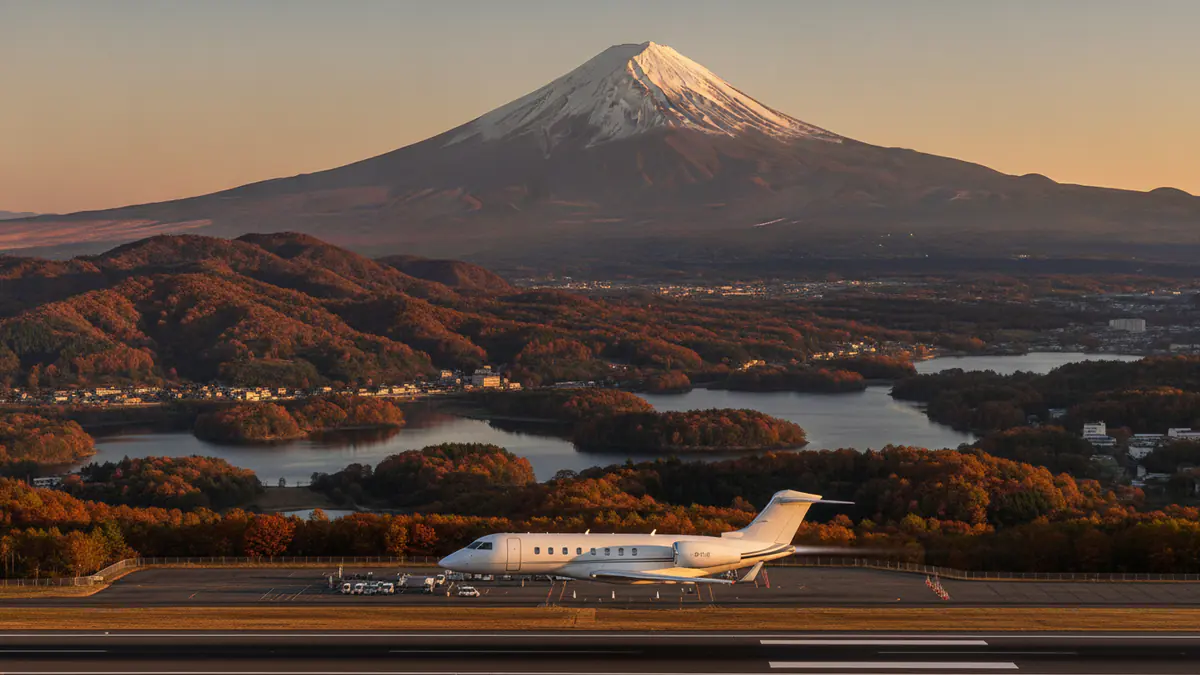
- Airports
- 2
- 0 business-aviation only
- Routes covered
- 1
- Cities
- 1
Airports for private jets in Japan
| Airport | Codes | Type | Runway | From centre |
|---|---|---|---|---|
| Haneda Airport | RJTT / HND | Commercial hub | 11,024 ft | 16 nm |
| Narita International Airport | RJAA / NRT | Commercial hub | 13,123 ft | 16 nm |
Distances are straight-line. Drive times are shown only once verified from a routing source.
Popular routes from Japan
| Route | Distance | Time | From |
|---|---|---|---|
| Tokyo to Singapore | 2,862 nm | 7 h | US$67,000 |
Estimate Lowest one-way estimate for the smallest aircraft category that can fly the route nonstop.
Empty legs from Japan
No live empty legs are connected for this search yet. Empty legs appear here only from real operator inventory; we never show made-up availability. A specialist can still check one-way opportunities for your dates.
Private jet travel Japan: planning around Tokyo's slots
Private jet travel Japan planning starts with an unusual fact: Japan is a wealthy, well-connected country with a relatively small private aviation market. Its airline network, high-speed trains and big-city airports are so efficient that business aviation grew more slowly here than in Europe or the United States, and the main Tokyo airports have limited room for private aircraft. None of that stops you from flying privately to Japan. It does mean that slots, parking and timing matter more here than almost anywhere else, and that early planning pays off. This page explains how the Tokyo airports work for business jets, where else in Japan private travellers go, what typical trips cost in our pricing model and how the seasons shape demand.
The tables above list the airports and routes we cover. What follows is the context behind them.
We are a charter broker. We do not own or operate aircraft; we compare what licensed operators can offer for your trip, explain the trade-offs and stay with you until you land. Read more about how we work on the JetPriceCheck homepage.
Tokyo: Haneda or Narita?
Tokyo has two major airports. Both are large commercial hubs, both handle business aircraft, and each has strengths.
Haneda
Haneda sits on Tokyo Bay, close to the city centre, which makes it the first choice for most private travellers. The airport's own business aviation page describes dedicated customs, immigration and quarantine (CIQ) facilities and gates for business aviation passengers, which keeps the arrival private and quick.
The limits are capacity and time. Haneda is one of the busiest airports in the world, and business aircraft need a slot for arrival and departure. The number of business-jet movements is limited, parking is scarce, and aircraft may only be allowed to stay for a set number of days. Business aviation guides such as Universal Weather's Tokyo guide note that requested times are not always available at Haneda. If your preferred slot is not free, the choice is a different time, a drop-and-go (the aircraft leaves after dropping you) or Narita.
Narita
Narita lies well east of Tokyo in Chiba, so the drive into the city is much longer. In exchange, it usually has more room for business aircraft, including longer parking, and it offers dedicated facilities for private passengers. For long stays, for large aircraft or when Haneda is full, Narita is often the practical choice.
Our Tokyo private jet charter page covers both airports and the ground transfers in detail.
Beyond Tokyo: Japan's other private jet destinations
We do not yet have a hub page for each region, but we arrange flights to all the main Japanese airports.
- Osaka and Kyoto. Kansai International Airport, built on an island in Osaka Bay, is the main gateway for Kyoto, Osaka and Nara. It handles business aircraft and is a common first stop for travellers who want to see the old capital.
- Hokkaido. New Chitose Airport near Sapporo is the gateway to Niseko and Hokkaido's other ski resorts, famous for their powder snow. Winter brings a sharp rise in private flights.
- Nagoya. Central Japan's Chubu airport serves the industrial heartland and is an alternative for central Honshu.
- Fukuoka and Kyushu. The southern island has its own business centres, hot springs and golf.
- Okinawa. Japan's subtropical islands in the far south attract beach and resort travellers.
Regional airports can have limited hours or facilities for business aircraft. We check each one against your aircraft and schedule.
Domestic legs on a foreign aircraft
Many private flights to Japan use aircraft registered abroad, for example in Hong Kong, Singapore or the United States. As a general rule, a foreign-registered aircraft cannot carry passengers on a commercial basis between two Japanese airports. If your trip has several stops inside Japan, the domestic legs may need a Japanese operator, or the itinerary may need to be designed around the rules. Tell us the full route at the start, and we will check with the operators before you commit.
Putting a Japan itinerary together
Most private trips to Japan combine two or three places. A common pattern for a first visit is Tokyo, then Kyoto, and in winter a few days in Niseko. Here is how we approach an itinerary like that.
Arrival. The long-haul flight lands at Haneda if a slot and parking are available on your date, or at Narita if not. With dedicated CIQ facilities, passengers are usually on the road soon after landing.
Tokyo to Kyoto. The two cities are linked by the Shinkansen, Japan's high-speed rail line, and for many travellers the train is quicker door to door than a short flight to Osaka. If you prefer to fly, the aircraft needs a slot at both ends and, if it is foreign-registered, the domestic-leg rules apply.
Kyoto to Hokkaido. This is a longer journey, and flying makes more sense. Kansai to New Chitose is a common routing in winter.
Going home. The aircraft can collect you from New Chitose or Kansai rather than returning to Tokyo, which saves a day of travel.
Where the aircraft waits. If the jet that brought you stays in Japan for the whole trip, it needs parking at each airport, and space is limited at the busiest ones. Often it is simpler and cheaper for the aircraft to leave after dropping you and return at the end.
Every itinerary is different, and the right answer depends on your group, your luggage and how much time you have. Tell us what you want to see, and we will suggest a combination of flights and ground travel that works.
Typical trips from Japan: estimates from our model
The following estimates come from our pricing model and use Tokyo as the example departure. They show the smallest aircraft category that can fly each trip nonstop, an estimated flight time and a one-way range in US dollars. They are estimates built on published market rates, not quotes.
- Tokyo to Hong Kong (1,567 nm): about 4 h 25 min in a light jet, estimated at $25,000–$36,000 one way.
- Tokyo to Singapore (2,861 nm): about 7 h in a super midsize jet, estimated at $67,000–$95,000 one way. Our Tokyo–Singapore route covers it in detail.
- Tokyo to Mumbai (3,636 nm): about 8 h 35 min in a heavy jet, estimated at $118,000–$181,000 one way.
- Tokyo to Sydney (4,221 nm): about 9 h 55 min in a heavy jet, estimated at $135,000–$207,000 one way.
- Tokyo to Dubai (4,305 nm): about 9 h 50 min in an ultra long range jet, estimated at $197,000–$276,000 one way.
- Tokyo to Abu Dhabi (4,343 nm): about 9 h 55 min in an ultra long range jet, estimated at $199,000–$279,000 one way.
Japan's geography makes most international trips long. Anything beyond East Asia needs a large-cabin jet, and those aircraft are fewer in number, so book early. Several trips, including Hong Kong, Singapore and above all Sydney, cross long stretches of ocean. Over-water flights need extra fuel reserves, so operators often use a larger aircraft than the smallest nonstop category, and each trip is checked by the operator before it is confirmed. Our aircraft guide and the guide to private jet sizes explain the categories.
Flights from the United States and Europe
Many private travellers arrive from the United States or Europe. From the US West Coast, Tokyo is a long Pacific crossing that calls for a long-range jet; from the East Coast or Europe, an ultra long range jet or a fuel stop is usually needed. We compare nonstop and one-stop options, because a stop can open up more aircraft and lower the cost, at the price of a longer day.
When to fly: Japan's seasons
Spring (late March to April) is cherry blossom season, one of the most popular times to visit Japan. Hotels in Tokyo and Kyoto fill up, and demand for private flights rises with them.
The rainy season (roughly June) brings humid, wet weather to much of the country outside Hokkaido.
Summer is hot and humid in the cities, while Hokkaido stays cooler and draws golf and nature travel.
Typhoon season (roughly August to October) can close airports or delay flights, especially in the south and west. Build slack into your schedule in these months and keep your plans flexible.
Autumn (October to November) brings colourful leaves and a second peak for leisure travel.
Winter (December to March) is ski season. Niseko and the other Hokkaido resorts, and the Japanese Alps in Nagano, draw visitors from Australia, Asia and further afield. Snow can affect airports, particularly in Hokkaido, and aircraft may need de-icing.
The Japan National Tourism Organization has more on what each season offers.
Entry rules for passengers
Passengers on an international private flight clear immigration, customs and quarantine at their first Japanese airport. At Haneda this is done in dedicated business aviation facilities. Many nationalities can visit Japan without a visa for a short stay, but the rules depend on your passport and the purpose of your trip; check the official guidance from the Ministry of Foreign Affairs of Japan before you travel. Give us each passenger's nationality early, because operators check travel documents before departure. Our guide to private jet security and passports explains what operators ask for.
What drives the cost of private jet travel in Japan
- Distance. Most international trips to Japan need a large-cabin aircraft, which costs far more per hour.
- Positioning. Few charter aircraft are based in Japan, so many trips use aircraft from Hong Kong, Singapore or the US, and the empty flights to position them count.
- Slots and parking. If the aircraft cannot stay at Haneda, it may reposition to Narita or elsewhere during your trip, and back again.
- Season. Cherry blossom, ski season and holiday periods push demand up.
- Domestic legs. A multi-city itinerary may need more than one operator.
Our private jet cost guide explains the numbers, and our methodology explains how our estimates are built. When you are ready, ask us for a quote and we will compare offers from licensed operators.
Ways to reduce the cost
Aircraft that bring passengers to Japan often leave empty. Our empty legs page and the guide to cheap private jet flights explain how to find them. For domestic travel between big cities, the train is often a strong alternative, and we will tell you when it makes more sense than a short private flight.
Who flies privately in Japan
- Business travellers visiting Tokyo, Osaka and Nagoya. See corporate jet charter.
- Ski groups and families heading to Hokkaido. See group private jet charter.
- Sports teams and touring artists travelling across Asia. See sports team private jet charter and entertainment private jet charter.
- Travellers with pets. Japan has strict animal import rules, so plan months ahead. See our pet-friendly private jet page.
For a car waiting at the aircraft, see private jet with chauffeur.
How to book with us
- Tell us every stop, with dates, passengers, luggage and each passenger's nationality.
- We check slots and parking at each airport, and whether domestic legs need a Japanese operator.
- We compare offers from licensed operators, including nonstop and one-stop options.
- You confirm and receive the operator's name and terms in writing.
- We stay in touch until you land.
Private jet travel Japan: frequently asked questions
Can private jets land at Haneda?
Yes. Haneda handles business aircraft and has dedicated CIQ facilities, but slots and parking are limited, so book early and be ready to adjust your time or use Narita.
How long is a private flight from Hong Kong to Tokyo?
In our model, Tokyo to Hong Kong takes about 4 h 25 min in a light jet; the reverse is similar. The estimate is $25,000–$36,000 one way, not a quote.
Can a foreign private jet fly between Japanese cities?
Generally not on a commercial basis. Domestic legs may need a Japanese operator, so tell us your full itinerary at the start.
When is the busiest time for private flights to Japan?
Cherry blossom season in spring, the Hokkaido ski season in winter and the autumn leaves are the main peaks.
How do I fly privately to Niseko?
The usual gateway is New Chitose Airport near Sapporo, followed by a drive to the resort. Snow and de-icing can affect timings in winter.