Region
Private jet charter in Africa
6 airports in Africa are in our dataset.
- Airports
- 6
- 1 business-aviation only
- Cities
- 5
Airports for private jets in Africa
| Airport | Codes | Type | Runway | From centre |
|---|---|---|---|---|
| Cape Town International Airport | FACT / CPT | Mixed | 10,502 ft | 2086 nm |
| O. R. Tambo International Airport | FAOR / JNB | Commercial hub | 14,495 ft | 1645 nm |
| Lanseria International Airport | FALA / HLA | Business aviation | 9,996 ft | 1629 nm |
| Marrakesh Menara Airport | GMMX / RAK | Mixed | 10,170 ft | 2527 nm |
| Cairo International Airport | HECA / CAI | Commercial hub | 13,124 ft | 1849 nm |
| Sharm El Sheikh International Airport | HESH / SSH | Commercial hub | 10,108 ft | 1789 nm |
Distances are straight-line. Drive times are shown only once verified from a routing source.
Empty legs from Africa
No live empty legs are connected for this search yet. Empty legs appear here only from real operator inventory; we never show made-up availability. A specialist can still check one-way opportunities for your dates.
Private jet charter Africa: one continent, very different trips
Private jet charter Africa enquiries rarely look alike. One traveller wants to go from a Cape Town villa to a lodge in the Okavango Delta in a day. Another has meetings in four capitals in five days, where airline connections would take two weeks. A third is flying from Europe to Marrakech for a long weekend, or from the Gulf to the Red Sea for winter sun. What they share is distance, variety and paperwork: Africa is huge, its airports range from major international hubs to gravel strips in the bush, and every border has its own permissions.
This page covers the African cities and airports in our data, the kinds of trips people take between them, how safari flying works, the permits and seasons that shape a plan, and what drives the price. The tables above list the airports and example estimates; the text below explains what sits behind them.
We are a charter broker. We do not own or operate aircraft. We work with licensed operators, compare what they can fly for your trip, and stay with you until you land. The JetPriceCheck homepage explains how we work.
Where we cover in Africa
Our data currently covers five African cities, grouped in three very different regions.
Southern Africa: Johannesburg and Cape Town
South Africa has the continent's most developed private aviation market, and the two cities work as a pair.
- Johannesburg is the operational centre. Lanseria International, north-west of the city, is a privately owned airport that has become the country's charter hub, while OR Tambo is the main airline gateway. See our Johannesburg private jet charter hub, with guides to Lanseria and OR Tambo.
- Cape Town is the leisure capital, with a private aviation terminal at its main airport and a strong summer season. See the Cape Town private jet charter hub and our Cape Town International airport guide.
Johannesburg is also the usual starting point for safari trips into Kruger, Botswana, Zimbabwe and Zambia.
North Africa: Marrakech
Marrakesh Menara Airport serves Morocco's best-known leisure city, a short flight from southern Europe. Most private traffic here is European: long weekends, weddings, milestone birthdays and company retreats. Our Madrid to Marrakech route shows how short the hop from Spain is, with flight times and estimates.
Egypt: Cairo and Sharm El Sheikh
Cairo International Airport is the gateway to the capital, Giza and the Nile Valley. Sharm El Sheikh on the Sinai coast is a Red Sea resort with its own international airport. Both are commercial hubs that also handle private flights. Egypt draws visitors from Europe and the Gulf, especially in the cooler months.
The four kinds of private trip in Africa
1. Safari flying
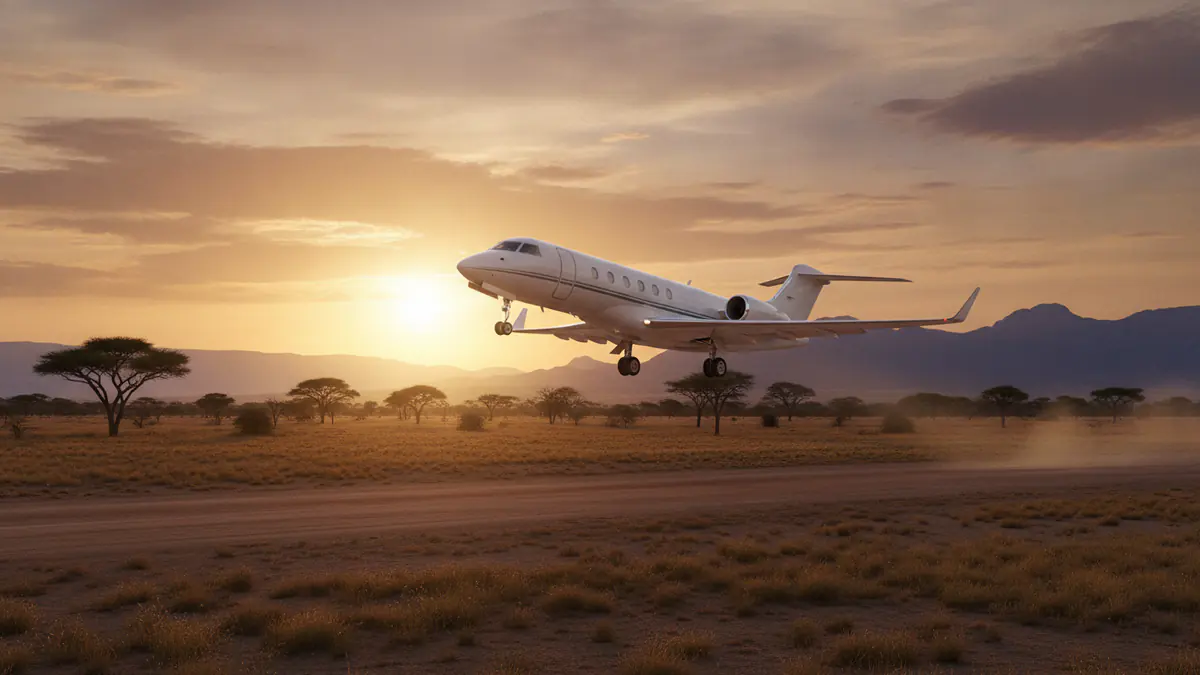
A safari is the most distinctive reason to fly privately in Africa. Most private lodges in the great wildlife areas are served by bush airstrips: short gravel or grass runways with no terminal and often no fuel. Jets cannot use most of them. The usual pattern is:
- A jet, or a long airline flight, to a regional airport with fuel and border formalities.
- A connecting flight in a light aircraft or turboprop to the lodge's airstrip.
- Onward hops between camps in the same kind of aircraft.
We plan the whole chain together so the timings, the aircraft and the luggage limits fit. Bush flights often limit bags by weight and ask for soft bags that fit a small hold, so ask before you pack. Weather matters too: in the rains some strips become unusable, which is one reason many safari regions are busiest in their dry season.
2. Business across the continent
Many African capitals are poorly connected to each other by air. A trip that visits Lagos, Nairobi, Kinshasa and Johannesburg by airline might route through Europe or the Gulf. A chartered jet flies your own schedule, waits while you work and moves on when you are ready. Companies in mining, energy, infrastructure, finance and telecoms use private aircraft this way. Our corporate jet charter page covers recurring and multi-stop trips.
3. Leisure trips from Europe and the Gulf
Marrakech, Cairo, Sharm El Sheikh and Cape Town all draw private travellers from outside Africa. North Africa is close to Europe: a light or midsize jet reaches Marrakech from Spain, France or Italy without difficulty. Cape Town is a very long flight from anywhere outside the region, usually in a heavy or ultra long range jet, or with a planned fuel stop.
4. Long-haul flights out of Africa
From Southern Africa, the main long-haul destinations are the Gulf, India, South America and Europe. The examples below start in Johannesburg and come from our pricing model.
| Example trip from Johannesburg | Smallest nonstop category (our model) | Estimated flight time | One-way estimate (USD) |
|---|---|---|---|
| Jeddah | Super midsize jet | 7 h 5 min | 68,000–97,000 |
| Riyadh | Super midsize jet | 7 h 50 min | 75,000–106,000 |
| Abu Dhabi | Heavy jet | 8 h 5 min | 110,000–168,000 |
| Dubai | Heavy jet | 8 h 10 min | 111,000–170,000 |
| Mumbai | Heavy jet | 8 h 55 min | 121,000–185,000 |
| São Paulo | Heavy jet | 9 h 25 min | 129,000–197,000 |
These are estimates from our pricing model, which is built on published market rates. They are not quotes, and these trips have no route pages of their own. Mumbai and São Paulo are long ocean crossings: operators carry extra fuel reserves and plan diversion airports for these sectors, and they often use a larger aircraft than our model's minimum. Each trip is checked by the operator against the aircraft, the load and the forecast winds.
Permits, borders and paperwork
Paperwork is the part of African private flying that most often catches people out.
- Landing and overflight permits. Many African countries require a permit for a private or charter flight to land, and some require one simply to fly through their airspace. Lead times differ from country to country. A long route, such as Cape Town to the Gulf, may cross several countries. The operator applies for these; we make sure the timeline allows for them.
- Designated border airports. Immigration and customs are only available at airports designated for international traffic. That is why a safari crossing from South Africa into Botswana usually stops at a border airport before continuing to a lodge strip.
- Visas. Private passengers need the same visas as airline passengers. Rules vary widely across Africa, and a multi-country trip may need several.
- Health requirements. Some countries require proof of certain vaccinations, such as yellow fever, depending on where you are arriving from. Check official health advice before you travel.
Send us every passenger's nationality and the full itinerary with your enquiry. Our guide to security and passports on private flights explains the general principles.
Safety and travel advice
Conditions differ greatly between countries and regions and can change quickly. Before booking, check your government's official advice for each country on the itinerary, such as the UK Foreign Office travel advice or your own country's equivalent. Operators also assess each route and airport, and they may decline a destination or change the plan if conditions require it. For security-conscious itineraries, our VIP private jet charter service covers discreet planning.
Seasons across Africa
Africa spans both hemispheres, so there is no single high season.
- Southern Africa has its summer from around November to March, the peak for Cape Town. The dry winter months are often preferred for game viewing in many southern safari areas.
- East Africa has its own dry seasons, which are generally the busiest for safaris.
- North Africa and Egypt are most popular in the cooler months, roughly autumn to spring. Summer heat is intense inland, although the Red Sea coast stays busy.
Peak weeks reduce availability for both jets and bush aircraft, and the best lodges book up far ahead. Plan the flights at the same time as the accommodation.
Choosing the right aircraft in Africa
- Light aircraft and turboprops for bush strips, short regional hops and island transfers. They are the workhorses of safari flying.
- Light and midsize jets for trips within a region, such as Cape Town to Johannesburg, or Europe to Marrakech.
- Super midsize and heavy jets for flights of five hours and more, such as Southern Africa to the Gulf.
- Ultra long range jets for nonstop flights to Europe, Asia or the Americas from the far south.
Our private jet sizes guide explains the categories, and the aircraft section compares individual models. Larger groups, such as wedding parties or company retreats, can use our group private jet charter service.
Who charters private aircraft in Africa
- Safari travellers who want to connect from a long-haul arrival to a lodge on the same day, or move between camps in different countries without returning to a hub.
- Companies and investors visiting mines, plants, projects and offices in several countries on one trip.
- Government, NGO and development delegations on tight multi-capital schedules.
- Wedding parties and celebrations in Marrakech, the Cape Winelands or on the coast, often moving guests from several European cities at once.
- Film and production crews working on location, and teams travelling to tournaments. Our entertainment charter and sports team charter services cover both.
- Patients who need to travel with medical support to a hospital in another city or country. We arrange these flights with licensed air-ambulance operators; it is not an emergency service. See medical private jet charter.
Each of these needs a slightly different plan. A safari puts weight limits and bush-strip timings first; a business trip puts schedule and permits first; a wedding puts cabin size and luggage first. Tell us what matters most and we will build the options around it.
What drives the price of a private flight in Africa
- Aircraft category. This remains the largest factor.
- Positioning. Outside South Africa, Morocco and Egypt, based aircraft can be scarce, so an aircraft may need to fly a long way to reach you, and home again after a one-way trip.
- Permits, handling and fuel. Fees vary between countries, and fuel prices can be high at remote airports.
- Crew time. Multi-stop and multi-day trips need crew accommodation and sometimes a larger crew.
- Season. Safari peaks and holiday periods tighten availability.
Our private jet cost guide explains typical costs by category and flight time, and our methodology explains how our estimates are built. If your dates are flexible, check the empty legs page.
How we plan an African itinerary
- You share the whole trip: every stop, the dates, passengers and nationalities, luggage, and any lodges already booked.
- We map the aircraft to each leg, from long-haul jets to bush connections, and check permits, border stops and timings with operators.
- You compare options, such as a nonstop heavy jet against a smaller aircraft with a stop.
- You confirm, and the operators fly. We coordinate between legs and stay with you throughout.
Private jet charter Africa: frequently asked questions
How much does it cost to charter a private jet in Africa?
It depends on the aircraft, the distance and the permits. As an example, our model estimates Johannesburg to Dubai at about USD 111,000 to 170,000 one way in a heavy jet. Short regional hops cost far less. These are estimates, not quotes.
Can a private jet fly directly to a safari lodge?
Rarely. Most lodge airstrips are too short and basic for jets, so the last leg is flown in a light aircraft or turboprop from a regional airport.
Which African cities are easiest to fly into privately?
In our data, Johannesburg and Cape Town have the most developed private aviation facilities, including private terminals. Marrakech, Cairo and Sharm El Sheikh are main airports that also handle private flights.
Do I need permits to fly a private jet in Africa?
Many countries require landing permits for private and charter flights, and some require overflight permits too. The operator obtains them; the main thing you can do is give enough notice.
Is it safe to fly privately in Africa?
Conditions vary by country. Check your government's official travel advice for each destination, and rely on the operator's own route assessment. We will not arrange a flight an operator has declined.