Route × aircraft
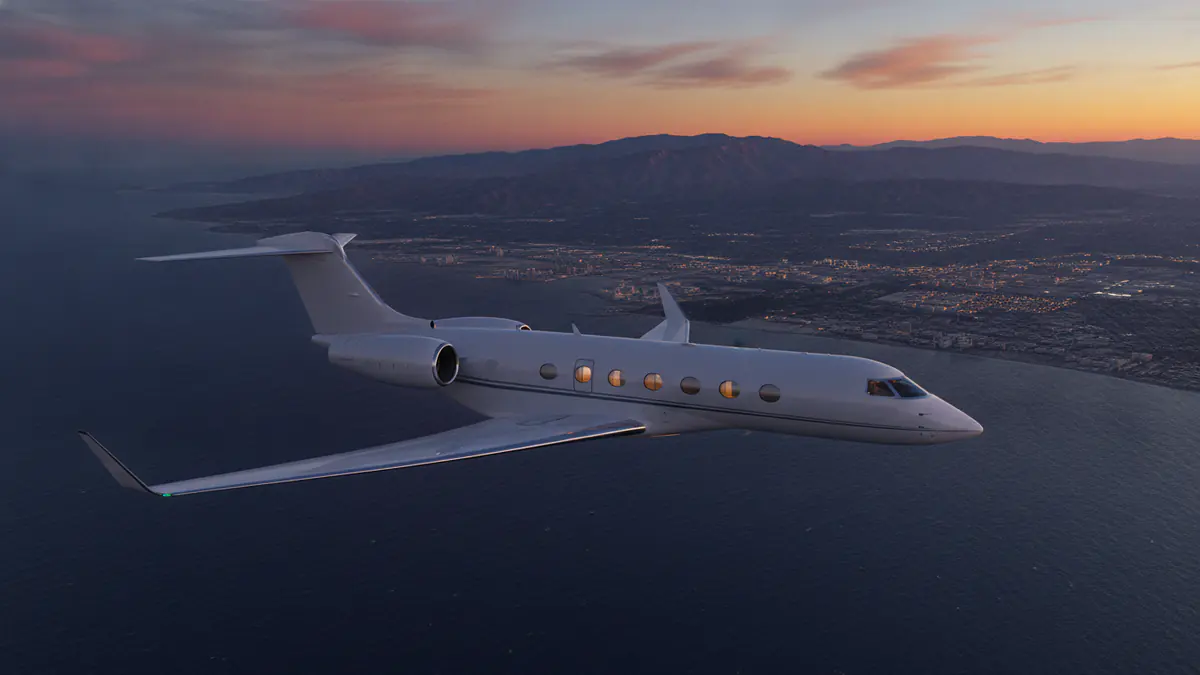
Gulfstream G650 from New York to Los Angeles
Can it fly nonstop?
Yes Nonstop
Yes. The trip needs about 2,236 nm including a routing allowance. The Gulfstream G650's published range is 7,000 nm; we treat 85% of that (5,950 nm) as practical with passengers, winds and reserves.
- Estimated time
- 5 h 5 min
- Distance
- 2,129 nm
- Passengers
- 14–16
- max 19 certified
- Baggage
- 195 cu ft
- One way
- US$102,000+
- Estimate
Airports for this aircraft
| Airport | End | Runway | Suitability |
|---|---|---|---|
| Teterboro Airport | Departure | 6,997 ft | Runway OK |
| Westchester County Airport | Departure | 6,549 ft | Runway OK |
| John F. Kennedy International Airport | Departure | 14,511 ft | Runway OK |
| Van Nuys Airport | Arrival | 8,001 ft | Runway OK |
| Los Angeles International Airport | Arrival | 12,894 ft | Runway OK |
Runway screening compares the longest runway with a typical requirement for the category. Operators confirm performance for each flight.
Estimated price
| Trip | Estimate | Billable hours |
|---|---|---|
| One way | US$102,000–US$142,000 | 8.1 |
| Return | US$127,000–US$178,000 | 10.2 |
Estimate From ultra long range jet hourly rates in pricing model market-2026-09. Method.
Alternatives on this route
| Aircraft | Category | Passengers | Time |
|---|---|---|---|
| Cessna Citation Latitude | Midsize Jet | 7–9 | 5 h 30 min |
| Bombardier Challenger 350 | Super Midsize Jet | 8–9 | 5 h 20 min |
| Cessna Citation X+ | Super Midsize Jet | 8–9 | 4 h 45 min |
| Cessna Citation Longitude | Super Midsize Jet | 8–9 | 5 h 10 min |
| Gulfstream G280 | Super Midsize Jet | 8–9 | 5 h 20 min |
| Embraer Legacy 650E | Heavy Jet | 13–14 | 5 h 15 min |
Gulfstream G650 New York to Los Angeles: the big-cabin transcon
A Gulfstream G650 New York to Los Angeles flight covers 2,129 nautical miles great-circle, and our screening puts it at about 5 hours 5 minutes nonstop. That makes it one of the quickest large cabins you can charter across the United States, but it is not the obvious default. For most travellers, the classic transcontinental aircraft is a super midsize jet, which does the trip nonstop in a comparable time for a lower price. The G650 earns its place when the group is bigger, the luggage is heavier, the winds are strong, or the aircraft has to do more than one crossing.
This page sits under our New York to Los Angeles private jet route, which covers airports, timing and pricing for the corridor as a whole. Here we look specifically at the G650: what it adds on a coast-to-coast flight, what it costs on our model, and when a smaller aircraft is the smarter choice. The nonstop verdict, airports and estimate tables above hold the numbers; this guide helps you decide.
We are a charter broker. We do not own or operate aircraft; we compare G650s and alternatives offered by licensed operators and manage the booking for you. You can read more on the JetPriceCheck homepage.
Why fly the G650 coast to coast
Winter headwinds stop being a question
On paper, the westbound transcon is well inside the range of many midsize and super midsize jets. In practice, the westbound leg flies into the prevailing westerly winds, which are strongest in winter when the jet stream sits further south and blows hardest. On a strong-wind day, a smaller jet flying near its limits may have to reduce passengers or baggage, or plan a fuel stop, to keep legal reserves.
The G650 removes that problem. Our data gives it a published range of 7,000 nm, and we treat 85% of that, about 5,950 nm, as a practical figure. The New York–Los Angeles trip needs about 2,235 nm with a routing allowance. Even a severe headwind day leaves an enormous margin, so a full cabin and a full hold remain possible on the westbound leg in January as easily as in July.
Compare that with the midsize end of the table. On our screening, the Cessna Citation Latitude has a practical range of roughly 2,300 nm, only just above what this trip requires. It can do the flight, but it is the kind of aircraft whose payload the operator will scrutinise on a windy winter day. That is not a reason to avoid it; it is a reason to understand what the G650 buys you.
Room for a bigger group
Our data lists typical G650 seating for 14–16 passengers, with a published maximum of 19, although individual aircraft vary. A super midsize jet typically seats around eight or nine. For a production crew, a family travelling with staff, or a leadership team moving together, the G650 can replace two smaller aircraft and keep everyone on the same schedule.
A cabin you can work and live in for five hours
Five hours is a working day. The G650's cabin is tall enough to stand and, according to published figures summarised on Wikipedia, among the widest in business aviation, with space for separate seating zones, a dining or conference table and a galley. Our data lists about 195 cubic feet of baggage volume, which suits film and photography cases, golf bags and a family's luggage for a long stay. Cabin layout differs by aircraft, so we include floor plans with every option.
Flight time, time zones and when to leave
Our estimate is about 5 hours 5 minutes block time from New York to Los Angeles, based on the G650's listed cruise speed plus a taxi-and-climb allowance. Winds shape the real number: the westbound flight is usually longer and the eastbound flight shorter, sometimes by a meaningful margin in winter.
Los Angeles is three hours behind New York all year, because both cities observe daylight saving time on the same dates. That creates two natural patterns:
- Westbound, morning departure. Leave New York mid-morning and land in Los Angeles around lunchtime local time, with the full afternoon ahead. The clock change works in your favour.
- Eastbound, overnight. Leave Los Angeles in the late evening and land in New York early the next morning. This is where the G650's cabin matters most: with seats that convert to beds and a dark, quiet cabin, a red-eye becomes a night's sleep rather than a lost one.
For the eastbound overnight, check the departure airport's rules. Van Nuys, the usual business aviation airport for Los Angeles, has noise rules that restrict some late departures, so we confirm the planned time with the operator before confirming the aircraft.
Airports for the G650 in New York and Los Angeles
New York: Teterboro, Westchester and alternatives
Teterboro in New Jersey is the default business aviation airport for Manhattan. It has a long-standing maximum aircraft weight limit of 100,000 lb, according to Wikipedia's Teterboro entry. A standard G650 is designed to operate within that limit, while heavier variants such as the longer-range G650ER may not be, so we confirm with the operator exactly which model is being offered and whether it can use Teterboro for your trip. Westchester County Airport, north of the city, suits travellers from Westchester, Connecticut and the northern suburbs, and is another common departure point for large-cabin jets.
Los Angeles: Van Nuys and the others
Van Nuys in the San Fernando Valley is the usual large-jet airport for Los Angeles, with the runway length and services a G650 needs. Other airports around the region each have their own trade-offs: some sit closer to the Westside or the beach cities but have shorter runways or tighter noise rules, and Santa Monica's shortened runway is not suited to large-cabin jets. The operator confirms which airports the aircraft can use at your planned weight and time. The route guide above this page covers the airport choice for the corridor in more detail.
What the G650 costs New York to Los Angeles
The estimate table above uses our pricing model with ultra-long-range jet hourly rates drawn from published market rates. For the G650 on this route, it gives an estimated USD 102,000–142,000 one way and USD 127,000–178,000 for a return. These are estimates to show scale, not quotes or offers. Only an operator can price a specific aircraft for specific dates. Our private jet cost guide explains how the ranges are built and what taxes and fees can sit on top.
Why a return is not double a one-way
The one-way estimate charges about 8.2 billable hours for a trip whose flight time is about 5.1 hours. The difference is the model's allowance for positioning: if the aircraft is based in New York and you are staying in Los Angeles, it usually has to fly home empty, and part of that cost falls on the charter. A return charges both legs, about 10.2 hours, but no empty flight on top. So the return is only about a quarter more than the one-way.
That makes G650 round trips within a few days relatively efficient. For longer stays, it is usually better to release the aircraft and book the return separately, when a different aircraft may already be positioned on the West Coast. Large-cabin jets repositioning between the coasts sometimes appear as empty legs, and they are worth checking if your dates are flexible.
Is the premium worth it?
Compared with a super midsize jet on this route, the G650's estimate is substantially higher, because the ultra-long-range hourly rate is higher and the aircraft is larger. Whether that premium is worth paying comes down to three questions:
- How many are travelling? Above eight or nine passengers, the comparison is really between one G650 and two smaller jets, and the G650 often wins on cost and simplicity.
- When are you flying? A winter westbound flight with a full cabin and a full hold is where the G650's range margin matters most.
- Is it one crossing or several? If the aircraft is continuing to Hawaii, Asia or Europe, its range makes the whole itinerary simpler.
If none of those applies, a super midsize jet is usually the better value, and we will say so.
Planning the day of a G650 transcon
A five-hour domestic flight is easy to underestimate. Most of the difference between a good and a mediocre G650 New York to Los Angeles trip is decided in the planning, not in the air.
Catering. On a flight of this length, the operator will offer full meal service. Catering is ordered through the operator in advance, usually a day or more before departure, and it is priced separately from the flying. If your group has dietary requirements, a lunch meeting planned on board, or children with specific needs, tell us when you book so the order reaches the right kitchen near the departure airport.
Connectivity. Many G650s carry high-speed connectivity suitable for video calls across the continental United States, but the system, speed and any data charges vary by aircraft. If working on board is the point of the trip, we confirm the connectivity specification before you choose between options.
Taxes. Domestic commercial charter flights in the United States are generally subject to federal excise tax, which operators usually show as a separate line on the quote. Our cost guide explains how it works and links the official IRS guidance.
Ground transport. Teterboro and Van Nuys are both some distance from the addresses most clients start and finish at. Traffic into Manhattan and across Los Angeles can add an hour or more at peak times, so we plan car pick-ups around the arrival time and the likely traffic, not just the scheduled landing.
Pets and extra passengers. The G650's cabin makes it one of the more comfortable options for travelling with a dog, subject to the operator's policy. A late addition to the passenger list is usually easy on a large-cabin jet, but the operator needs every name before departure.
A little planning here turns an expensive aircraft into a genuinely productive or restful day, which is the reason to choose it in the first place.
G650 or another aircraft on this route
| Aircraft | Role on New York to Los Angeles | Choose it when |
|---|---|---|
| Bombardier Challenger 350 | The classic super midsize transcon | Up to about eight passengers, lower budget |
| Cessna Citation Longitude | Newer super midsize with a wide cabin | Small group wanting a quiet, modern cabin |
| Cessna Citation Latitude | Midsize, close to its practical range | Light loads, calm winds, tight budget |
| Embraer Praetor 600 | Super midsize with long range | Small group wanting range margin in winter |
| Bombardier Challenger 650 | Large cabin, nonstop | Bigger group, lower rate than a G650 |
| Embraer Legacy 650E | Large cabin with generous baggage | Group with a lot of luggage |
Each of these is shown in the alternatives section above with our estimate for the route. The ultra-long-range jet category page shows the G650's peers, and our aircraft guide covers every class.
About the G650
The G650 is built by Gulfstream Aerospace, entered service in 2012 and went out of production in 2025, according to Wikipedia. The manufacturer's website lists its current models. In charter, the individual aircraft matters as much as the model: year of manufacture, refurbishment, layout, connectivity and the operator's crew all vary. Our Gulfstream G650 page gathers the model's figures.
Questions about the G650 from New York to Los Angeles
Can the G650 fly New York to Los Angeles nonstop in winter?
Yes. The trip needs about 2,235 nm with a routing allowance, far below our practical range figure of about 5,950 nm for the G650, so westbound headwinds do not threaten the nonstop.
How long does it take?
About 5 hours 5 minutes on our estimate. Westbound is usually longer and eastbound shorter because of prevailing winds.
Can a G650 use Teterboro?
Teterboro has a 100,000 lb weight limit. A standard G650 is designed to operate within it; we confirm the specific aircraft and model variant with the operator.
Is a G650 overkill for this trip?
For small groups in calm weather, often yes: a super midsize jet does the trip well for less. For larger groups, heavy baggage, winter westbound flights or onward legs, the G650 makes sense.
Do you own the aircraft?
No. We are a broker: licensed operators fly the aircraft, and we arrange and manage the charter on your behalf.
To check G650 availability for your dates, use the request form below or head back to the JetPriceCheck homepage.
Questions
Can a Gulfstream G650 fly from New York to Los Angeles nonstop?
Yes. The trip needs about 2,236 nm including a routing allowance. The Gulfstream G650's published range is 7,000 nm; we treat 85% of that (5,950 nm) as practical with passengers, winds and reserves.
How long does the Gulfstream G650 take from New York to Los Angeles?
About 5 h 5 min, from 2,129 nm at the Gulfstream G650's 488 kt cruise speed plus a taxi and climb allowance.
How much does a Gulfstream G650 cost from New York to Los Angeles?
Our one-way estimate is US$102,000 to US$142,000, based on ultra long range jet hourly rates. It is an estimate, not a quote.