Airport comparison
Private jet airports near London
4 airports within 60 nm of central London can handle private aircraft. We compare them on facts; the right one depends on where you are going on the ground and which aircraft you fly.
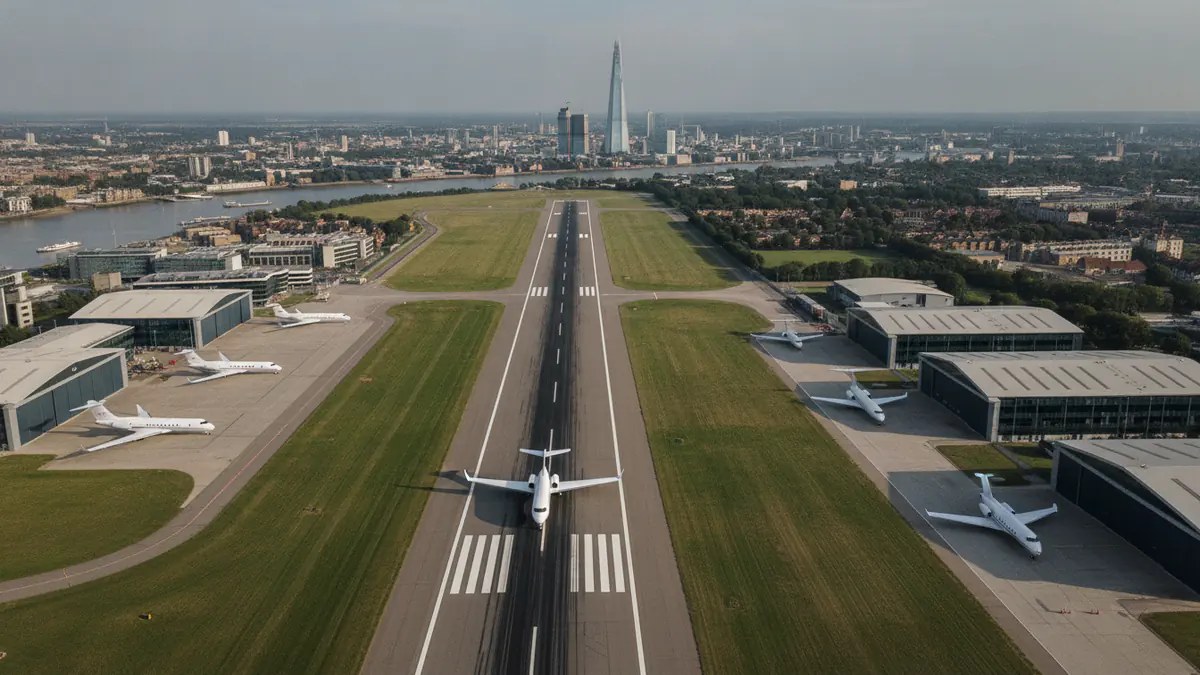
Side by side
| Airport | Type | From centre | Runway | Customs |
|---|---|---|---|---|
| London City Airport EGLC | Mixed | 7 nm / 13 km | 4,948 ft | yes |
| London Biggin Hill Airport EGKB | Business aviation only | 12 nm / 23 km | 5,925 ft | yes |
| London Luton Airport EGGW | Mixed | 24 nm / 44 km | 7,093 ft | yes |
| Farnborough Airport EGLF | Business aviation only | 28 nm / 52 km | 8,005 ft | yes |
Distances are straight-line from the city centre. Drive times depend on traffic and your start point and are not shown until verified.
Trade-offs
- Closest: London City Airport, about 7 nm from the centre.
- Longest runway: Farnborough Airport at 8,005 ft, which matters for heavier aircraft and long-range departures.
- Business aviation only: Biggin Hill, Farnborough. No airline traffic, which usually means shorter queues on the ground.
FBOs near London
No verified FBO records for these airports yet.
Private jet airports London: four airfields, four different jobs
Private jet airports London travellers use most often are Farnborough, Biggin Hill, Luton and London City. Each one sits on a different side of the capital, handles a different mix of aircraft and keeps different hours, so the "right" London airport is rarely the one that looks closest on a map. It is the one that fits where you are going on the ground, the aircraft you need and the time you want to leave.
The table above compares the four on distance from the centre, airport type, runway and customs. This guide turns those rows into decisions. It explains what each airfield is really like to use, which trips it suits, where the catches are, and how we weigh them when we plan a flight. We are a charter broker: we do not own or operate aircraft, we arrange flights with licensed operators and help you choose the airport that makes the whole journey work. You can read more about how we work on the JetPriceCheck homepage.
How to choose between the private jet airports around London
Before looking at individual airports, it helps to know the four questions that decide almost every London departure.
1. Where are you starting on the ground?
London is large and its traffic is slow. A 20-minute difference in drive time is common between airports that sit a similar straight-line distance from the centre. A traveller in Canary Wharf, one in Mayfair and one in the Surrey hills should often choose three different airports. The distances in our table are measured from central London in a straight line; your door-to-airport time depends on your address, the hour and the motorway you need.
2. Which aircraft does the trip need?
A short hop to Paris or Geneva can be flown in a light or midsize jet, which almost any London airfield can take. A nonstop flight to New York, Dubai or Los Angeles usually calls for a super midsize, heavy or ultra-long-range jet, and that narrows the options. Some airports limit aircraft by type, some by weight or noise, and a long sector with a full fuel load benefits from a long runway. Our aircraft guide explains the categories.
3. What time do you want to fly?
Operating hours differ a great deal. Some London airports close in the late evening, some restrict weekend flying, and busy mixed-use airports ration night slots. A late-night return from the Middle East or an early-morning departure for a meeting in Milan can rule an airport in or out on timing alone.
4. How much does the airport add to the cost?
Handling, landing and parking charges vary between airports and with aircraft size. So does positioning: if the nearest suitable aircraft is based at one airport and you choose another, the short hop between them is part of the bill. Our private jet cost guide explains how those items build up.
The sections below take each airport in turn with those four questions in mind.
Farnborough: the dedicated business aviation airport to the south-west
Farnborough Airport is the only one of the four that handles no scheduled airline traffic at all. It is a business aviation airport by design, and our table marks it as such. For many travellers, that is the whole appeal: no airline queues, no crowded terminal, and an operation built around private flights.
Farnborough lies in Hampshire, south-west of London, and it is the furthest of the four from the centre in our table. That sounds like a disadvantage until you look at who uses it. For homes and offices in west London, Surrey, Berkshire and the M3 and M4 corridors, it is often the most convenient choice, and the drive from Kensington or Chelsea can compete with the drive to airports that are nominally closer.
It also has one of the longer runways in the London area, which matters for heavy and ultra-long-range jets departing on transatlantic and Middle East flights with a full fuel load. That is one reason why Farnborough is a common choice for flights such as our London to New York corridor and London to Los Angeles.
The catches are hours and capacity. According to Farnborough's own noise FAQ and its Wikipedia entry, the airport operates under a planning permission that caps annual movements and limits weekend flying, and it is not open around the clock. Very early or very late departures must be checked against its published hours.
Farnborough suits: west London and the south-west of the capital, long-range heavy jets, travellers who value a quiet, airline-free terminal.
Biggin Hill: the closest dedicated business airfield, on the south-east side
London Biggin Hill is, like Farnborough, focused on business and general aviation, and it is the closest of the dedicated business airfields to central London in our table. It sits in the London Borough of Bromley, to the south-east of the city.
Biggin Hill has built its reputation on flexibility. The airport describes itself on its operations page as open from early morning until late evening on weekdays, with shorter hours at weekends, and its Wikipedia entry describes a long history as a business aviation base. Many travellers heading for the City, Canary Wharf, south London or Kent find it a practical choice, and helicopter transfers into central London are sometimes used to cut the road journey.
It handles a wide range of jets, from light jets used for European trips to larger long-range types. Handling and parking charges are often reported by the market as lower than at Farnborough, though that varies by operator and aircraft and we check it for each trip rather than assume it.
The trade-off is road access: south-east London's approach roads can be slow at peak times, so travellers from the west or north may lose in traffic what they gain in distance.
Biggin Hill suits: the City, Canary Wharf and south-east London, Kent, European hops, and evenings when Farnborough is closing.
Luton: the northern option with scale and longer hours
London Luton is a mixed airport: a busy airline airport with a large business aviation operation on the same field. It sits north of London, off the M1, and is one of the country's busiest airports for private flights.
For travellers based in north London, Hertfordshire, Buckinghamshire or the Midlands, Luton is often the quickest to reach. It has a long runway suitable for long-range aircraft, and it keeps longer operating hours than the dedicated business airfields, which makes it useful for late arrivals and early departures.
The catch is that Luton is slot-coordinated because of its airline traffic. According to Universal Weather and AIN, business aviation flights must hold slots, enforcement has tightened, and summer night slots for ad hoc flights have been restricted in recent seasons. Your operator applies for the slot; we make sure the timing is confirmed before you commit, and we keep a backup airport in mind for busy summer nights. Its Wikipedia entry gives the wider background.
Luton suits: north London and the Home Counties to the north, late-night returns outside peak summer restrictions, and heavy jets on long sectors.
Farnborough or Luton?
These two airports are the most common choice for long-range departures, and they are opposites in character: one dedicated and quiet with fixed hours, the other large and busy with longer hours and slot rules. We set them out side by side in our Farnborough vs Luton comparison.
London City: minutes from the financial district, with strict aircraft rules
London City Airport sits in the Royal Docks, a short drive from Canary Wharf and the City of London, and it is the closest airport to the centre in our table. For a banker with a morning meeting in Zurich or Geneva, there is no quicker start.
The limitation is the approach. London City has a steep approach path, and only aircraft types approved for steep approaches, flown by approved crews, can use it. The airport's Jet Centre approved-aircraft page lists the types, and the Wikipedia entry describes the runway and the approach. In practice, many popular light and midsize business jets are approved, while many heavy and ultra-long-range jets are not. The airport also closes for a period at weekends, so a Saturday afternoon or Sunday morning plan needs checking.
London City is a mixed airport with a busy airline schedule, and our table marks it that way. It works brilliantly for short European business trips, and it is rarely the answer for a nonstop flight to New York or Dubai.
London City suits: Canary Wharf and the City, short European business trips in approved aircraft, day returns.
Private jet airports around London at a glance
| Question | Farnborough | Biggin Hill | Luton | London City |
|---|---|---|---|---|
| Scheduled airline traffic | None | None | Heavy | Heavy |
| Side of London | South-west | South-east | North | East, closest to centre |
| Long-range heavy jets | Yes | Many types | Yes | Mostly not (steep approach) |
| Late evening flights | Limited by hours | Until late evening on weekdays | Longer hours, slot rules | Limited, weekend closure |
| Typical strength | Quiet, dedicated terminal | Flexibility, south-east access | Scale, north London access | Speed to the City |
Other airfields that sometimes make sense
The four airports above handle most private flights to and from the capital, but they are not the only ones. London Stansted, to the north-east, has a business aviation operation alongside its airline traffic and is sometimes used when Luton slots are tight. Oxford, to the north-west, can suit travellers heading to the Cotswolds. RAF Northolt in west London has historically accepted some civil business flights under restrictive rules that change from time to time; we check its current status case by case rather than rely on it. We treat them as answers to specific trips, not defaults.
Matching London airports to common routes
The airport often follows the destination. Here is how we tend to think about the corridors that start in London.
- Short European hops. A flight on our London to Milan corridor is usually flown in a light or midsize jet. Any of the four airports can work; London City is fastest for the City, Biggin Hill for the south-east, Farnborough for the west.
- The Middle East. Our London to Dubai route guide typically calls for a super midsize or heavy jet. Farnborough and Luton are the natural departure points, with Biggin Hill an option for many types.
- North America. Nonstop flights to New York, Boston, Miami and Los Angeles are long-range missions. Runway length, fuel load and departure time all count, which is why Farnborough and Luton dominate here.
For every other route that starts in London, see our London departures hub or the full directory of charter routes.
If you already know where you are going and roughly when, ask JetPriceCheck for options and we will suggest an airport as part of the quote, based on your address and the aircraft available.
Customs, events and timing
All four airports in our table can handle international flights, with passport and border checks carried out at the private terminal rather than in an airline hall. Customs availability can depend on notice, especially outside normal hours, so we confirm it with the operator for every flight. The biggest single disruption to the calendar is the Farnborough International Airshow in July of even-numbered years, which tightens parking and slots at Farnborough for its duration; major events in the city can affect all four airports. If you can move by a few hours, or use a second airport, you usually gain choice of aircraft.
Empty legs from London
Because so many aircraft are based around London and so many flights end or begin there, empty legs from London are common. An empty leg is a positioning flight an operator sells at a reduced price because the aircraft has to fly that sector anyway. The airport is fixed by the original booking, so an empty leg can mean flying from Luton when you would have chosen Biggin Hill. For many travellers that trade is well worth it. Our empty-leg flights page explains how they work and what to watch for.
Frequently asked questions
Which private jet airport is closest to central London?
London City is the closest airport to the centre in our table, followed by Biggin Hill. Closest in a straight line is not always quickest by road, and London City only accepts aircraft approved for its steep approach.
Which London airport is used most for private jets?
Farnborough, Luton and Biggin Hill each handle large numbers of business flights, and London City handles many short European trips. The choice depends on where you are starting and the aircraft you need rather than on traffic volume.
Can a large private jet fly from London City?
Many heavy and ultra-long-range business jets are not approved for London City's steep approach. For long-range flights we normally plan Farnborough, Luton or, for many types, Biggin Hill instead.
Can I fly from London late at night?
It depends on the airport and the season. Luton keeps longer hours but rations night slots, while Farnborough and Biggin Hill close in the evening. We check your preferred time against each airport before confirming.
Does the airport change the price?
Yes. Handling, landing and parking charges differ, and an airport away from the aircraft's base adds positioning.
Do you own the aircraft at these airports?
No. JetPriceCheck is a broker. We arrange flights with licensed operators, compare what is available at each of the private jet airports London offers, and stay with the trip until you land.
Sources
- Farnborough Airport (Wikipedia)
- Farnborough noise and operations FAQ
- London Biggin Hill Airport (Wikipedia)
- Biggin Hill Airport operations
- Luton Airport (Wikipedia)
- London Luton slot enforcement – Universal Weather
- London City Airport (Wikipedia)
- London City Airport Jet Centre: approved aircraft
- London slot restrictions limit bizav night flights – AIN