Airport comparison
Private jet airports near Miami
5 airports within 60 nm of central Miami can handle private aircraft. We compare them on facts; the right one depends on where you are going on the ground and which aircraft you fly.
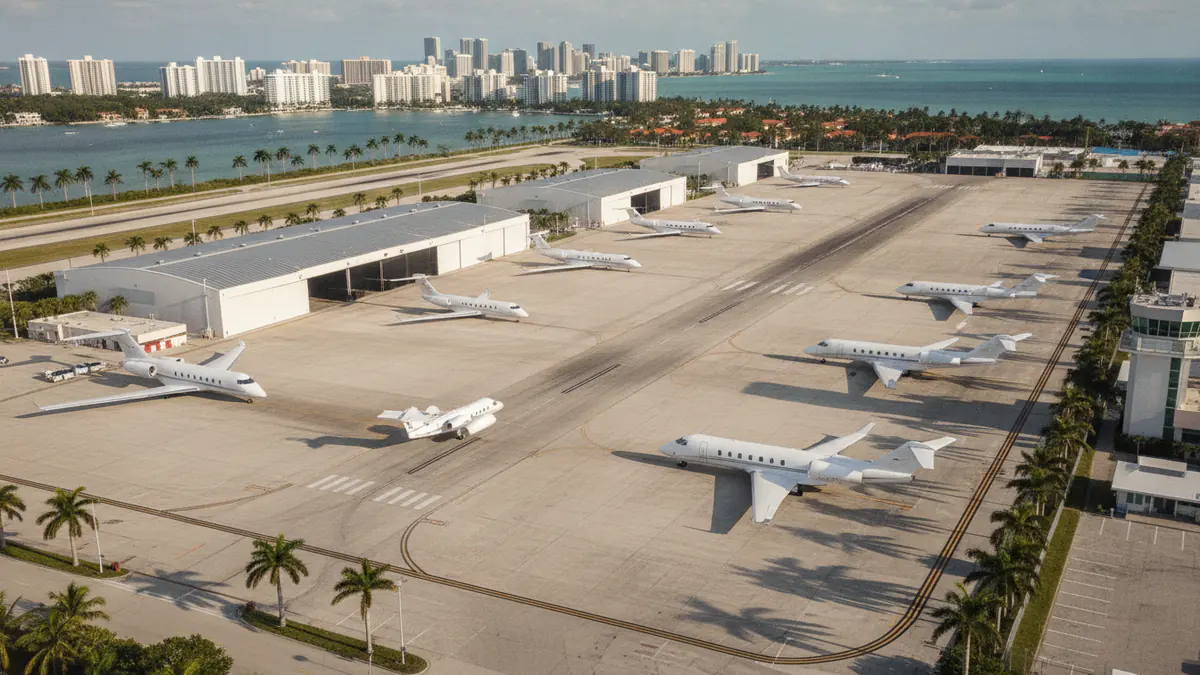
Side by side
| Airport | Type | From centre | Runway | Customs |
|---|---|---|---|---|
| Miami International Airport KMIA | Commercial hub | 6 nm / 11 km | 13,016 ft | yes |
| Miami-Opa Locka Executive Airport KOPF | Business aviation only | 10 nm / 18 km | 8,002 ft | on-request |
| Fort Lauderdale Executive Airport KFXE | Business aviation only | 26 nm / 48 km | 6,002 ft | on-request |
| Boca Raton Airport KBCT | Business aviation only | 37 nm / 69 km | 6,276 ft | yes |
| President Donald J. Trump International Airport KPBI | Mixed | 56 nm / 103 km | 10,001 ft | yes |
Distances are straight-line from the city centre. Drive times depend on traffic and your start point and are not shown until verified.
Trade-offs
- Closest: Miami International Airport, about 6 nm from the centre.
- Longest runway: Miami International Airport at 13,016 ft, which matters for heavier aircraft and long-range departures.
- Business aviation only: Opa-locka, Fort Lauderdale Executive, Boca Raton. No airline traffic, which usually means shorter queues on the ground.
FBOs near Miami
No verified FBO records for these airports yet.
Private jet airports Miami: four choices, one question
The private jet airports Miami travellers use are spread across three counties, and the right one is rarely the one closest to downtown. It is the one closest to where you are actually going, cleared for the aircraft you are flying and able to process your passengers if the trip crosses a border. The table above lists four airports within our search radius: Miami International (about 6 nm from the city centre), Miami-Opa Locka Executive (about 10 nm), Fort Lauderdale Executive (about 26 nm) and Palm Beach International (about 56 nm). This guide turns those distances into a decision.
We are a charter broker. We do not own or operate aircraft; we ask licensed operators for aircraft that suit your trip and help you choose the airport that makes the day easiest. You can read more about how we work on the JetPriceCheck home page.
A short summary before the detail: for most private flights in and out of Miami, Opa-locka is the default. Fort Lauderdale Executive is the natural alternative when your address is in Broward County or the northern beaches. Miami International works in specific cases, especially when you connect with an airline flight. Palm Beach International is a separate market for Palm Beach itself, not a Miami airport in practice, but it belongs on the list because many South Florida trips start or end there.
The Miami private jet airport map at a glance
Straight-line distance from the centre tells only part of the story. South Florida's roads, bridges and rush hours decide how long the drive to the aircraft really takes, and the causeways to Miami Beach add their own delays at busy times. Before comparing runways, place yourself on the map.
| Where you are going on the ground | Airport to consider first | Why |
|---|---|---|
| Downtown, Brickell, Coconut Grove | Opa-locka or Miami International | Both are within a short drive; Opa-locka avoids airline traffic |
| Miami Beach, Bal Harbour, Sunny Isles | Opa-locka or Fort Lauderdale Executive | Northern beaches sit between the two |
| Fort Lauderdale, Boca Raton area | Fort Lauderdale Executive | No need to cross Miami-Dade traffic |
| Palm Beach, Jupiter | Palm Beach International | It serves a different part of the coast |
| An airline connection at MIA | Miami International | Keeps you on one airfield |
These are starting points, not rules: the operator's base, the aircraft and customs needs can all shift the answer.
Miami-Opa Locka Executive (OPF): the default for most private flights
Miami-Opa Locka Executive sits north-west of downtown and is run by the Miami-Dade Aviation Department, the same county department that operates Miami International, according to the department's Opa-locka page. It is described as a reliever airport, which in practice means it exists to take general and business aviation away from the airline hub. It has no scheduled passenger service.
That is why it tends to be our first suggestion. Private terminals on the field handle check-in, security and boarding without airline queues, and the airport is used to everything from light jets to large long-range aircraft. Our table lists it with customs available, which matters for Caribbean and international returns. Our Opa-locka airport guide covers the airfield itself in more depth.
The trade-off is location. Opa-locka is inland, so the drive to Miami Beach or Brickell depends heavily on the hour. If you are staying on the beaches north of Miami Beach, compare it with Fort Lauderdale Executive before you decide.
Our route pages model most Miami corridors from Opa-locka, because it is the airport operators most often quote from. That includes the Miami to Nassau route, where the fact pack puts the flight at about 161 nm and roughly 55 minutes in a light jet on our screening estimates.
Fort Lauderdale Executive (FXE): the Broward alternative
Fort Lauderdale Executive is owned by the City of Fort Lauderdale, according to the airport's official site, and like Opa-locka it is a business and general aviation airfield with no scheduled airline service. It has a U.S. Customs facility on site, which makes it a practical port of entry for flights back from the Bahamas, the Caribbean and Mexico.
The main reason to choose Fort Lauderdale Executive over the Miami airports is geography. At about 26 nm from central Miami it is further away on paper, but it is much closer to Fort Lauderdale, Pompano Beach and the Boca Raton area. For a household or business based in Broward County, it can cut the ground journey more than any change of aircraft would cut flight time. Our Fort Lauderdale Executive guide covers noise rules and the layout of the field.
Runway length is the question to ask for larger aircraft. Fort Lauderdale Executive is used every day by business jets, but for a heavy jet at high weight on a long sector, an operator may prefer a longer runway. We confirm the aircraft's performance numbers with the operator before we commit to the airport.
Miami International (MIA): when the airline hub makes sense
Miami International is the closest airport to the city centre in our table, at about 6 nm, and it has full customs. It is also one of the busiest airline hubs in the United States, which is exactly why most private flyers choose one of the dedicated airfields instead. Airline traffic can mean longer taxi times, slot and parking constraints and higher handling fees.
There are still good reasons to fly private into Miami International:
- Airline connections. If you are connecting to or from a long-haul airline flight at MIA, landing on the same airfield avoids a road transfer.
- Operator preference. An operator may already hold arrangements there for a particular aircraft or mission.
For most leisure and business trips, though, Miami International is the exception rather than the rule, and we will explain why if a quote shows it.
Palm Beach International (PBI): a separate market up the coast
Palm Beach International is owned by Palm Beach County and handles both airlines and a large business aviation community, according to its Wikipedia entry. At about 56 nm from central Miami it is not a Miami airport for most trips, but it matters in two cases.
The first is obvious: if your destination is Palm Beach, Jupiter or the northern part of the coast, fly there directly. The second is timing. During the peak winter weeks, when South Florida's business aviation ramps are at their busiest, an operator may suggest Palm Beach as an alternative if parking is tight further south. Our fact pack does not confirm customs at Palm Beach, so for an international arrival we check with the operator before we plan it.
Customs and international arrivals in South Florida
Miami is the gateway to the Bahamas, the Caribbean and Latin America, so customs is part of many trips. U.S. Customs and Border Protection lists the general aviation airports where private flights can clear into the country, and our table shows Opa-locka, Miami International and Fort Lauderdale Executive with customs available.
Three practical points apply to almost every private arrival from abroad:
- Passenger manifests. Private international flights to and from the United States file passenger details in advance through CBP's eAPIS system. Your operator does this; you provide passport details early.
- Hours and notice. Customs at general aviation airports keeps set hours and needs notice of an arrival. A late-evening return from Nassau may need to be planned around those hours.
- The right paperwork. Travellers need the documents they would need for any entry to the United States. Pets, firearms and some goods have their own rules.
We check customs availability for your exact arrival time with the operator, and never assume that an airport's customs facility will be open simply because it exists.
Which Miami private jet airport for which route
The corridors listed on our route pages show how the airport choice changes with the trip. All the flight times below are screening estimates from our fact packs, not firm schedules.
Short hops: Nassau and Orlando
On short sectors the drive to the airport is a large share of the total journey. A trip to Nassau is about 161 nm; the Miami to Orlando route is about the same distance. Both suit a light jet or a turboprop, and both reward choosing the airport nearest your front door. For the Bahamas, add customs on the return to the checklist.
Domestic business corridors: Atlanta
The Miami to Atlanta corridor is about 522 nm, roughly 1 hour 50 minutes in a light jet on our estimates. For a day trip, Opa-locka or Fort Lauderdale Executive usually wins, because an early departure without airline queues is the whole point.
Longer sectors: Aspen, Cabo and Los Angeles
The Miami to Aspen route and the Miami to Cabo San Lucas route are both over 1,500 nm. Our table shows a light jet at the edge of its useful range on these trips, so many travellers step up to a super midsize jet for more cabin space. The Miami to Los Angeles route is about 2,035 nm; our estimates show a midsize jet as the smallest category to fly it nonstop. On long sectors, runway length and aircraft weight matter more, which can favour Opa-locka or Miami International over a shorter field.
You can see every corridor that starts here on our page of departures from Miami, and every city pair we cover in the route directory.
Aircraft size and the Miami private jet airports
Every airport in the table handles business jets, but not every airport suits every aircraft at every weight. The main factors are:
- Runway length. Larger jets need more runway at high weights, especially in summer heat. We confirm them with the operator for your aircraft.
- Parking. During peak weeks, parking for large aircraft fills up first. A heavy jet may drop passengers and reposition elsewhere to park.
- Noise rules. Fort Lauderdale Executive runs a noise abatement programme, and other airports have their own procedures. These affect late departures more than daytime flights.
If you are still choosing the aircraft, our guide to private jet categories explains the differences in cabin, range and baggage.
Seasons, events and hurricane planning in Miami
South Florida's business aviation calendar is strongly seasonal. The winter months bring the heaviest demand, as travellers head south from the Northeast and Canada, and ramps at the Miami private jet airports are busiest from roughly December to April.
Two events concentrate that demand further. Art Basel Miami Beach takes place in December, and the Miami Grand Prix runs in spring, usually in late April or early May. During those weeks, parking for large aircraft can be scarce and prices tend to rise. Book early, and be open to a different airport if it saves a repositioning flight. We do not publish exact event dates; check the organisers' calendars for your year.
Summer is quieter, but it brings the Atlantic hurricane season, which runs from 1 June to 30 November. The National Hurricane Center publishes forecasts and advisories. When a storm threatens, operators may move aircraft out of the region and airports can close. Flexible plans and a clear cancellation policy matter most in those months.
What airport choice does to the price
Landing, parking and handling fees vary between airports, with the airline hub usually at the higher end. Positioning matters more: if the aircraft is based at Opa-locka and you ask to depart from Palm Beach, the flight to bring it there is part of the price.
The largest factors remain the aircraft category, the flight time and the season. Our private jet cost guide explains how estimates are built, and our empty-leg flights page explains how discounted positioning flights work. South Florida produces many of them, especially in spring, when aircraft that flew south for the winter head back north.
When you want a firm figure, ask JetPriceCheck for a quote and we will ask licensed operators for availability at the airport that suits your trip.
How we choose the airport for your Miami trip
As a broker, we treat the airport as part of the trip rather than a detail. For each request we:
- Start from the ground. Where are you leaving from, and where are you going after landing?
- Match the aircraft. Check runway, weight and parking needs for the aircraft that fits your group.
- Check customs and hours. For international legs, confirm that the airport can clear passengers at your arrival time.
- Compare the options. Where two airports work, show the difference in drive time, fees and positioning.
- Confirm with the operator. The operator makes the final call on the airport, and we tell you before you commit.
Smaller airfields such as Kendall-Tamiami and Boca Raton are not in our table yet, but we can include them in a quote.
Frequently asked questions
Which is the main private jet airport in Miami?
For most private flights, Miami-Opa Locka Executive is the main choice because it has no scheduled airlines and handles aircraft of all sizes. Fort Lauderdale Executive is the usual alternative for Broward County and the northern beaches.
Can a private jet land at Miami International?
Yes. Private jets use Miami International, but airline traffic and higher fees mean most travellers prefer a dedicated airfield. It makes most sense when you connect with an airline flight.
Which Miami airport should I use for a flight to the Bahamas?
Opa-locka and Fort Lauderdale Executive are both common for Bahamas trips, and both are listed with customs, which you need on the way back. Choose the one closer to your address, and check customs hours for your return time.
Is Palm Beach International a good alternative to Miami?
Only if your destination is on the Palm Beach side of the coast, or if parking further south is tight during a peak week. At about 56 nm from central Miami, the drive usually outweighs any saving.
Do hurricanes affect private flights from Miami?
They can. During the season from June to November, a storm can close airports and move aircraft out of the area. Keep your plans flexible and read the operator's cancellation terms.
Sources
- Miami-Opa locka Executive (OPF) – Miami-Dade Aviation Department
- Miami–Opa Locka Executive Airport (Wikipedia)
- Fort Lauderdale Executive Airport (FXE) – City of Fort Lauderdale
- Palm Beach International Airport (Wikipedia)
- General Aviation Airports – U.S. Customs and Border Protection
- National Hurricane Center – NOAA