Airport comparison
Al Maktoum (DWC) vs Dubai International for private jets
Al Maktoum International Airport and Dubai International Airport both serve Dubai, 24 nm apart. Here is how they differ for private flights.
Unverified Missing values are shown as not verified, never guessed.
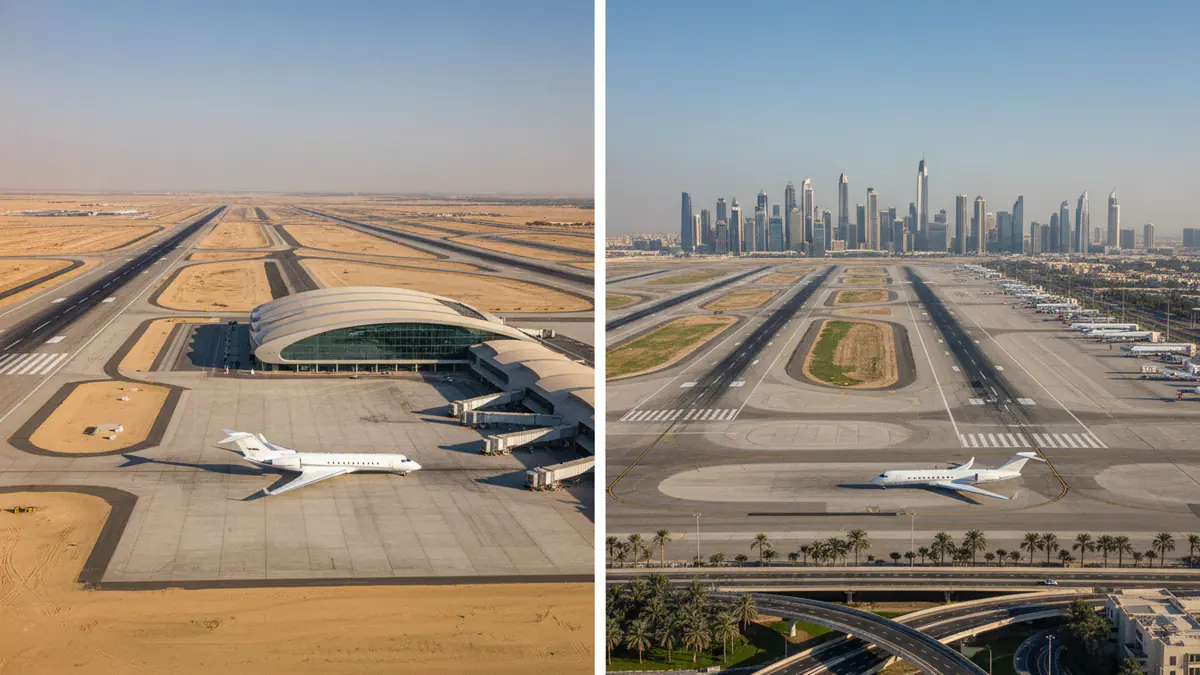
Side by side
| Al Maktoum (DWC) | Dubai International | |
|---|---|---|
| Codes | OMDW / DWC | OMDB / DXB |
| Type | Mixed airline and business aviation | Commercial hub |
| Longest runway | 14,764 ft | 14,590 ft |
| Customs | Yes | Yes |
| Operating hours | Not verified | Not verified |
| Distance to central Dubai | 13 nm (straight line) | 11 nm (straight line) |
Trade-offs
- Dubai International is closer to central Dubai (11 nm vs 13 nm, straight line). Your actual start point matters more than the centre.
- Al Maktoum (DWC) has the longer runway (14,764 ft vs 14,590 ft), which matters for heavier aircraft and long-range departures.
Al Maktoum International Airport vs Dubai International Airport: the short answer
Choosing between Al Maktoum International Airport vs Dubai International Airport is the first real decision on almost any private flight to Dubai. For most private travellers the answer is Al Maktoum, also called Dubai World Central (DWC): it has room for business jets, flexible timings and space to park an aircraft for a week. Dubai International (DXB) wins on one thing, location, and that advantage only matters if you can get a slot at the hour you want and you are staying close to the old city.
The table above sets the two airports side by side on the facts in our dataset: codes, role, customs and the runway figure we hold. This guide turns those facts into a decision. It explains why the two airports behave so differently for private aviation, how to choose based on where you are staying and how long the aircraft will wait, and what is changing over the next decade.
We are a charter broker. We don't own or operate aircraft; we ask licensed operators for options on your dates and tell you plainly which airport each one proposes and why. You can read more about how we work on the JetPriceCheck homepage.
Two airports, two very different jobs
Dubai runs two international airports under one operator, Dubai Airports, and each has been given a distinct role. Understanding that role explains almost everything about how they treat a private jet.
Dubai International (DXB): the airline mega-hub
Dubai International sits in the Al Garhoud area on the edge of Deira, close to the historic centre. It is the home base of Emirates and flydubai and, according to Wikipedia, it has for years been the world's busiest airport for international passengers. Its runways are dedicated almost entirely to scheduled airline traffic, and every movement is tightly coordinated. Private flights are permitted, and there are facilities for them, but they compete for space with some of the densest airline schedules on earth.
For a private traveller, that means DXB can feel like a privilege rather than a default. Slots at popular hours may simply not be available, and even when an arrival slot is granted, the aircraft may not be allowed to stay. Our data marks DXB's role as a commercial hub for exactly this reason.
Al Maktoum (DWC): the business aviation airport
Al Maktoum International lies in Dubai South, south-west of the city between Jebel Ali and the border with Abu Dhabi. Its Wikipedia entry gives its runway as about 4,500 metres, roughly 14,764 ft, which matches the figure in our table. Airline traffic at DWC is still modest compared with DXB, and the airport has become the natural home of business aviation in Dubai: a cluster of private terminals, generous ramp space and handlers used to clients with particular requests.
Dubai's authorities have deliberately encouraged private flights to move from DXB to DWC over roughly the past decade, as reported by FlightGlobal, by limiting private slots at the hub and making DWC easier to use. That policy is why an operator quoting a flight to Dubai will usually propose DWC first unless you ask otherwise.
How the two airports compare for a private flight
The data table above lists the entity facts. The table below compares Al Maktoum International Airport vs Dubai International Airport on the things that actually shape a private trip. The judgements are general; each operator confirms availability for your specific date.
| What matters to you | Al Maktoum (DWC) | Dubai International (DXB) |
|---|---|---|
| Getting a slot at your chosen time | Usually straightforward | Often difficult at peak hours |
| Parking the aircraft for several days | Usually possible | Often limited; aircraft may need to reposition |
| Distance to Deira, Downtown, DIFC | Longer drive | Much closer |
| Distance to Dubai Marina, Palm Jumeirah, Jebel Ali | Closer | Similar or longer, depending on traffic |
| Onward drive to Abu Dhabi | Shorter | Longer |
| Taxi and waiting times on the ground | Typically short | Can be longer in airline peaks |
| Very large or ultra-long-range jets | Plenty of runway and ramp | Possible, but parking is the constraint |
| Flexibility if your schedule moves | Good | Limited once slots are set |
The pattern is clear. DXB is attractive for a quick business trip into central Dubai with a fixed timetable and an aircraft that leaves again soon after dropping you. DWC is the better fit for almost everything else, and especially for leisure stays, longer visits and trips where the departure time may change.
If you are weighing the two for a specific trip, the fastest route to an answer is to send us your dates and where you are staying. We will ask operators for both options where DXB is realistic, and show you the difference in total journey time and in estimate before you commit.
Which Dubai airport suits where you are staying
The most practical way to choose between Al Maktoum International Airport vs Dubai International Airport is to start from your final address rather than from the airport. Our dataset puts the two airports about 24 nautical miles apart, and Dubai stretches along the coast, so the airport that is closer depends heavily on the district.
Deira, Bur Dubai, Downtown and DIFC
If your meetings or hotel are in the older districts, around the Burj Khalifa or in the financial centre, DXB is much nearer. On a clear road the drive from DXB to Downtown is short, while the same journey from DWC is typically well over half an hour and can be considerably more in rush-hour traffic on Sheikh Zayed Road. For a same-day business round trip, the time saved on the ground can outweigh the slot constraints, provided a slot is available.
Dubai Marina, Palm Jumeirah, Jebel Ali and Expo City
For the western half of the city, the picture flips. DWC is close to Jebel Ali and Expo City, and the Marina and the Palm are within a reasonable drive. Many resort and villa stays fall in this part of Dubai, which is one reason leisure travellers rarely feel the need to argue for DXB.
Abu Dhabi and beyond
If your trip combines Dubai with Abu Dhabi, DWC is the obvious choice: it sits on the Abu Dhabi side of the city, cutting a meaningful amount of driving from the onward journey.
Slots, parking and the drop-and-reposition pattern
The biggest practical difference between the two airports is not the runway or the terminal; it is what happens to the aircraft after you step off.
Why DXB slots are hard to get
DXB is a fully coordinated airport, which means every arrival and departure needs an allocated slot and the schedule is planned tightly around airline banks. Private operators can apply for slots, but at the busiest times there may be nothing close to the hour you want. When a slot is granted, sticking to it matters: arriving far outside the allocated time can cause problems for the operator.
Why parking decides many trips
Even when a DXB slot exists, parking a private jet at the hub for days is often not possible. The common workaround is a drop-and-reposition: the aircraft lands at DXB, the passengers disembark, and the jet flies empty to DWC to park. It then repositions back to DXB for your departure, or you depart from DWC instead. Each empty sector adds flight time, fees and complexity to the charter. If the aircraft will stay with you, it is usually simpler to use DWC from the start.
Flexibility when plans change
A fixed DXB slot can be hard to move at short notice. At DWC, changing a departure by a few hours is normally much easier. For principals whose meetings run long, or families who like to keep the day open, that flexibility is worth more than the extra driving time. Some sources describe DWC as operating around the clock; your operator confirms the current hours for your date.
Aircraft size and performance
Our table shows long runways at both airports, from public data we have not independently verified. In practice both airports have runways long enough for any business jet, so runway length is not what separates them.
What does matter is summer heat. Between roughly June and September, Dubai's afternoon temperatures reduce aircraft performance, and a long-range jet departing fully fuelled for New York or Singapore needs more runway. At DWC that is never a concern. The larger the aircraft, the more ramp space also matters: a heavy jet or ultra-long-range jet is far easier to park at DWC than at a busy hub. Browse the categories in our aircraft guide if you are deciding between a super midsize and a long-range cabin for your trip into Dubai.
Cost: how the airport choice affects the price
The airport you choose affects the charter estimate indirectly rather than directly. Landing and handling fees differ between airports, but the larger cost drivers are the ones the airport choice creates:
- Repositioning sectors. A drop at DXB followed by a hop to DWC for parking adds flight time twice: once after your arrival and once before your departure.
- Waiting and crew time. If a DXB slot forces a departure at an awkward hour, you may pay for crew duty or overnight costs you would otherwise avoid.
Our private jet cost guide explains how hourly rates, positioning and fees build up an estimate, and why every figure on this site is an estimate until an operator quotes. If your dates are flexible, it is also worth checking the empty leg flights page: aircraft often reposition in and out of Dubai, and a one-way repositioning sector can be offered at a lower price. Availability depends entirely on operators' schedules.
Timing: seasons, events and airspace
Dubai's private traffic peaks in the cooler months, broadly from late autumn to early spring, when leisure travel, conferences and exhibitions fill the city. Around the year-end holidays and during major trade shows, both airports get busier, but DXB's slot situation tightens most because airline demand rises at the same time. That is when the advantages of DWC are most visible.
In high summer, leisure demand into Dubai falls and slots at DXB can be easier to find, although heat affects aircraft performance and passenger comfort on the ramp. For the city-level view of routes and seasons, see our Dubai private jet charter page.
Regional airspace conditions can change quickly in the Gulf, and both airports have seen temporary operational disruptions. Before any trip, the operator checks current notices for both airports and for the routing, and we pass on anything that changes your plan.
The future: airline traffic is moving to Al Maktoum
Dubai has announced a major expansion of DWC. Gulf News has reported that the first phase of the new terminal is planned for the early 2030s, with airline operations eventually transferring from DXB to DWC. When that happens, the roles described on this page will change: DWC will become the airline hub as well as the business aviation airport, and the question of how private flights fit alongside a mega-hub will move with it.
For any trip in the next few years, none of this changes the practical advice. DWC is where most private flights go today, and the expansion mainly explains why investment in private terminals and services is concentrated there.
How to decide: a simple checklist
When comparing Al Maktoum International Airport vs Dubai International Airport for your own trip, work through these questions in order:
- Will the aircraft wait for you in Dubai? If yes, start with DWC.
- Is your schedule fixed to the hour? If not, DWC's flexibility is valuable.
- Where are you staying or meeting? Old city and Downtown favour DXB; the Marina, Palm, Jebel Ali and Abu Dhabi favour DWC.
- How large is the aircraft? Heavy and ultra-long-range jets point to DWC.
- Is it peak season? In the busiest months, assume DXB slots will be scarce.
- Is it a quick same-day drop? This is where DXB is most worth asking for.
If most of your answers point one way, that is your airport. If they are split, we will ask operators to price both and set out the trade-off.
For the full entity details, see the dedicated guides to Al Maktoum (DWC) for private jets and Dubai International (DXB) for private flights. The Dubai private jet airports overview puts both in the context of the city, and the private jet routes directory lists the corridors that use Dubai.
Frequently asked questions
Can a private jet land at Dubai International?
Yes. Private flights are permitted at DXB, but they need a slot at a heavily coordinated airline hub, and parking for more than a short stop is often limited. Many operators propose DWC instead, or a drop at DXB followed by repositioning.
Why do most private jets use Al Maktoum instead?
Because Dubai's airport authorities have made DWC the home of business aviation: slots are easier, there is space to park, and the private terminals are concentrated there. For most trips, that makes the longer drive into the city worthwhile.
How far apart are DWC and DXB?
Our dataset puts them about 24 nautical miles apart. By road, the drive between them depends heavily on the time of day and traffic on the main coastal highways.
Which airport is closer to Dubai Marina and Palm Jumeirah?
Generally DWC, although the difference is smaller than for the old city. For Downtown, DIFC and Deira, DXB is much closer.
Does the airport choice change the charter price?
Indirectly. Landing and handling fees differ, but the bigger effect comes from repositioning sectors and crew time when an aircraft cannot stay at DXB. We show the difference when we ask operators for both options.
Can I arrive at one airport and depart from the other?
Often, yes. A common pattern is to arrive at DXB for a close-in meeting and depart from DWC, where the aircraft has been parked. The operator plans the positioning; tell us your schedule and we will check what works.