Destination
Private jet to Courchevel
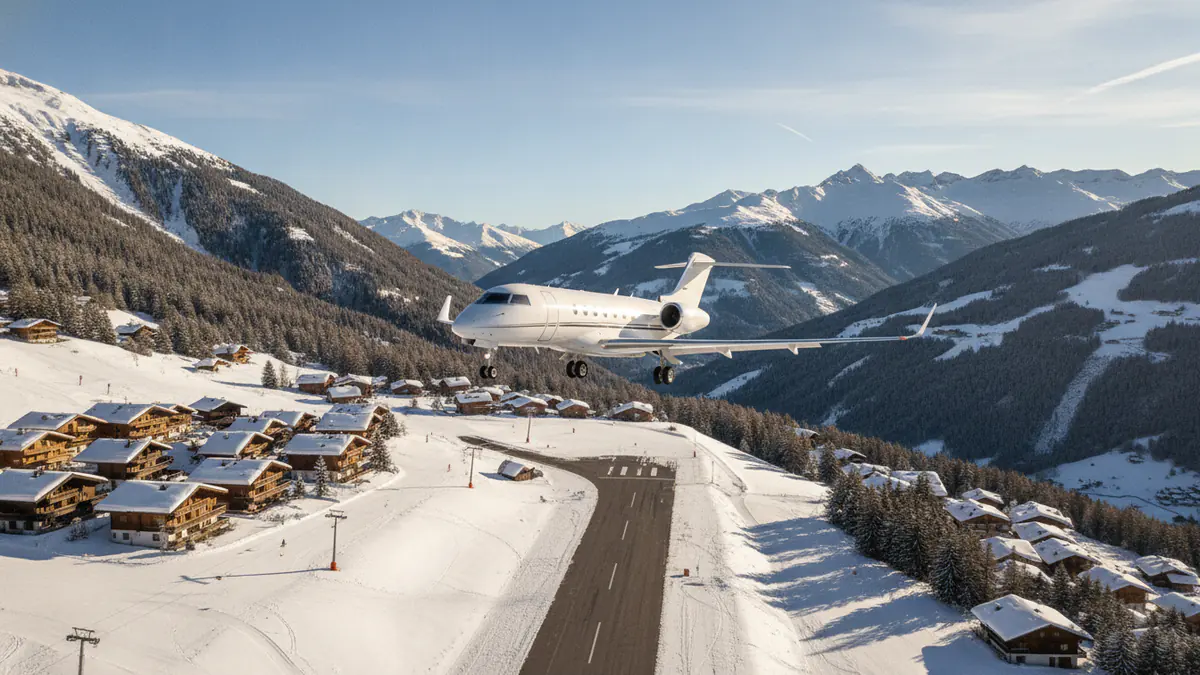
French Alps ski resort about two hours by road from Geneva and Lyon-Saint-Exupéry airports. Its altiport, at 2,007 m, has a 537 m runway with a slope of up to 18.5%, is closed at night and takes only certain private and commercial flights. Private flights use Courchevel Altiport and Geneva Airport.
When to fly to Courchevel
- Ski season (Dec, Jan, Feb, Mar, Apr): peak demand.
- Summer (Jul, Aug): shoulder demand.
- Off season (May, Jun, Sep, Oct, Nov): low demand.
Airports for Courchevel
| Airport | From centre | Runway |
|---|---|---|
| Courchevel Altiport | 1 nm | 1,762 ft |
| Geneva Airport | 54 nm | 12,795 ft |
Flying into the Trois Vallées
A private jet to Courchevel sounds like a single flight, but in almost every case it is a flight plus a short final leg over the mountains. Courchevel sits high in the Savoie Alps, at the heart of Les Trois Vallées, and it has its own tiny airfield, the altiport, perched above the resort. Most jets simply cannot land there. So the real planning questions are which airport you fly into, how you cover the last stretch up the valley, and how you avoid the pinch points of the ski season, especially Saturday changeover days.
The data sections above this guide show the demand calendar, the two airports in our dataset and their distance from the resort: Courchevel Altiport about 1 nautical mile away and Geneva Airport about 54 nautical miles away. This guide explains what those numbers mean in practice, which aircraft make sense for each option, and how we arrange the whole journey from your departure city to the door of your chalet.
We are a charter broker. We do not own or operate aircraft. We work with licensed operators, compare what is available for your dates, and coordinate the ground and helicopter legs so the trip feels like one journey. You can read more about how we work on the JetPriceCheck home page.
Why travellers fly privately to Courchevel
Courchevel is one of the best-known ski resorts in the world, and the villages that make it up, from Le Praz at the bottom to Courchevel 1850 at the top, are linked into the vast Trois Vallées ski area alongside Méribel and Val Thorens, according to Wikipedia's entry on the resort. Many of its guests arrive from London, Paris, Geneva, the Gulf, New York and further afield, often as families with a great deal of luggage.
The scheduled way in is an airline flight and a long transfer up the Tarentaise valley, shared with thousands of other visitors on the same day. A private flight changes that in three ways:
- You choose the time. Arriving on a Friday afternoon, or very early on Saturday, can keep you ahead of the worst of the valley traffic.
- Luggage travels with you. Skis, boot bags, children's equipment and a week's wardrobe all go on the aircraft, subject to the aircraft's baggage space.
- The last leg can be short. With the right aircraft, or a helicopter connection, the final stretch shrinks from hours to minutes.
Courchevel Altiport: who can land there
Courchevel Altiport (ICAO LFLJ, IATA CVF) is one of the most famous airfields in the Alps. Our dataset lists its longest runway at 1,762 feet, which is roughly 537 metres, and Wikipedia's entry on the altiport describes a steeply sloped strip at around 2,000 metres elevation. Aircraft land uphill and take off downhill, and there is no chance of a go-around once an aircraft is committed on final approach.
That has three practical consequences for a private flight:
- Only suitable aircraft. The runway is far too short for most business jets. Operations are generally flown by capable single-engine or twin turboprops and by helicopters, and each operator decides which of its aircraft can use the field.
- Only qualified pilots. French rules require a specific mountain-airfield qualification for crews landing at altiports. Your operator must have pilots who hold it and are current on the site.
- Weather decides. Low cloud, snowfall and wind can close the altiport for hours at a time. A flight planned into Courchevel always needs a fallback.
Our airport data also shows the altiport's customs status as unknown, and it has no published operating hours in our dataset. Please treat it as a domestic landing spot: if you are arriving from outside the Schengen Area, you should expect to enter France or Switzerland at a larger airport first. We check all of these points with the operator for each trip rather than assuming anything.
When the altiport makes sense
The altiport is a strong option when you want the shortest possible last leg and can travel light. A typical plan is to fly a jet to a larger airport, then hop up in a turboprop or helicopter that is cleared for the site. That hop only takes minutes, and it can drop you within a short drive of Courchevel 1850. Because it depends on daylight and weather, we pair it with a road option in reserve for the same afternoon.
For large groups, bulky luggage, winter evenings or tight schedules, a jet to Geneva and a road or helicopter transfer usually works better.
Geneva: the usual gateway for a private jet to Courchevel
For most jets, the arrival airport is Geneva Airport. It sits about 54 nautical miles from Courchevel as the crow flies in our data, and our dataset lists its longest runway at 12,795 feet, long enough for every business jet category, including ultra-long-range aircraft arriving from North America or the Gulf. Geneva also has customs, which our data confirms, so international flights can clear formalities on arrival.
Geneva brings its own rules. It is a busy mixed airport with slot coordination and night restrictions, and in winter the business aviation apron fills quickly on peak weekends. The Geneva airport guide covers slots, the late-evening rules and the French sector in more detail. Two points matter most for a Courchevel trip:
- Parking on busy weekends. On the heaviest days of the ski season, operators may need to drop passengers and reposition the aircraft to another airport to park. That can add positioning costs, so book early for peak weeks.
- France or Switzerland on arrival. Geneva sits on the Swiss–French border, and the airport has a French sector used mainly by airline passengers. If your group needs to enter France rather than Switzerland, tell us when you book and we will confirm what is possible for your flight with the handler. We do not assume the French side is available for business aviation on your date.
From Geneva to the chalet
From Geneva there are two practical ways to reach Courchevel:
By road. A private driver takes you south towards Albertville, then up the Tarentaise valley through Moûtiers and on to the resort. In clear conditions, allow roughly two and a half to three hours. On a Saturday in February, or in heavy snow, it can take a good deal longer, and snow chains or winter tyres are a legal and practical requirement on the final climb. A good driver times the departure around the valley's traffic peaks.
By helicopter. A helicopter transfer from Geneva usually takes well under an hour, landing at or near the altiport. It is weather dependent, and each helicopter has baggage limits, so bulky ski bags sometimes travel separately by road. When it works, it turns the last leg into a short, spectacular flight over the mountains. We always keep a road option booked in reserve.
Other airports worth considering
Our dataset lists two airports for Courchevel, but experienced mountain travellers know the region has more options. Chambéry Savoie Mont Blanc Airport is closer to the Tarentaise than Geneva and sees much of its traffic in winter. It can suit some jets and some schedules, and the road transfer from there is generally shorter. Grenoble and Lyon are further away but occasionally useful when Geneva is congested.
They are not yet in our dataset, so we check them case by case with the operator.
Choosing the aircraft
A private jet to Courchevel usually involves two aircraft decisions: the main flight into the Alps, and the last leg up the mountain.
The main flight
The right aircraft depends on your departure city and your group. Browse the categories in our aircraft guide, but as a rule of thumb:
| Departing from | Typical category | Why |
|---|---|---|
| Within western Europe (London, Paris, Brussels, Milan) | Light or midsize jet | Short sectors; the main constraint is luggage, not range |
| Northern or eastern Europe | Midsize or super midsize jet | More range and a larger baggage hold for ski equipment |
| The Gulf | Super midsize or heavy jet | Longer sector; larger groups and more luggage |
| North America | Heavy or ultra-long-range jet | Transatlantic range and cabin space for a long night flight |
Ski luggage changes the maths. A light jet that seats six in comfort may carry only four skiers with a full set of equipment. When you ask us for options, tell us how many ski bags, boot bags and large suitcases you are bringing, and whether any equipment can be shipped ahead or rented at the resort.
The last leg
If you want to use the altiport, the operator will propose a suitable turboprop or helicopter. Turboprops can carry more luggage than a helicopter, but both have firm weight limits at high altitude on a cold, short runway. We ask about weights early so there are no surprises on the day.
When to fly: the ski season calendar
The demand calendar above divides the year into three periods. Our data marks the ski season, from December to April, as peak demand, with July and August as a shoulder season and the months in between as low.
Peak weeks within the peak
Within the ski season, demand is not even. The weeks around Christmas and New Year, the February school holidays in the UK and France, and Easter, when it falls early enough for good snow, are the most crowded. We do not publish holiday dates here; they change each year and vary by country, so check them for the year you are travelling.
The Saturday problem
Many chalets and hotels in the Trois Vallées run on a Saturday-to-Saturday week. The result is one of the most concentrated travel days in European aviation: departures and arrivals, road transfers and helicopter hops all bunch into a few hours. If you can arrive on a Friday or Sunday, you usually gain more choice of aircraft, more room on the apron at Geneva and a quieter drive up the valley.
Summer in Courchevel
Summer is quieter: hiking, biking and golf draw visitors in July and August, airports are less congested, and short-notice trips are easier to arrange.
What affects the cost
This page does not show estimate ranges for Courchevel, because the price depends mainly on your departure city and the aircraft category, and our corridor list does not include a route page ending here. Our private jet cost guide explains how our estimates are built. For a Courchevel trip, these are the factors that matter most:
- Aircraft category. Moving from a light jet to a super midsize jet changes the price more than any other choice.
- Positioning. In peak weeks, many aircraft are already committed. If the nearest suitable aircraft is some distance away, the flight to position it is part of the price.
- Parking or repositioning at Geneva. A drop-and-go followed by a repositioning flight adds cost, as does keeping an aircraft on the ground for a week.
- The last leg. A helicopter or turboprop transfer to the altiport is priced separately from the main flight, and so is a private car from Geneva.
- Timing. Saturday requests in February are in highest demand. A day's flexibility can make a real difference.
When you are ready for firm figures, ask JetPriceCheck for a quote and we will ask licensed operators for availability on your dates, together with the transfer options for the last leg.
Empty legs to and from the Alps
The ski season produces empty-leg flights. Aircraft drop passengers in the Alps on a Saturday and return to their base empty, and the same thing happens in reverse a week later. An empty leg is a positioning flight that an operator offers for sale, usually for less than a full charter.
The catch is flexibility. The date, time and aircraft are fixed by the original booking, and the flight can change or be cancelled if the paying client's plans change. For a Courchevel trip, an empty leg can suit a couple or a small group travelling light who can adapt their dates. It suits a family with a fixed chalet booking less well. You can see current listings and learn how they work on our empty-leg flights page.
How we arrange a private jet to Courchevel
- Tell us the essentials. Dates, departure city, passengers, ski bags and your chalet address.
- We choose the arrival airport and explain the trade-offs.
- We source aircraft from licensed operators and present them side by side.
- We plan the last leg, with a road option in reserve.
- We stay with the trip if snow or a slot change moves the plan.
If your winter plans include other resorts or cities, browse our directory of private jet routes or explore more destinations.
Planning checklist
- Passports. Arriving via Geneva means entering Switzerland, or France where the French sector is available.
- Luggage. Count ski and boot bags; they often decide the aircraft.
- Weather buffer. Keep the evening free if you plan a helicopter or altiport hop.
- Peak weeks. Book early and avoid Saturday if you can.
Frequently asked questions
Can a private jet land at Courchevel?
Most jets cannot. The altiport's runway is very short and steep, and only suitable aircraft flown by specially qualified pilots can use it. A private jet to Courchevel usually lands at Geneva, followed by a car or a helicopter transfer.
How long is the transfer from Geneva to Courchevel?
By road, allow roughly two and a half to three hours in good conditions, longer on busy Saturdays or in heavy snow. A helicopter usually takes well under an hour, weather permitting.
What is the busiest time to fly to Courchevel?
The ski season, December to April, is peak demand in our data. Christmas, New Year and the February school holidays are the busiest weeks, and Saturdays are the busiest day.
Can I clear customs at the Courchevel Altiport?
Our data lists the altiport's customs status as unknown, so we plan international arrivals through an airport with customs, such as Geneva, and use the altiport only for the last leg.
Is a helicopter transfer to Courchevel worth it?
It saves hours on a busy day and is a memorable arrival, but it depends on the weather and has baggage limits. We always keep a road option in reserve.
Flying privately to Courchevel
When is the busiest time to fly privately to Courchevel?
Demand peaks in December, January, February, March, April. Book early for peak weeks.
Which airports serve Courchevel for private jets?
Courchevel Altiport (LFLJ) and Geneva Airport (LSGG).